
 Nana Muazin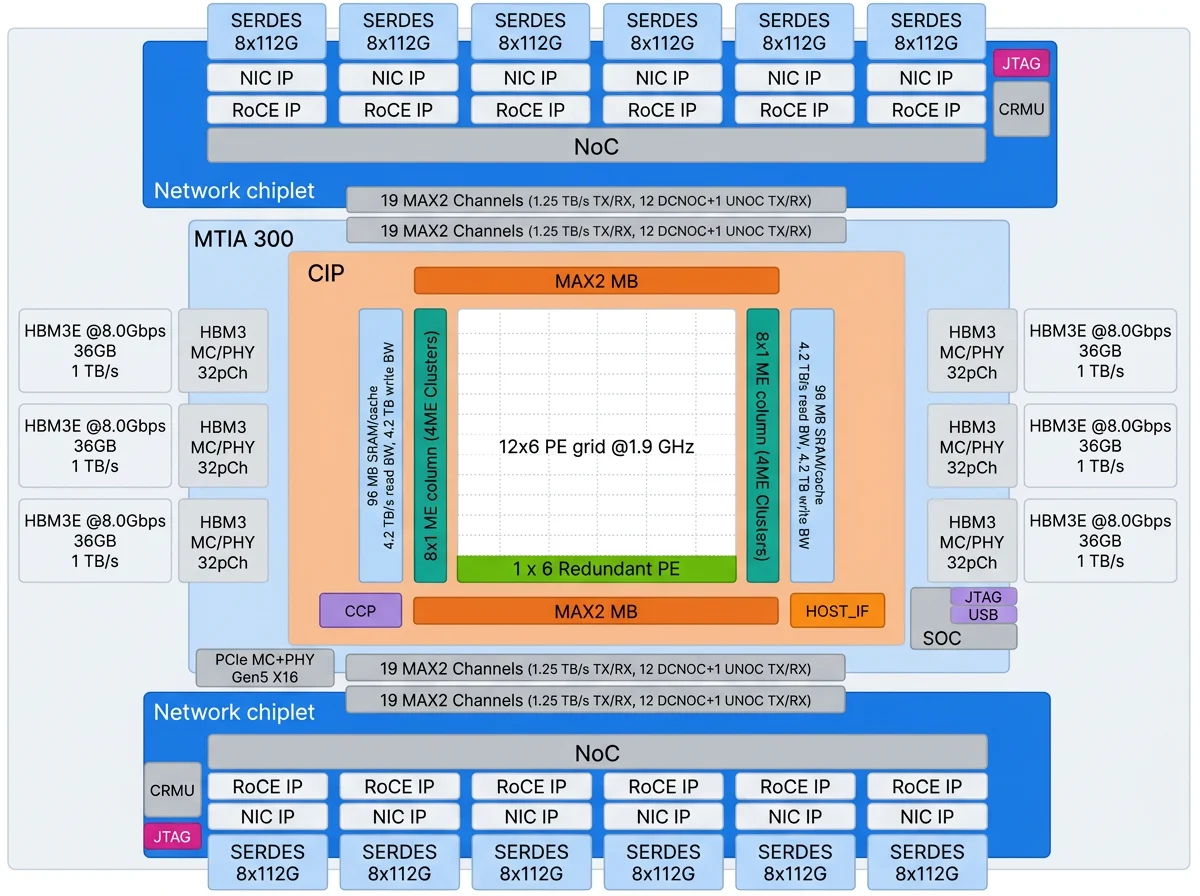
In the rapidly evolving landscape of artificial intelligence, the hardware powering the world’s most sophisticated recommendation systems is undergoing a fundamental transformation. As deep learning models transition from simple predictive tools to complex engines capable of curating personalized content—from short-form videos to real-time social media feeds—the infrastructure required to train them has hit a critical bottleneck.
Meta, a leader in large-scale machine learning, has unveiled the MTIA 300, the latest iteration of its homegrown Meta Training and Inference Accelerator (MTIA) family. This chip represents a radical departure from traditional accelerator design, prioritizing high-speed communication as a first-class citizen alongside raw computational power. By addressing the specific challenges of recommendation models, Meta is setting a new benchmark for how AI infrastructure is designed, built, and scaled.
The Infrastructure Challenge: Why Recommendation Models Are Different
To understand the significance of the MTIA 300, one must first recognize the unique architectural demands of recommendation models. Unlike Large Language Models (LLMs), which are primarily constrained by floating-point throughput—the raw ability to crunch vast numbers of matrix multiplications—recommendation models are governed by "embedding tables."
These tables, which house over 99% of a model’s parameters, require a massive amount of data movement between accelerators. During the training phase, the system must perform frequent collective communication operations, such as AllReduce, AllToAll, and AllGather. On conventional GPU-based architectures, these operations compete for the same resources used for actual computation. When a streaming multiprocessor is occupied with moving data across a network, it is unavailable for training, leading to significant hardware underutilization and wasted potential.
This "communication-compute contention" is the primary enemy of efficiency in large-scale AI clusters. Meta’s approach with the MTIA 300 is to solve this by fundamentally changing the architecture of the chip itself.
Chronology: From General-Purpose Roots to Specialized Silicon
The development of the MTIA 300 is the culmination of years of iterative research at Meta.
- Initial Discovery: Meta’s engineering teams identified that their recommendation systems were suffering from persistent bottlenecks that were not present in general-purpose GPU clusters. The team realized that as these models grew in size, the "host-device-NIC" pipeline—where the CPU manages traffic between the accelerator and the network—was becoming the primary point of failure.
- The Design Phase: Recognizing that the network needed to be physically integrated into the chip, Meta began the co-design of the MTIA 300 alongside the HCCL (Hardware Communication Collective Library). This was not a "bolt-on" addition; the team designed the hardware and the software stack concurrently to ensure seamless interaction.
- The ISCA 2026 Milestone: The formal unveiling of the MTIA 300 architecture occurred at the International Symposium on Computer Architecture (ISCA) in 2026. The technical papers presented there detailed the innovative "express doorbell" mechanism and the integration of 800 Gbps RDMA NICs directly onto the chip package.
- Production Deployment: Following successful internal testing, the MTIA 300 was deployed into production, where it demonstrated a 3.9x performance improvement over existing GPU-based clusters for large-scale recommendation tasks.
Supporting Data: By the Numbers
The efficiency gains reported by Meta are driven by several key technical specifications that distinguish the MTIA 300 from legacy designs.
Integrated Networking and I/O Bandwidth
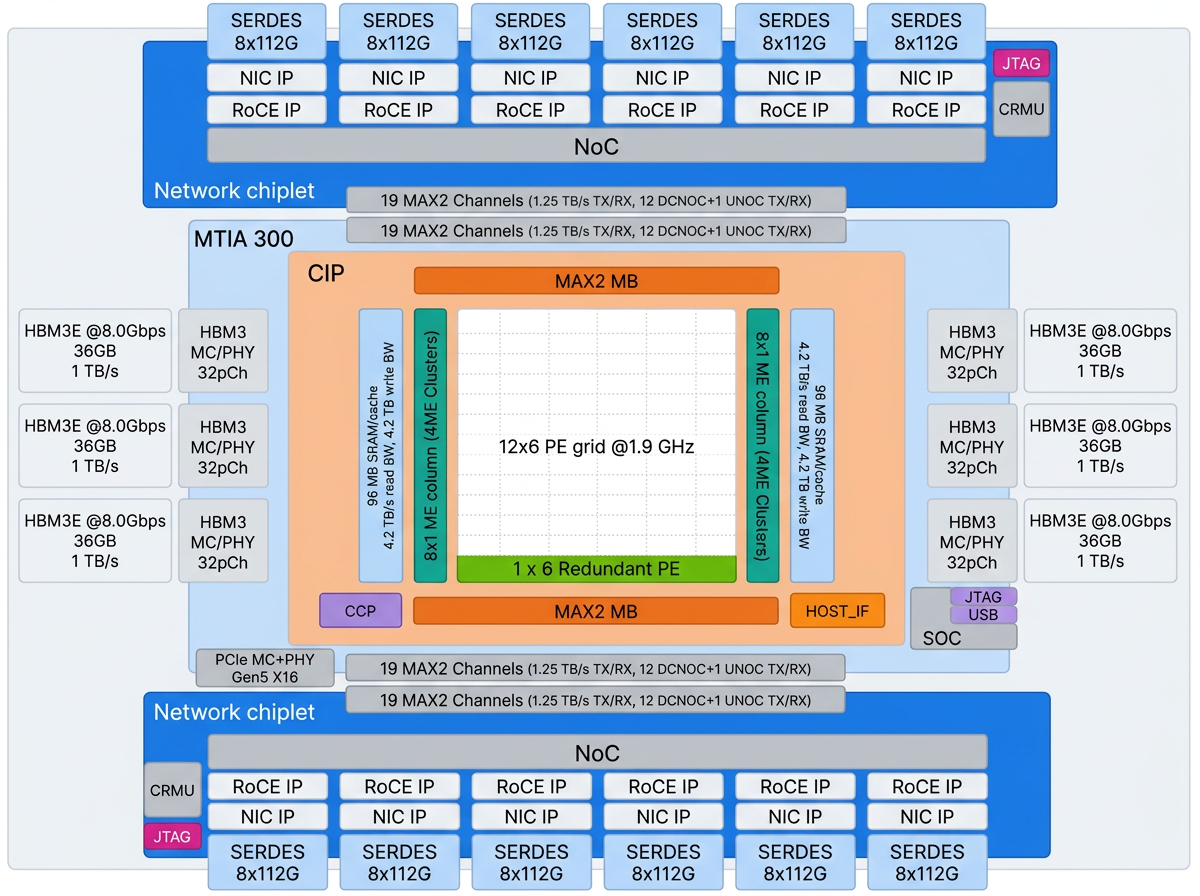
The MTIA 300 eliminates the PCIe bus bottleneck by embedding two network chiplets directly into the chip package. Each chiplet contains six custom 800 Gbps RDMA NICs, delivering a total of 1.2 TB/s of I/O bandwidth. This bypasses the host CPU entirely, allowing the accelerator to communicate directly with other nodes in the network at speeds previously impossible in standard architectures.
Dedicated Message Engines
Perhaps the most striking innovation is the inclusion of 16 dedicated Message Engines (MEs) alongside the 12×6 grid of processing elements (PEs). By offloading communication tasks to these MEs, the compute grid is left almost entirely free for training operations.
- Compute Degradation: While traditional GPU architectures suffer from up to 20% degradation in compute throughput during heavy collective operations, the MTIA 300 maintains a degradation rate of less than 0.5%.
- Throughput Metrics: The system achieves more than 2.8 TB/s of reduction throughput, enabling line-rate execution of AllReduce and ReduceScatter collectives.
- Production Performance: In a real-world test on a 150-billion-parameter recommendation model, the MTIA 300 achieved a total communication time 3.9 times faster than a comparable GPU-based cluster.
Latency Optimization
The introduction of "express doorbells" has streamlined the transaction process. By allowing the work request write to serve as the doorbell, the system eliminates an extra memory read, saving approximately 800 nanoseconds per operation. While 800ns may seem negligible in isolation, across millions of transactions in a training run, these savings contribute significantly to overall speed.
Official Perspectives: The Philosophy of System-Level Co-Design
Meta’s engineering leadership emphasizes that the MTIA 300 is not just about raw silicon; it is about the "system-level co-design" of compute and communication.
According to spokespeople from the Meta AI infrastructure team, the decision to build the HCCL library alongside the hardware was a pivotal moment. By compiling collectives into subgraphs of work-queue entries with explicit dependencies, the system becomes "autonomous." Once the host copies the instructions into High Bandwidth Memory (HBM), it is no longer involved. This removes the host CPU as a potential point of contention or latency.
Furthermore, the integration with the PyTorch ecosystem—specifically the torch.compile and torchcomms interfaces—ensures that the advanced capabilities of the MTIA 300 are accessible to developers. By tracing collectives through the compiler, the system can select topology-aware algorithms that exploit the asymmetric bandwidth between scale-up (within a rack) and scale-out (across racks) communication, minimizing traffic in bandwidth-constrained environments.
Implications for the Future of AI
The MTIA 300 is a harbinger of a broader shift in the AI hardware industry. As inference models move toward reasoning-based, agentic, and long-context use cases, the nature of communication demands is changing. Messages are becoming smaller, more frequent, and increasingly latency-sensitive.
1. The Death of the General-Purpose Bottleneck
The success of the MTIA 300 suggests that the era of relying solely on general-purpose GPUs for every facet of AI training may be nearing an end. When hardware is designed specifically for the unique communication patterns of a model, the performance gains are multiplicative rather than incremental.
2. The Rise of "Communication-First" Architecture
For years, the industry focused on floating-point operations (TFLOPS) as the primary metric of AI hardware performance. Meta’s shift proves that if the network cannot keep pace with the compute, the compute is effectively useless. We can expect future silicon designs from other major players to mimic the "integrated network chiplet" strategy seen in the MTIA 300.
3. Scaling to Billions of Parameters
By providing 216 GB of HBM3E memory and high network bandwidth, the MTIA 300 allows for larger local batch sizes and higher-precision datatypes. This scalability is essential for the next generation of AI, which aims to move beyond simple content recommendation into the realm of complex, multi-modal, and agentic reasoning.
4. A Foundation for Next-Gen Silicon
Meta has made it clear that the principles established in this project—integrated networking, offloaded execution, and system-level co-design—are the blueprint for their future AI silicon. As the company continues to push the boundaries of what is possible in artificial intelligence, the MTIA 300 stands as a testament to the idea that true innovation happens when you rethink the entire stack, from the silicon up to the software library.
In conclusion, the MTIA 300 represents more than just a faster chip. It is a strategic pivot in how Meta handles the massive data-flow requirements of the modern internet. By treating the network as an integral part of the compute architecture, Meta has successfully minimized the latency and contention that have long plagued large-scale AI training, paving the way for a more responsive, efficient, and intelligent future.


 Lina Hope
 Nila Kartika Wati
 Dwi Wanna
 Muslim
 Nana Wu

 Rifan Muazin
 Asro
Asro