
 Jia Lissa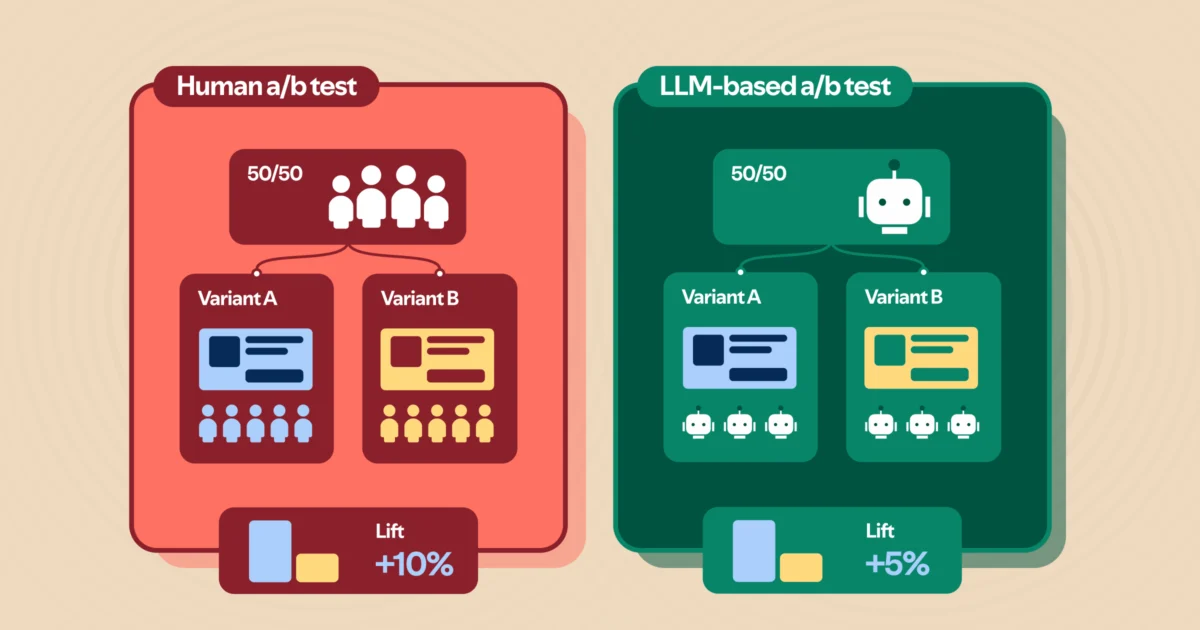
In the rapidly evolving landscape of product development, the allure of the "synthetic user" is powerful. The promise is seductive: instead of the weeks-long slog of traffic allocation, user recruitment, and the statistical noise of real-world A/B testing, organizations could simply prompt a Large Language Model (LLM) to predict how humans will react to a new feature, interface, or pricing model. This vision of near-instantaneous decision-making, which promises to slash costs and accelerate innovation cycles, has gained significant traction in Silicon Valley and beyond.
However, a new paper, “LLMs as Surrogates for Human Experiments,” warns that this shortcut comes with a hidden, heavy price. By analyzing thousands of experiments from the Upworthy Research Archive, researchers have demonstrated that while LLMs can act as effective proxies for human behavior, they do so only under strict, often unverifiable conditions. The study suggests that substituting human data for synthetic predictions trades the gold-standard of “identification by design” for a fragile “identification by assumption.”
The Core Conflict: Design vs. Assumption
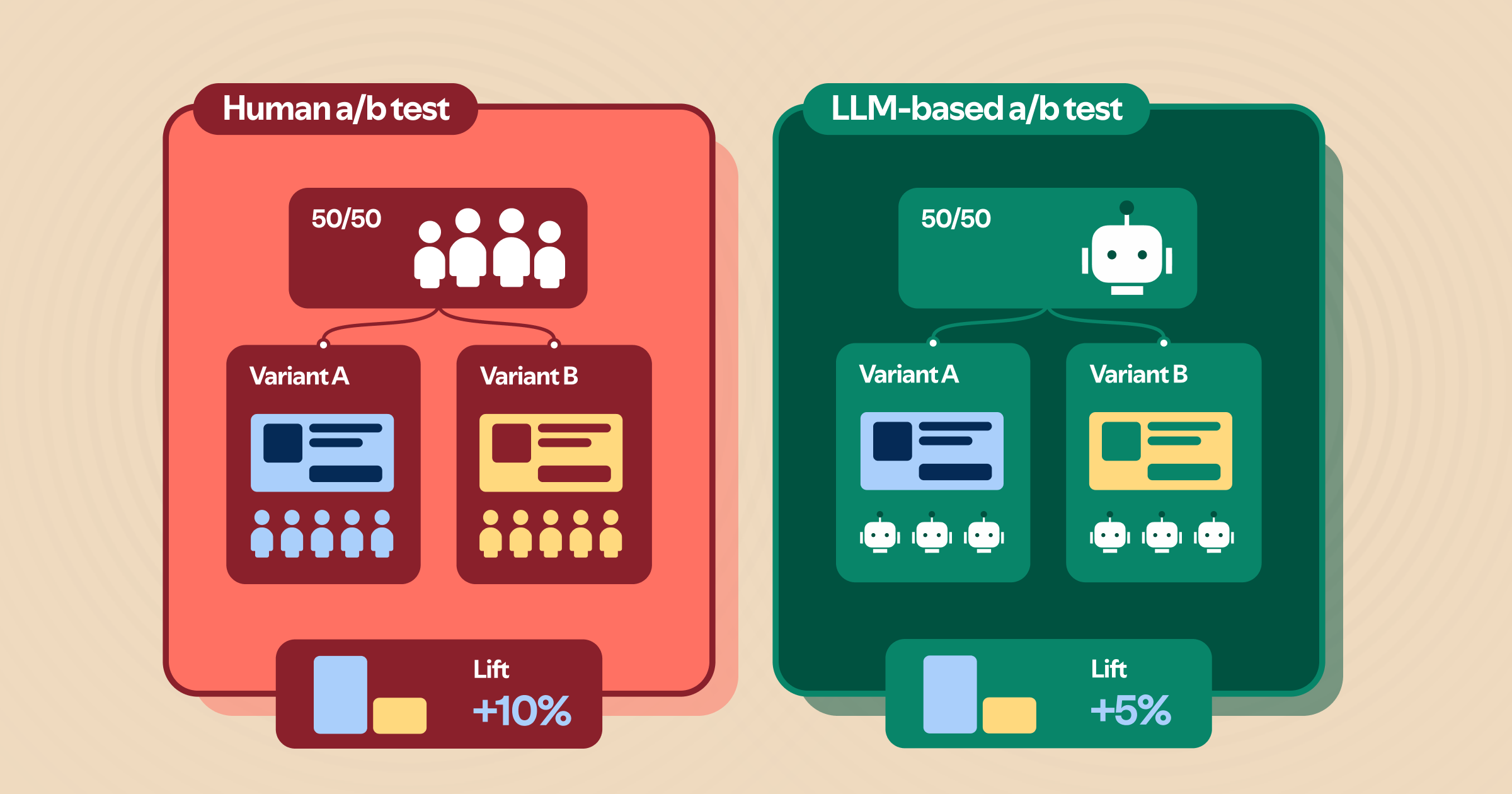
At the heart of the debate is the fundamental purpose of an A/B test. Randomized controlled trials are the bedrock of digital product development because they provide causal identification of a treatment effect by design. When you randomly assign users to a control or treatment group, you isolate the impact of the variable in question.
When you replace those users with an LLM, you are no longer conducting a controlled experiment; you are conducting a simulation. The validity of that simulation relies entirely on the assumption that the model’s internal logic mirrors the complexities of human psychology. As the researchers note, this moves the burden of proof from the experimental setup to the model’s output—a shift that is rarely acknowledged in corporate boardrooms looking to expedite product shipping.
Chronology of the Research: Putting Models to the Test
To test whether LLMs could truly stand in for humans, the research team turned to the Upworthy Research Archive—a massive, open-access repository containing thousands of A/B tests regarding news headline engagement.
Phase 1: The Raw Prediction Failure
The researchers prompted GPT-4o-mini to predict the click-through rates (CTR) for thousands of headlines. When these raw predictions were analyzed using standard statistical methods, the results were sobering: the model recovered only 39% of the observed human treatment effect. The LLM was not merely adding noise; it was systematically attenuating the results, effectively "dampening" the impact of the treatments.
Phase 2: Calibration and Machine Learning
Recognizing that raw predictions were insufficient, the team attempted to "calibrate" the LLM outputs. They tested two methods:
- Linear Calibration (OLS): A rigid, traditional statistical approach that failed significantly, landing 3.8 standard errors away from the human benchmark.
- Non-linear Machine Learning (Random Forest/Gradient Boosted Trees): These methods proved far more adept, capturing the complex, non-linear mapping between AI predictions and human outcomes.
Phase 3: Mitigating Token Noise
A secondary discovery involved "sampling temperature"—the inherent randomness in how LLMs generate tokens. The study found that even with high-performing models, a single prediction is often noisy. By generating multiple outputs per experiment and averaging them, the researchers were able to filter out the noise and hone in on a more stable signal.
Supporting Data: When Surrogacy Holds
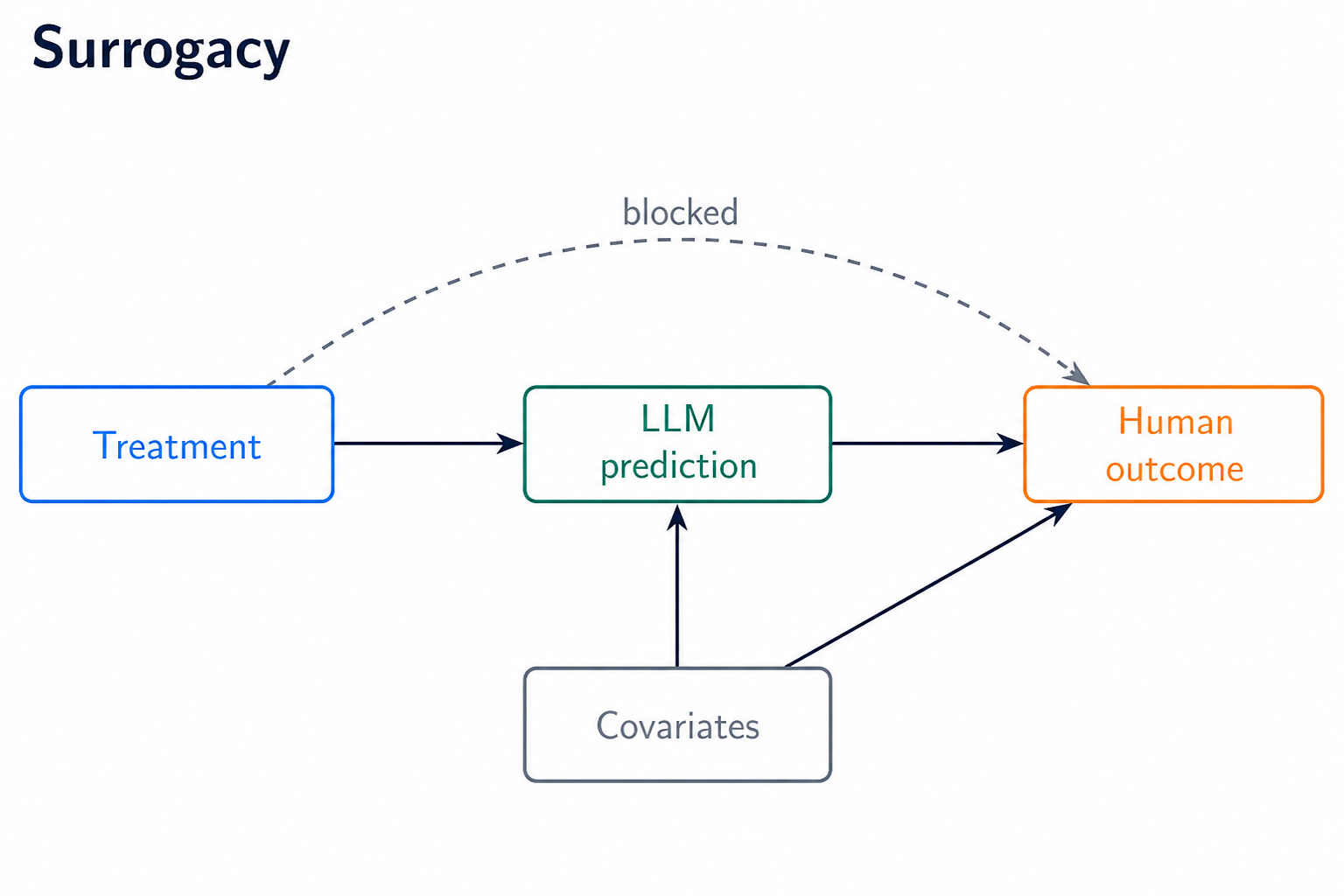
For an LLM to be a valid surrogate, the research identifies two mathematically rigorous conditions that must be met:
1. The Surrogacy Assumption
This requires that the LLM output acts as a "full mediator." In simpler terms, once you know what the LLM predicts, knowing whether a human was in the treatment or control group provides no additional information. If the LLM captures everything about the treatment that influences human behavior, the proxy is valid. However, this is rarely true in practice; human behavior is influenced by variables—such as cultural context, mood, and latent subconscious bias—that are often invisible to the model.
2. The Comparability Assumption
This assumption demands that the "calibration function"—the mathematical bridge between LLM predictions and human reality—remains stable. If a company shifts from testing text-based headlines to testing complex visual UI layouts, the relationship between AI prediction and human outcome shifts. If the distribution of user characteristics or the nature of the treatment changes, the previous calibration becomes obsolete.
The "Paradox of Benefit": Implications for Innovation
The most damning conclusion of the study is what could be called the "Paradox of Benefit." The researchers found that the conditions required for LLM-based A/B testing are most easily satisfied when the intervention is small, repetitive, and well-understood—such as tweaking a headline for a news article.
Conversely, the promise of AI-driven testing is most attractive for "big swings"—new UI paradigms, radical pricing shifts, or unprecedented feature launches. These are precisely the areas where the "comparability" assumption is weakest. Because there is no historical data for a truly novel innovation, there is no way to calibrate the model effectively.
The Cost of Scaling
If an organization adopts LLM-based testing across its entire product portfolio, the systematic attenuation of effects—making treatments look less effective than they are—could lead to a "innovation death spiral." Organizations might kill off high-potential features because the LLM failed to predict their success, or conversely, launch poorly performing features because the model’s calibration was based on outdated, dissimilar experiments.
Official Perspectives and Industry Reactions
The research has sent ripples through the data science community. Proponents of "Synthetic User Testing" argue that while the paper identifies significant risks, the field is moving faster than the research can track. With the advent of fine-tuning, retrieval-augmented generation (RAG), and more sophisticated prompt engineering, some argue that the "calibration" problem can be solved by training models specifically on a company’s historical user behavior data.
However, the authors remain cautious. Even if an LLM is fine-tuned to a specific company’s history, it is tethered to that history. In a fast-moving tech environment, the "present" is rarely a perfect reflection of the "past." The authors stress that "advances in LLM predictions are not a way out of human validation."
Final Implications: Augmentation, Not Replacement
The paper concludes with a nuanced stance that rejects the binary choice between "Human Testing" and "AI Testing." Instead, it suggests a hierarchy of use:
- Filter, Don’t Decide: Use LLMs to discard clearly poor ideas or to identify high-potential variants, thereby saving "experimental slots" for only the most promising concepts.
- Variance Reduction: Utilize LLM predictions as covariates to reduce noise in actual human experiments, potentially allowing for smaller sample sizes and faster completion times.
- The "Design by Assumption" Warning: Organizations must acknowledge that replacing humans with AI is a shift from scientific rigor to reliance on a model’s latent biases.
The ultimate message is one of humility. In the rush to automate the user feedback loop, product teams risk losing the very thing that makes A/B testing valuable: the unpredictable, unsimulated reality of human choice. As the researchers aptly put it, "Do not give up the gold standard."
While LLMs are undoubtedly powerful tools for simulation, they are currently better suited as a compass for navigation than as an autopilot for product innovation. For the most critical decisions—those that define the future of a product—human validation remains the only metric that cannot be replaced by an assumption.

 Muslim
 Ali Ikhwan

 Siti Muinah

 Lina Irawan