
 Raul Delapena Setiawan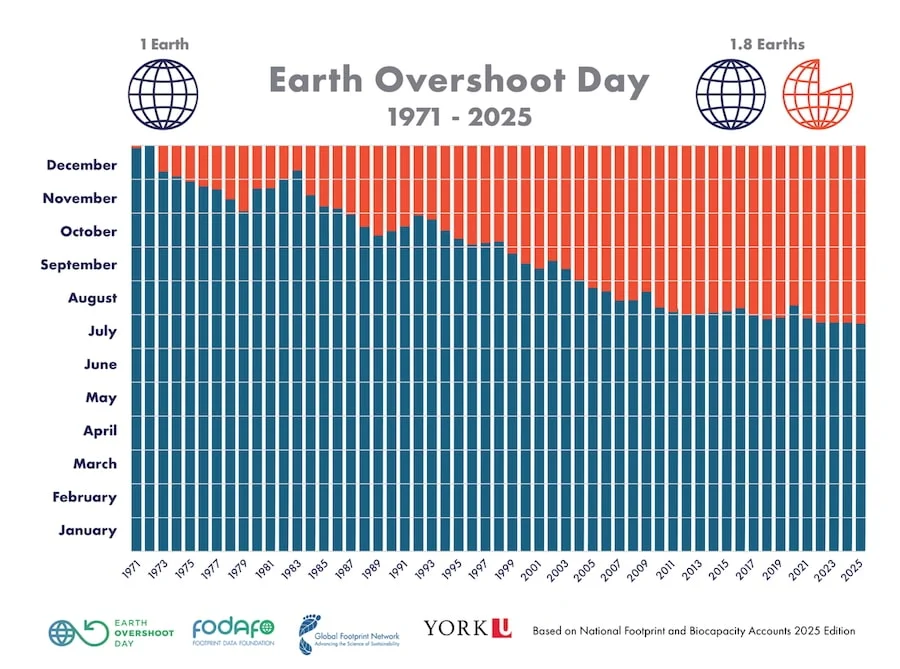
By [Your Name/Journalistic Staff]
On July 24, 2025, humanity reached a grim ecological milestone. Earth Overshoot Day—the date when human demand for natural resources exceeds what the planet can regenerate within a full year—arrived earlier than ever before in recorded history. This sobering marker signifies that for the remainder of the year, the global population is effectively operating on an "ecological deficit," liquidating the natural capital that supports life on Earth.
According to the Global Footprint Network, which calculates the date annually, humanity is currently consuming resources and producing waste 1.8 times faster than the planet’s ecosystems can replenish or absorb. This year’s date, July 24, surpasses the previous records of July 25 set in both 2022 and 2023, confirming a persistent and accelerating trend of environmental overconsumption that threatens the stability of global life-support systems.
The Chronology of Consumption: A Half-Century of Decline
The concept of Earth Overshoot Day, launched in 2006 by political economist Andrew Simms in partnership with the Global Footprint Network, was designed to make the abstract concept of ecological limits tangible. While the date is announced annually, the Global Footprint Network recently undertook an exhaustive effort to recalculate historical data, providing a clearer, more harrowing picture of how humanity’s "ecological footprint" has expanded over the last 50 years.
The trajectory is undeniable. In 1972, humanity lived roughly within the means of the planet, with the overshoot date falling on December 31. By 1979, the date had shifted to November 3. The 1980s saw a volatile fluctuation as global industrialization accelerated, with the date pulling back to December before plummeting to October 12 by 1989.
Throughout the 1990s, the date remained in October until 1999, when it reached September 25. The turn of the millennium marked an era of rapid resource extraction; by 2006, the year the index was formalized, the date had moved to August 22. Since then, the date has consistently trended earlier, entering July for the first time in 2018. Although the 2020 pandemic caused a temporary dip, the relentless pace of consumption has since reclaimed its upward momentum, cementing July as the "month of overshoot."

Supporting Data: The Mechanics of Ecological Bankruptcy
The data behind Earth Overshoot Day is rooted in the "Ecological Footprint" accounting framework. This system measures the demand for biological resources—including food, fiber, timber, and land for infrastructure—against the Earth’s "biocapacity," or the ability of ecosystems to regenerate those resources and absorb waste, most notably carbon emissions.
The current 1.8-planet demand is not merely a statistical curiosity; it is a physical reality reflected in the depletion of freshwater aquifers, the collapse of overfished marine populations, the loss of biodiversity, and the atmospheric saturation of greenhouse gases.
The Global Footprint Network emphasizes that this is a cumulative crisis. Even if the date were to stop moving earlier, the existing deficit continues to accumulate. We are currently witnessing the symptoms of this deficit in the form of extreme weather, ocean acidification, and the breach of seven out of nine "planetary boundaries"—the threshold conditions that keep the Earth in a stable, hospitable state for human civilization.
Official Responses: A Call for Systemic Transformation
The arrival of the earliest Earth Overshoot Day in history has prompted urgent, high-level warnings from environmental scientists and policy experts. The tone among researchers has shifted from cautious observation to blunt, existential concern.
Lewis Akenji, a board member of the Global Footprint Network, did not mince words regarding the collective debt humanity has accrued. "We are stretching the limits of how much ecological damage we can get away with," Akenji stated. "It is now a quarter into the 21st century and we owe the planet at least 22 years of ecological regeneration, even if we stop any further damage now."
Akenji’s statement highlights a fundamental flaw in modern economic planning: the failure to account for biological depreciation. He argued that the scale of current policy responses is insufficient to meet the magnitude of the crisis. "If we still want to call this planet home, this level of overshoot calls for a scale of ambition in adaptation and mitigation that should dwarf any previous historical investments we have made, for the sake of our common future."

Mathis Wackernagel, the co-founder of the Global Footprint Network, emphasized the inevitability of change, framing it as a choice between proactive design or reactive disaster. "Because of the nature of physics, overshoot cannot last," Wackernagel noted. "It will end either by deliberate design or dumped-on disaster. It should not be too hard to choose which one is preferable, particularly in light of so many possible choices."
The Implications: Moving the Date
While the data presents a grim reality, the Global Footprint Network maintains that the situation is reversible. Through their "Power of Possibility" campaign, they have outlined specific, scalable interventions that could fundamentally shift the date back toward the end of the calendar year.
Strategic Interventions:
- Decarbonizing Energy: The most significant leverage point lies in carbon emissions, which constitute a massive portion of the global ecological footprint. Cutting global carbon emissions by 50% would shift Earth Overshoot Day by approximately three months.
- Circular Food Systems: Reducing global food waste by 50%—a goal that is technologically and logistically feasible—would push the date forward by 13 days.
- Green Governance: Implementing a global-scale Green New Deal, focusing on infrastructure and circular economic policies, could move the date by 42 days.
- Renewable Energy Transition: Generating at least 75% of global electricity from renewable sources would move the date by 26 days.
These interventions suggest that the current trajectory is not a fixed destiny but a consequence of policy and consumption choices. However, the window for implementation is narrowing. As the planet reaches these milestones earlier each year, the "cost" of transition increases, as do the risks associated with waiting.
A Future Defined by Constraints
The 2025 Earth Overshoot Day serves as a diagnostic of a global civilization that has outgrown its home. We are currently living as if we had access to nearly two Earths, yet we only possess one.
The implications for the next decade are clear: the global economy must transition from a model of linear extraction to one of regenerative circularity. This requires not only individual changes in consumption—such as dietary shifts or reduced energy use—but a fundamental restructuring of global trade, manufacturing, and energy production.
As we move past July 24, every day represents a deepening of the ecological deficit. The message from the scientific community is unified: the era of "cheap" growth is over. The challenge for the remainder of the 21st century will be to align human prosperity with the biological realities of a finite planet. Whether that alignment comes through the foresight of deliberate, systemic design or the harsh necessity of climate-induced disaster remains the defining question of our time.


 Laily UPN
 Lina Hope
 Iffa Jayyana
 Rifan Muazin
 Suro Senen
 Lina Irawan