
 Lina Irawan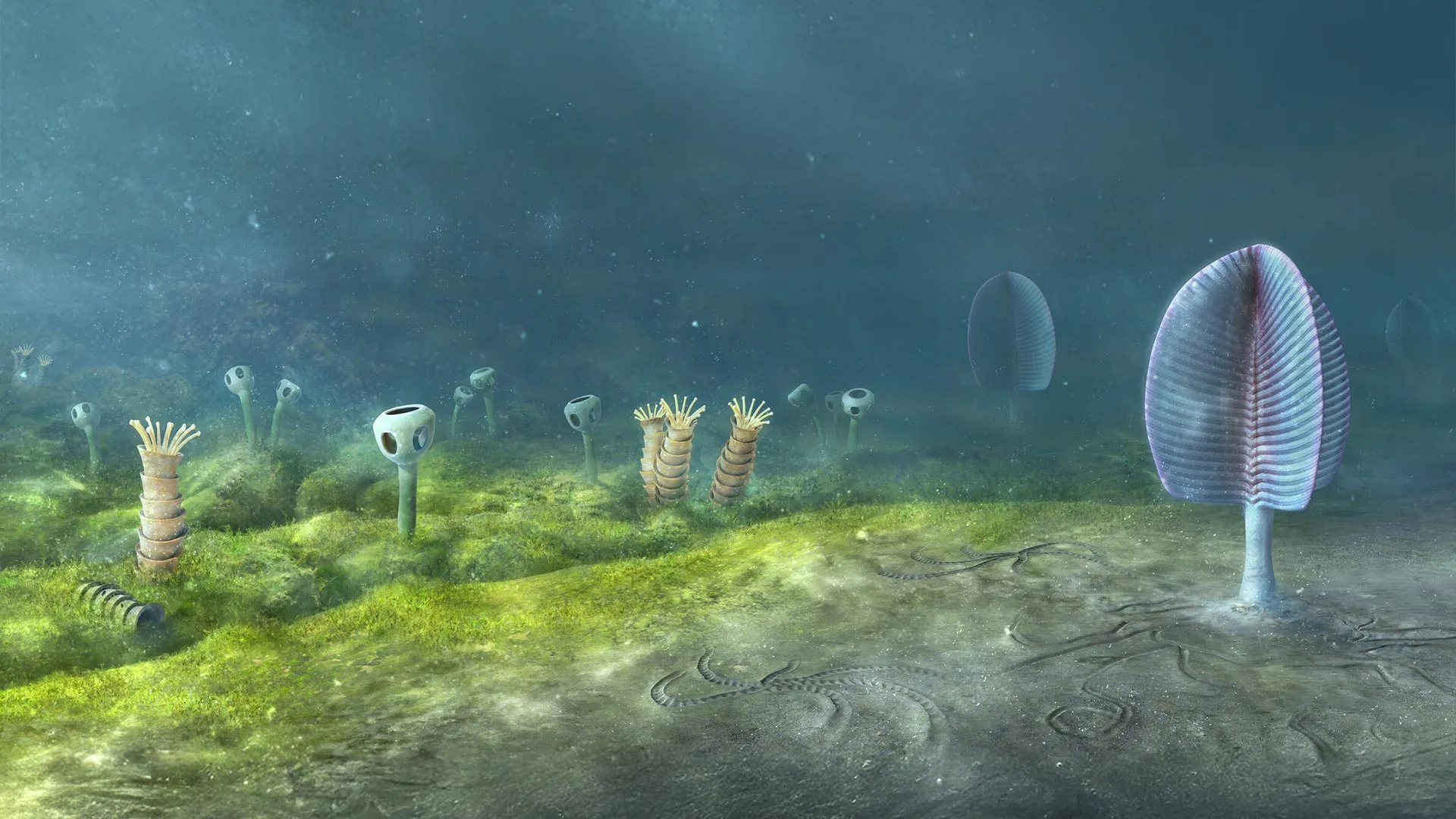
For decades, paleontologists have operated under a foundational assumption regarding the dawn of animal life: if an ancient, pristine fossil bed lacks evidence of animals, then animals simply did not exist at the time the deposit was formed. This "absence as evidence" logic has anchored our understanding of the timeline of complex life on Earth. However, a groundbreaking study led by the University of Oxford and published in Science Advances on October 2, 2024, has systematically dismantled this pillar, suggesting that the animal kingdom may have emerged up to 200 million years earlier than the fossil record currently reflects.
The Evolutionary Puzzle: A Sudden Emergence?
The standard narrative of biological history describes a dramatic "explosion" of life leading into the Cambrian Period, roughly 539 to 487 million years ago. In this view, complex, multicellular animal life appears in the fossil record with relative suddenness. While molecular clock data—which tracks genetic divergence between living species—has long suggested that the common ancestors of modern animals lived much earlier, the physical evidence in the rocks has remained stubbornly silent.
By using fossil sites like the Weng’an Biota in China—a 590-million-year-old treasure trove of microscopic, perfectly preserved organisms—as a "hard stop," researchers previously concluded that if animals had existed, they would surely have left a trace in such exquisite conditions. Because the Weng’an Biota contains no definitive animal fossils, the scientific consensus held that animal evolution must have occurred after its formation. The new study challenges this premise, suggesting that the "absence" in the rock record is a failure of preservation or environmental suitability, not a lack of biological presence.
Chronology: Rewriting the Deep Past
To test the validity of the Weng’an assumption, an international team of researchers from the University of Oxford, UC Berkeley, ETH Zürich, and Yale University turned their attention to the Kheseen Biota in Mongolia.
The Kheseen Biota is a fascinating case study in taphonomy—the study of how organisms decay and become fossilized. While the site is roughly 40 million years younger than the Weng’an Biota, it shares several species, indicating comparable geological and biological conditions. Crucially, by the time the Kheseen Biota was deposited, we know with certainty that animals existed elsewhere on Earth, as confirmed by findings in Namibia and South China.
The team utilized advanced scanning electron microscopy to examine over 140 samples from the Kheseen site, including previously undocumented locations. They unearthed a wealth of microscopic life, including acritarchs—enigmatic, spherical, spiny organisms—and complex embryo-like structures containing internal cells. Despite this extraordinary level of preservation, which rivals the Weng’an Biota, not a single specimen could be definitively identified as an animal.
This finding acts as a "smoking gun" for the research team. If animal life was present on Earth during the formation of the Kheseen Biota, but failed to leave a trace in these perfectly preserved rocks, then the absence of animal fossils in the older Weng’an deposits is no longer a valid argument for their non-existence at that time.
Supporting Data: Molecular Clocks and Hidden History
With the primary constraint of the Weng’an Biota invalidated, the researchers shifted their focus to significantly older deposits: the Svanbergfjellet Formation in Norway, the Bitter Springs Group in Australia, and the Chuar Group in Arizona. These sites date back to between 850 and 730 million years ago.
These formations have long been considered capable of preserving animal remains, yet none have yielded such evidence. In the past, this led scientists to cap the potential age of animal life at this window. The research team, however, recalibrated their "molecular clock" models using these older, broader geological constraints.
By integrating the genetic differences observed in extant species with these expanded temporal boundaries, the models produced a striking result: the estimated origin of the animal kingdom shifted backward by approximately 200 million years. This adjustment suggests that the first animals likely emerged between 800 and 700 million years ago, deep within the Neoproterozoic Era.
This timeline is further bolstered by "chemical fossils"—biomarkers preserved in ancient rocks that show molecular signatures consistent with sponges dating back at least 650 million years. Because these early animals were soft-bodied, lacking the mineralized shells or skeletons that characterize later life, they would have been notoriously difficult to capture in the fossil record. Their preservation would have required a "perfect storm" of rare geochemical conditions, explaining why they have remained invisible for so long.
Official Perspectives: The Experts Speak
The lead investigators emphasize that this study does not claim to have discovered the first animals, but rather to have cleared the path for a new understanding of when they might have appeared.
"The Kheseen Biota breaks the argument that the exceptional microfossils of Weng’an mean we would have seen animal fossils in the assemblage had they existed at the time," said Associate Professor Ross Anderson of the Oxford University Museum of Natural History, the senior author of the study. "The Kheseen microfossils are just as well-preserved, yet animals continue to be absent—despite the fact we know at that point they existed."
Orin Lole Durbin, the study’s first author and a researcher at Virginia Tech who initiated the work as an undergraduate at Oxford, struck a note of cautious optimism. "Pre-Ediacaran animal body fossils still elude us, and this analysis does not prove that animals existed 800 million years ago," Durbin noted. "However, our new fossil evidence from Mongolia undermines one of the main arguments for restricting animal origins to the Ediacaran interval. Meanwhile, our molecular-clock analyses show how much further back their evolutionary history could extend."
Implications: A New View of "Snowball Earth"
Perhaps the most provocative implication of this research concerns the "Snowball Earth" hypothesis. The Cryogenian Period, which began approximately 720 million years ago, was defined by extreme, planet-wide glaciations. If the origin of animal life is pushed back to the 800-to-700-million-year range, it creates a fascinating, albeit complex, timeline.
It suggests that animal life may have either predated these catastrophic ice ages or, more remarkably, emerged during them. This forces a total reevaluation of the environmental pressures that drove the evolution of early complex life. Rather than being a period of biological stagnation, the Neoproterozoic might have been a crucible of rapid adaptation and evolutionary innovation.
The Path Forward: Seeking the First Ancestors
The researchers acknowledge that the quest to identify the "first animal" is far from over. Future studies must pivot away from relying solely on specific fossil sites as definitive chronological anchors. Instead, the scientific community must embrace a multi-faceted approach.
"Until that evidence becomes available, the precise birth date of the animal kingdom remains uncertain," Professor Anderson concluded.
Future research will likely focus on a wider array of geographical locations and environmental contexts to understand the specific chemical barriers to fossilization. By combining traditional body-fossil hunting with the analysis of traces of animal activity (ichnology) and chemical biomarkers, paleontologists hope to eventually pull back the veil on the 200-million-year "ghost period" of animal evolution.
For now, the study stands as a vital reminder that in the history of our planet, the absence of evidence is not necessarily evidence of absence. The ancestors of every animal on Earth today may have been thriving in the deep, ancient oceans long before the rocks we currently study were ever formed, waiting for science to develop the tools necessary to find them.


 Laily UPN
 Dwi Wanna
 Basiran
 Neng Nana
 Iffa Jayyana
 Raul Delapena Setiawan
 Rifan Muazin
 Asro
Asro