
 Nana Wu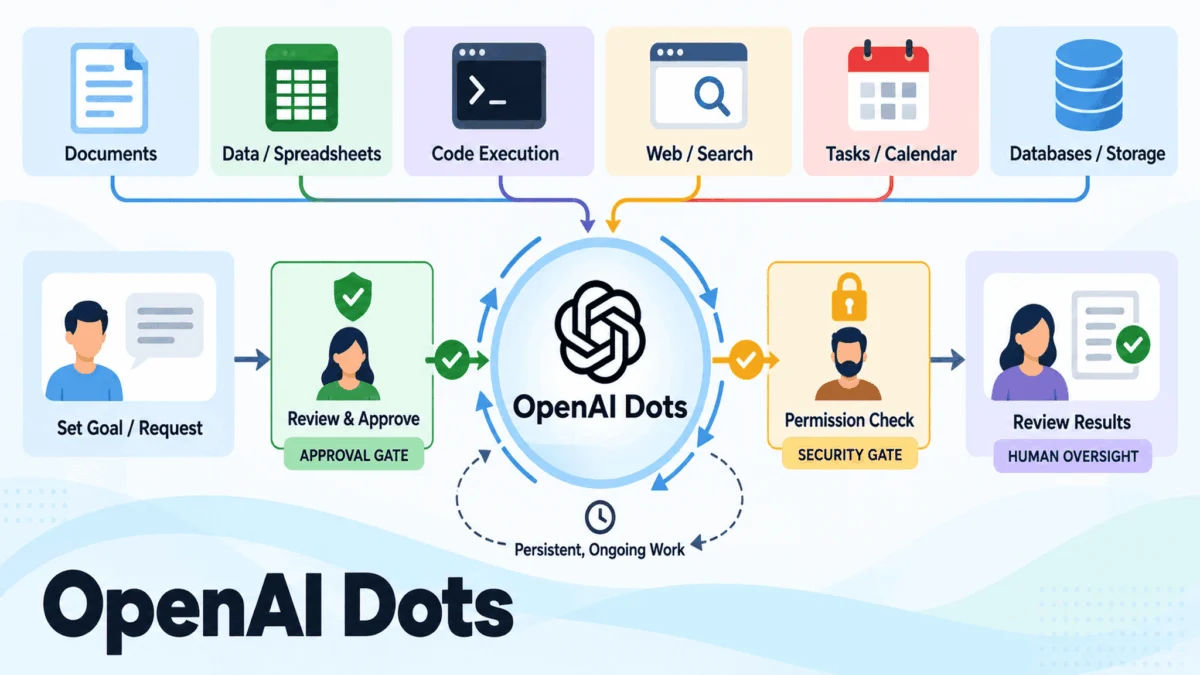
On September 29, 2026, the artificial intelligence landscape shifted from the era of "chat" to the era of "agency." During the highly anticipated DevDay 2026 conference, OpenAI unveiled Dots, a suite of always-on AI agents designed to operate autonomously within a user’s cloud environment. Unlike the reactive chatbots that have defined the last two years of AI adoption, Dots represent a fundamental move toward persistent, background-running digital coworkers capable of navigating complex, multi-step workflows without constant human intervention.
For the data science and machine learning community, this announcement marks a departure from prompt-engineering-heavy workflows toward a model of delegation and oversight. However, as the industry begins to grapple with the reality of persistent agents, the prevailing sentiment remains one of cautious optimism. While the potential for productivity gains is immense, the practical, security, and ethical considerations surrounding Dots demand a measured approach.
The Chronology of the Agentic Revolution
The path to Dots was not an overnight development, but the culmination of years of iterative research at OpenAI.
- Pre-2024 (The Foundation): The industry relied on "Chat-as-a-Tool," where LLMs were essentially advanced text completion engines. Interactions were transactional: prompt in, response out, session closed.
- 2024–2025 (The Agentic Experimentation): We saw the emergence of "Agentic Workflows" where models could call tools. However, these were brittle, often failing when context lengths were exceeded or when multi-step logic required sustained state memory.
- September 2026 (The Paradigm Shift): OpenAI introduced GPT-6 Astra, the underlying intelligence that powers Dots. This was the moment the industry moved from "AI as a tool" to "AI as a coworker." By providing these agents with their own persistent cloud computing resources, OpenAI effectively solved the "session-boundary" problem that had previously shackled AI utility.
Understanding Dots: What They Are and How They Function
At its core, a "Dot" is a specialized instance of the GPT-6 Astra model that exists independently of a specific browser window or active conversation. It functions as a background worker with access to over 4,000 third-party applications.
From Reactive to Proactive
In the traditional ChatGPT model, the AI waits for a command. A Dot, by contrast, operates under a "standing goal." For instance, instead of asking an AI to "check for new invoices," a user can assign a Dot the standing objective of "monitor incoming email, extract invoice data, reconcile it with our CRM, and draft a payment request for my approval." The Dot continues to perform this task in the background, even after the user has closed their laptop.
The Delegation Model
During his keynote, Sam Altman emphasized that the goal of Dots is to mirror the relationship between a manager and a high-agency employee. The agent learns from feedback loops; if a user corrects the way an invoice is formatted, the Dot internalizes that preference. This eliminates the "re-prompting tax"—the time spent re-explaining the context of a project every time a new session begins.
Integration and Reach
Dots are accessible via the interfaces practitioners already use: ChatGPT, Slack, and Microsoft Teams. While the current version lacks standalone email addresses and direct phone-calling capabilities—and texting remains restricted to a US-based Pro beta—the ability to bridge these platforms creates a cohesive, cross-functional ecosystem.
The Technical Edge: Why Astra Changes Everything
Previous agentic features often collapsed under the weight of complexity. If a task required more than three or four steps, the model would inevitably "drift," hallucinate, or lose its place in the sequence.
The introduction of GPT-6 Astra addresses these failures through three primary technical pillars:
- Reliability in Multi-Step Execution: Astra is optimized for reasoning chains. It can maintain a logic path across disparate tools, ensuring that if a process involves API calls, database queries, and file manipulation, it doesn’t lose the "thread" of the objective.
- State Persistence: Unlike session-bound agents, Dots retain a long-term memory of preferences. They are designed to build a "working model" of the user’s specific environment.
- Tool-Use Efficiency: The agent is designed to manage its own constraints. When it hits a friction point, it doesn’t just stop; it can pivot or flag the issue for human intervention, acting with a level of situational awareness that was previously unavailable.
Implications for Data Science and Machine Learning
For the data scientist, the arrival of Dots is both a massive opportunity and a significant challenge to the status quo.
The Automation of "Draining" Tasks
Data science work is often plagued by what could be described as "administrative overhead":
- Monitoring model training jobs and surfacing anomalies.
- Updating documentation as data schemas evolve.
- Collating status reports from various team members.
- Managing version control logs.
Dots can compress these hours of mundane work into minutes. By delegating these "high-volume, low-intellectual-value" tasks to an agent, practitioners can reclaim time for exploratory analysis, architectural design, and high-level strategy.
The Responsibility Shift
The introduction of autonomous agents shifts the data scientist’s role from "doer" to "architect of delegation." This requires a new set of skills:
- Goal Definition: Writing a brief for an agent is a task in itself. If the goal is vague, the results will be suboptimal.
- Permission Boundaries: Practitioners must define where the agent can go and what it can touch. This is a critical safety measure for pipeline integrity.
- Review Checkpoints: The "always-on" nature of Dots means that the risk of compounding errors is higher. A malfunctioning script running in the background for six hours could wreak havoc on a production database.
Critical Constraints and Security Concerns
Despite the excitement, the practical adoption of Dots faces significant hurdles.
Availability and Exclusivity
Currently, the feature is limited to ChatGPT Pro ($100/month) and Business Premium users. Notably, users in the European Economic Area (EEA), Switzerland, and the UK are excluded from the launch, citing regulatory complexities. This fragmentation creates a tiered ecosystem where access to advanced automation is currently restricted to high-budget US-based enterprises.
The "Black Box" of Memory
One of the most pressing concerns for security-conscious organizations is the lack of transparency regarding Dot memory. Currently, users cannot view, edit, or delete the specific "memories" a Dot has formed. If an agent ingests sensitive client data, there is no simple way to "forget" that data while retaining the functional knowledge it learned from the experience. For firms dealing with proprietary intellectual property or PII (Personally Identifiable Information), this is a significant barrier to compliance.
Compliance and Uptime
OpenAI has yet to publish detailed uptime guarantees or industry-standard compliance certifications (such as SOC2 or HIPAA) specifically for the Dots architecture. Without these, large-scale deployment in regulated industries remains a distant prospect.
The Verdict: Informed Skepticism
The "always-on agent" has been the "holy grail" of the AI industry for years. Dots is undeniably the most credible, functional iteration to date. However, the most important takeaway from the launch is not technical—it is organizational.
Using Dots successfully requires a high level of workflow maturity. If a practitioner cannot articulate their own processes, they cannot effectively delegate them to an AI. Those who treat Dots as a "magic button" to solve their productivity woes will likely find that they have merely outsourced their mistakes to a faster, more autonomous engine.
Conversely, for those who take the time to design clear boundaries, define explicit goals, and establish robust human-in-the-loop review processes, Dots offers a transformative change in how work is accomplished. We are moving toward a future where the AI is not just a participant in the conversation, but an active agent in the project lifecycle.
The agent is only as good as the brief it receives. As we integrate these tools into our daily workflows, the primary challenge for the data science community will be to ensure that while the agents stay "on," our own critical judgment never switches "off."


 Dwi Wanna


 Muslim


 Rifan Muazin
 Asro
Asro