
 Rifan Muazin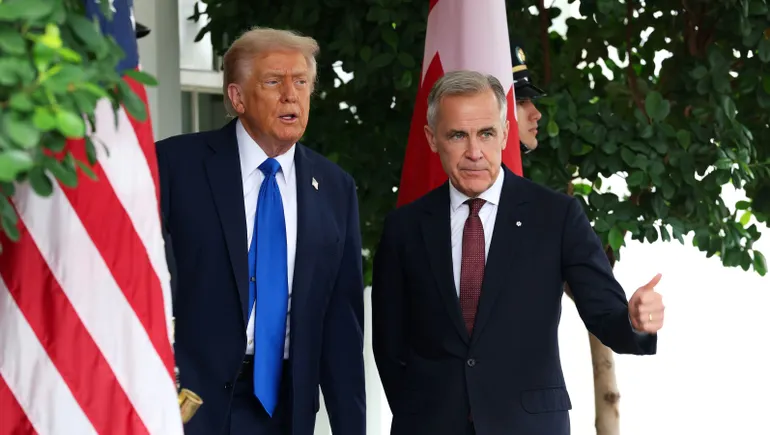
The economic partnership between the United States and Canada—long touted as the world’s most integrated and stable trading relationship—is currently facing its most severe period of volatility in modern history. As of Monday, the trade war has entered a dangerous new phase, with U.S. President Donald Trump announcing a sweeping 50% tariff on all automotive vehicles, trucks, automotive components, and steel imports originating from Canada.
Scheduled to take effect on January 1, this aggressive move follows the collapse of high-stakes negotiations aimed at preventing a previous set of tariffs on $20 billion worth of Canadian goods. The sudden breakdown of these talks has left supply chains in disarray, manufacturing sectors on edge, and the future of the United States-Mexico-Canada Agreement (USMCA) hanging in the balance.
The Core Conflict: A Timeline of Escalation
The current friction is the culmination of more than a year of diplomatic brinkmanship and shifting trade policies. To understand the gravity of the situation, one must look at the recent sequence of events:
- Early 2025: The U.S. implemented sweeping levies on various Canadian imports, citing national security and trade imbalances. Canada retaliated with tariffs on $60 billion of U.S. goods, though some were later rescinded as a gesture of goodwill.
- Late 2026: Tensions flared again when the White House proposed a new round of 50% tariffs. Following intense negotiations, these were initially slated for mid-August.
- August 2026 (The Three-Day Delay): President Trump granted a three-day reprieve on the initial 50% tariffs, providing a window for Canadian Prime Minister Mark Carney’s administration to reach a settlement.
- August 22, 2026: Prime Minister Carney abruptly suspended all trade negotiations just hours before the implementation deadline, declaring that the U.S. had introduced "uneconomic and unfair" terms at the eleventh hour.
- Late August 2026: The initial 50% tariffs on $20 billion in Canadian goods took effect.
- Monday, August 31, 2026: President Trump announced a further expansion of tariffs, specifically targeting the automotive and steel sectors, to take effect at the start of the new year.
The Breakdown: Why Negotiations Failed
The collapse of the August talks represents a significant diplomatic failure. Both sides have publicly accused the other of bad faith, revealing the widening chasm in their economic priorities.
The Canadian Perspective
Prime Minister Mark Carney, in a formal address on Saturday, articulated Ottawa’s frustration with the process. Carney argued that while both nations appeared to be nearing a "mutually beneficial agreement" earlier in the week, the U.S. side introduced new, punitive demands in the final hours.
"They asked too much and offered too little," Carney remarked. The Canadian government maintains that the U.S. proposals were not merely trade adjustments but were fundamentally designed to undermine the economic sovereignty of Canadian industry. Consequently, Canada has vowed to implement "dollar-for-dollar" retaliatory tariffs by September 8. These countermeasures are expected to target vital U.S. export sectors, including:
- Dairy products
- Appliances and household electronics
- Agricultural machinery
- Pulp and paper products
- Steel and aluminum
The U.S. Perspective
The White House and the U.S. Trade Representative (USTR) office have framed the stalemate as a result of Canadian obstructionism. U.S. Trade Representative Jamieson Greer, speaking in a CNBC interview on Monday, defended the administration’s position by highlighting the concessions the U.S. had allegedly placed on the table.
According to Greer, the U.S. had offered to halve existing tariffs on Canadian steel and aluminum while simultaneously reducing levies on lumber and automobiles. "They wanted more," Greer stated, suggesting that the Canadian government was unwilling to meet the U.S. halfway. The Trump administration continues to characterize the current trade flow as a system where Canada is "ripping off" the American worker, a narrative that remains central to the President’s domestic trade policy.
Implications for the North American Supply Chain
The ambiguity surrounding these new tariffs creates a hazardous environment for manufacturers, logistics providers, and consumers. As of this writing, the White House has yet to publish an official tariff order clarifying how these new 50% levies will interact with existing Section 232 duties.
Automotive Industry Vulnerability
The automotive industry is perhaps the most heavily integrated sector between the two nations. Modern vehicles often cross the U.S.-Canada border multiple times during the assembly process. A 50% tariff on finished vehicles, trucks, and parts threatens to halt production lines, lead to massive price hikes for consumers, and force automakers to reconsider their North American footprint. Industry analysts fear that the logistical complexity of applying these tariffs could lead to gridlock at border crossings and a severe inventory shortage.
The USMCA in Jeopardy
The trilateral USMCA framework, which replaced NAFTA, was intended to provide long-term certainty for investors. However, the current impasse has stalled the required multi-year review of the agreement. The U.S. has notably declined to extend the pact without further negotiations, creating a regulatory vacuum. While Mexico and the U.S. have moved forward with bilateral discussions, the Canada-U.S. track remains effectively frozen. This bifurcation of the trilateral agreement threatens to dismantle the unified North American economic block that has defined regional trade for decades.
Economic Impact and Future Outlook
The broader economic implications are significant. Canada’s commitment to retaliatory tariffs suggests that the trade war will not be limited to the automotive sector but will extend to the agricultural and manufacturing heartlands of the United States.
Domestic Consequences for Canada
For Canada, the tariffs pose a threat to its GDP, particularly in provinces heavily reliant on U.S. trade. Prime Minister Carney’s decision to retaliate is a calculated risk; while it protects domestic industries from being undercut by cheaper, non-tariff-burdened U.S. goods, it also invites higher costs for Canadian consumers and businesses that rely on U.S. imports.
The "New Normal" of Trade Relations
The relationship has shifted from one of strategic alliance to one of transactional volatility. Since 2025, Canada has implemented a range of defensive measures, including quotas on automotive imports and the prohibition of U.S.-made alcohol in certain territories. These actions demonstrate that Ottawa is moving toward a strategy of economic decoupling, a sharp departure from the deep integration that characterized the 20th and early 21st centuries.
As the January 1 deadline approaches, global markets are bracing for further uncertainty. Investors are closely monitoring the rhetoric coming from both Washington and Ottawa, looking for any sign of a thaw in relations. However, with both leaders entrenched in their respective positions—President Trump citing the need to protect the American industrial base and Prime Minister Carney defending the integrity of Canadian trade—the likelihood of a near-term resolution appears slim.
Conclusion: A Developing Crisis
This is an evolving story. As the White House prepares to formalize the tariff orders and the Canadian government finalizes its list of retaliatory targets, the business community remains in a state of high alert. The breakdown of the USMCA review process, combined with the lack of progress in bilateral talks, suggests that the North American trade landscape is entering a period of fundamental, and potentially permanent, restructuring.
For businesses operating across the border, the immediate priority is contingency planning. Whether these tariffs are used as a final negotiating tactic or represent a permanent shift in trade policy, the era of predictable trade relations between the United States and Canada has, for the moment, reached its end. Further updates will be provided as additional details regarding the tariff implementation and legislative responses emerge.

 Sagoh
Sagoh
 Ali Ikhwan
 Raul Delapena Setiawan
 Reynand Wu


 Azzam Bilal Chamdy
