
 Layla Zulfa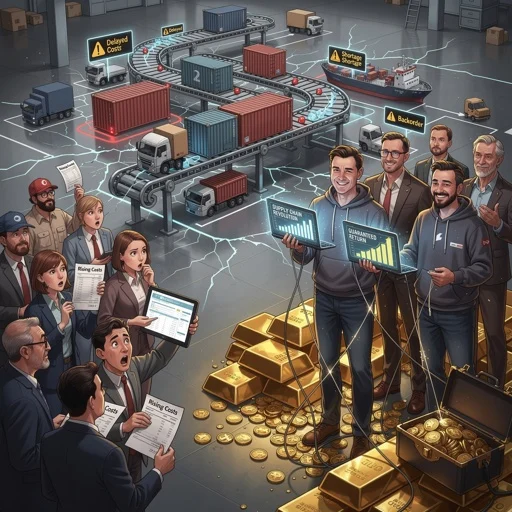
For decades, the promise of "End-to-End (E2E) Supply Chain Planning" has served as the holy grail for enterprise technology vendors. It is a marketing mantra that suggests a seamless, integrated flow of data and decisions from the raw material supplier to the end consumer. However, a growing chorus of industry experts, led by supply chain analyst Lora Cecere, is challenging this narrative, labeling it as a dangerous myth that prioritizes technological "buzz" over tangible business results.
The Anatomy of a Myth: Why E2E Fails
The core of the issue lies in the chasm between the marketing of "unified platforms" and the reality of complex, siloed corporate architectures. While vendors frequently host glitzy conferences in global hubs like Shanghai to showcase their latest "orchestration" tools, the reality on the ground for most supply chain leaders remains stagnant. Despite the implementation of multi-million-dollar planning suites, inventory levels remain bloated and operating margins continue to slide.
The frustration is palpable. As vendors pivot toward "agentic AI" and automation, they often layer these advanced technologies over archaic, fractured data taxonomies. This is what critics call "AI Stupid"—the process of accelerating flawed, disconnected decisions through expensive new software.
Chronology of a Failed Promise
- The Early 2000s: The rise of ERP dominance. Organizations begin the arduous task of digitizing operations, assuming that a single "system of record" will naturally facilitate E2E planning.
- The 2010s: The "Gold Digger" Era. Software vendors aggressively market "integrated planning suites," leading to a decade of costly implementations that failed to bridge the gap between planning and execution.
- 2024-2025: The AI Hype Cycle. Technology providers shift their narrative to "AI-driven orchestration," promising that generative agents can solve the integration issues that humans and traditional algorithms could not.
- Present Day: The pushback. Industry practitioners begin openly questioning the feasibility of E2E platforms, arguing that the architecture itself is built on a fundamental misunderstanding of supply chain physics.
The Structural Incompatibility: Why Systems Cannot Talk
The failure of E2E planning is not due to a lack of computing power or "laziness" on the part of developers. It is a structural failure. According to Trevor Miles, founder of Azirella, the problem is that modern supply chain stacks are designed for transactions, not decisions.
The Vocabulary Gap
A critical barrier to integration is the semantic disagreement between systems. A "site" in a Transportation Management System (TMS) refers to a loading dock; in a planning system, it is a stocking point; in an ERP, it is a plant with specific storage locations. Middleware can force these systems to exchange data, but it cannot force them to share a common definition of reality. Consequently, as data flows through the stack, the context—the "why" behind a decision—is stripped away, leaving only raw, disconnected numbers.

The Aggregation Trap
Julien Brun, CEO of SIMCEL, highlights that the moment a planner aggregates data for S&OP (Sales and Operations Planning), they destroy the granular rules that govern the physical supply chain. Rules such as Minimum Order Quantities (MOQ), shelf-life constraints, and specific lead-time variations exist only at the transaction level. When companies aggregate data to create a "top-level view," they inadvertently delete the very logic required to execute that plan effectively.
Expert Insights: Redefining the Architecture
To move beyond the current impasse, industry leaders suggest a fundamental shift in how we approach trade architecture.
Pat Byrne, founder of IndEco Systems, argues that the industry needs a shared rules-based ontology. Instead of building more "planning modules," organizations must codify:
- Authority: Who has the power to override a system-generated decision?
- Evidence: What data points are required to validate a change?
- Feedback Loops: How does the system learn from the difference between the plan and the actual outcome?
Without this governed framework, AI will simply act as a high-speed engine for replicating bad decisions across the entire enterprise.
Strategic Implications: A New Path Forward
For organizations tired of the "Misguided Gold Digger" narrative, the path forward requires a shift from reactive, software-dependent thinking to data-driven, flow-based management.

1. Reclaiming EDI as an Asset
The industry has long viewed Electronic Data Interchange (EDI) as a legacy burden. However, it remains one of the few areas where standardized data exchange actually works. Instead of abandoning EDI, firms should leverage it as an "outside-in" signal. By treating EDI streams as a source of predictive analytics for lead-time variability and out-of-stock alerts, organizations can gain a real-time pulse of their network that no "orchestration" tool can replicate.
2. Demand Management as a Flow
True demand management is not a series of time-phased spreadsheet outputs; it is a fluid, continuous process. By mapping demand streams based on market characteristics—rather than forcing all products into a one-size-fits-all model—planners can apply appropriate, specialized logic to each flow. This involves measuring "Forecast Value Added" (FVA) and recognizing when an item is simply not forecastable, thus requiring a switch to a responsive, rather than predictive, supply model.
3. The Lead-Time Reality Check
Lead times are the most overlooked variable in enterprise systems. Currently, most organizations treat lead times as "set-and-forget" parameters in their ERP, MRP, and TMS systems. In a volatile market, these static numbers are a recipe for failure. Organizations must align these parameters across all fifteen+ systems that rely on them. By using real-time transportation visibility data to update lead-time parameters dynamically, companies can create a more accurate and resilient planning environment.
Conclusion: Erasing "Stupid"
The industry stands at a crossroads. We can continue to spend billions on software that promises an illusory "End-to-End" state, or we can begin the hard work of building a governed, reality-based operating model.
The goal is not to abandon technology, but to abandon the myth of the monolithic, "all-knowing" system. By focusing on granular decision-making, acknowledging the structural limits of aggregation, and utilizing existing, standardized data streams like EDI, supply chain leaders can finally move from the era of "AI Stupid" to an era of genuine operational intelligence. The "Gold Diggers" will continue to sell their myths, but those who build supply chains rooted in physical reality and clear, governed logic will be the ones who truly thrive.


 Sagoh
Sagoh
 Ali Ikhwan
 Raul Delapena Setiawan
 Reynand Wu


 Azzam Bilal Chamdy
