
 Laily UPN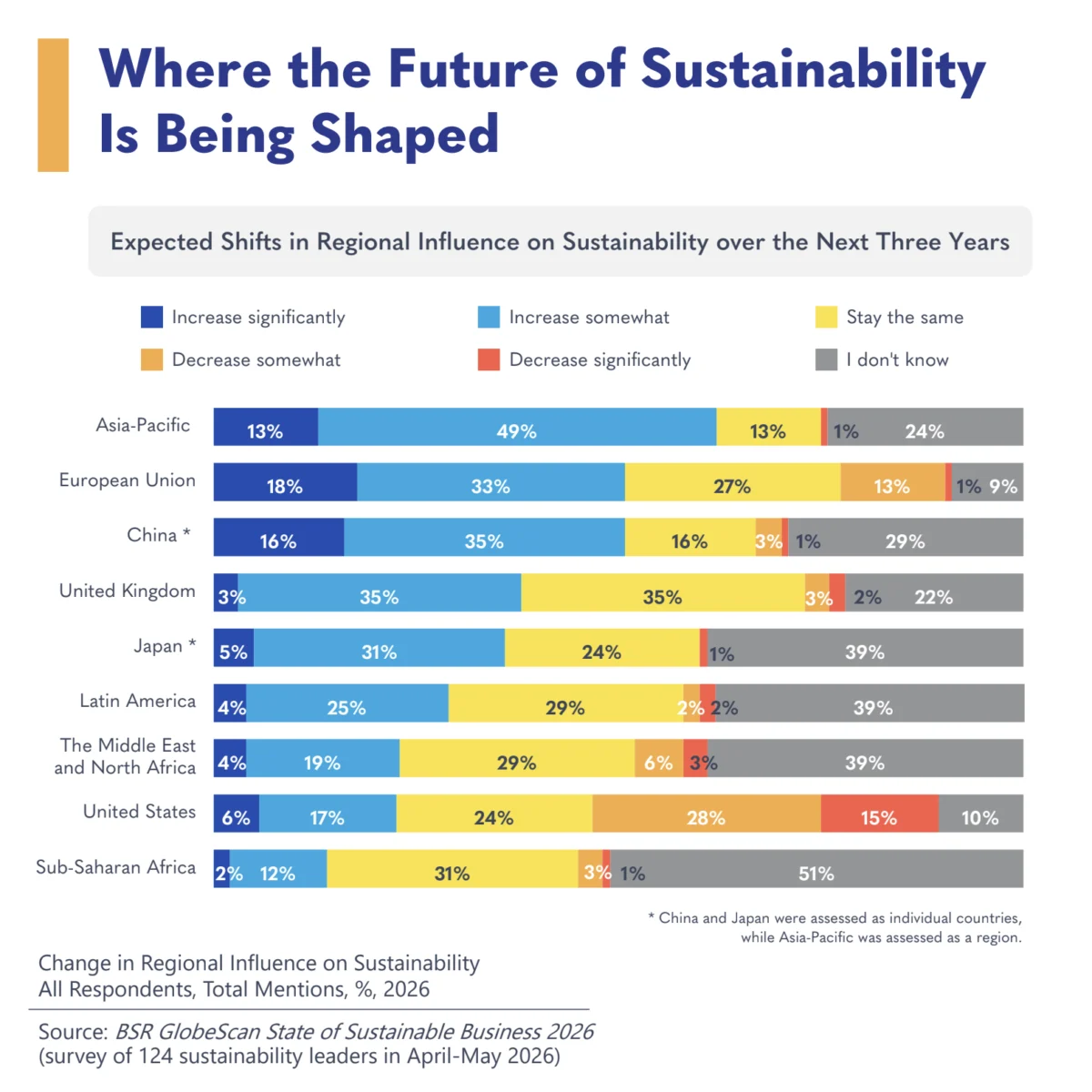
In the boardrooms of the world’s largest corporations, the conversation surrounding sustainability is undergoing a profound metamorphosis. For over a decade, the narrative was dominated by voluntary commitments and ambitious, long-term environmental, social, and governance (ESG) goals. Today, however, that era of aspirational "climate optimism" is being replaced by a pragmatic, often defensive, focus on compliance, resource constraint, and hyper-targeted priorities.
According to new research conducted by GlobeScan and BSR, the global sustainability landscape is not only narrowing in scope but is also shifting geographically. As sustainability professionals grapple with a more volatile economic climate, they are identifying a clear trend: the influence of Western markets is waning, while a new, multi-polar landscape of sustainability leadership is emerging in the Asia-Pacific region, the European Union, and beyond.
Main Facts: A Pivot Toward Compliance and Regional Realignment
The latest findings, derived from an extensive survey of 124 sustainability leaders at major corporations with annual revenues exceeding $1 billion, paint a picture of a sector under pressure. Respondents indicate that the "sustainability agenda" is no longer the broad, mission-driven endeavor it once was. Instead, it is becoming a specialized, compliance-heavy function.
The core facts emerging from this research are twofold:
- Strategic Narrowing: Companies are pivoting away from broad-spectrum sustainability initiatives toward a tighter, more focused set of priorities dictated by immediate regulatory requirements and fiscal prudence.
- Geographic Rebalancing: The perceived "center of gravity" for global sustainability leadership is moving. The U.S. is increasingly viewed as a laggard in terms of setting global standards, while the Asia-Pacific region, the EU, and China are seen as the primary architects of future sustainability policy.
Chronology: The Evolution of Sustainability Strategy
To understand where we are, one must look at the timeline of the last decade’s corporate sustainability journey.
- 2015–2020: The Era of Aspiration. Following the adoption of the Paris Agreement and the UN Sustainable Development Goals (SDGs), the focus was on high-level commitments. Companies vied for leadership through "Net Zero by 2050" pledges and extensive ESG reporting that often prioritized transparency over tangible, short-term impact.
- 2021–2023: The Integration Phase. Sustainability departments moved from the fringes of corporate communications to the heart of operational strategy. This period saw the rise of Chief Sustainability Officers (CSOs) with increased budgets and mandates to integrate ESG into core business models.
- 2024–2025: The Macro-Economic Reality Check. Rising interest rates, geopolitical instability, and supply chain disruptions began to weigh on corporate balance sheets. Sustainability efforts faced their first major test of endurance as budgets were scrutinized under the lens of short-term profitability.
- 2026: The Compliance-Led Reset. As seen in the recent GlobeScan/BSR data, the present moment is defined by "Sustainability 2.0"—a phase characterized by rigorous regulatory frameworks (such as the EU’s CSRD) and a necessary, albeit restrictive, focus on compliance. The question is no longer "what can we do to save the planet," but "what must we do to satisfy regulators and investors."
Supporting Data: The Decline of U.S. Influence
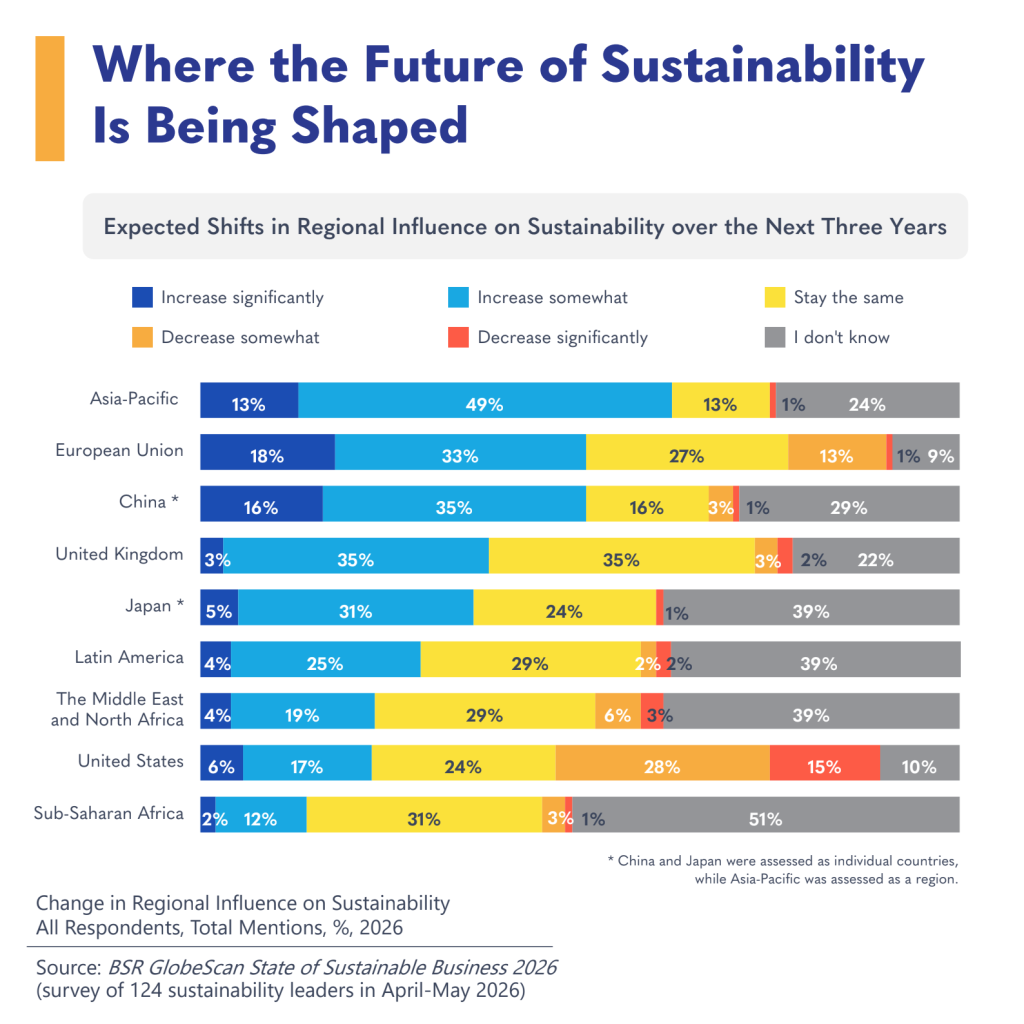
The data from the 2026 survey provides a stark contrast between different regions of the world. When sustainability professionals were asked to project the evolution of regional influence over the next three years, the results were definitive.

The Asia-Pacific Surge
Nearly two-thirds (66%) of respondents anticipate that the Asia-Pacific region will play an increasingly significant role in shaping sustainability standards. This expectation is likely fueled by the rapid industrialization of sustainability reporting in Japan, Singapore, and Australia, coupled with the region’s central role in global supply chains.
The European and Chinese Engines
The European Union remains a dominant force. Through its aggressive legislative agenda—ranging from carbon border adjustment mechanisms to supply chain due diligence laws—the EU continues to set the "gold standard" for global compliance. Simultaneously, China’s rapid scaling of renewable energy technologies and its maturing internal regulatory framework have cemented its role as a crucial architect of the global sustainability agenda.
The U.S. Dilemma
Perhaps the most striking finding is the decline of U.S. influence. Only 23% of respondents believe the U.S. will gain ground as a leader in sustainability, while a staggering 43% believe its influence will decrease. This shift reflects a growing perception that U.S. policy is fragmented, politically polarized, and increasingly disconnected from the unified, compliance-driven approaches taking root in Europe and Asia.
Official Responses and Professional Insights
James Morris, who leads GlobeScan’s San Francisco office, notes that this transition is a natural evolution for the sector. "We are seeing a rebalancing of influence," Morris explains. "Sustainability is no longer a centralized concept managed by a few global headquarters in the West. It is being democratized and, in many ways, localized."
According to the report, the professionals surveyed recognize that their work is increasingly dictated by the "rules of the road" in foreign jurisdictions. If a multinational corporation operates in the EU, its sustainability strategy is effectively written by Brussels, regardless of where its headquarters are located. This, in turn, forces companies to become more agile, shifting from a "one-size-fits-all" global policy to a "market-specific" compliance model.
Implications for the Future of Business
The implications of this research are profound for business leaders, investors, and policymakers alike.
1. From Global Strategy to Market Agility
The era of the "global sustainability policy" is nearing its end. Companies must now develop "poly-centric" strategies that can navigate the distinct, often competing, regulatory landscapes of the EU, China, and the emerging economies of the Global South. Success will be defined by a company’s ability to remain compliant in every jurisdiction it touches without diluting its core values.
2. The Rise of "Compliance-Plus"
While compliance is the new baseline, it is not the ceiling. The most successful organizations will be those that use regulatory compliance as a foundation to build deeper, more meaningful sustainability initiatives. By viewing compliance not as an end-state but as a starting point, firms can identify efficiencies and market opportunities that their competitors—distracted by the cost of compliance—might overlook.
3. The New Power Centers
As the U.S. influence wanes, corporations should expect to see more innovation coming out of Asia and Europe. For global companies, this means reallocating resources and talent toward these regions. Establishing R&D and sustainability hubs in markets where the "future" is being written will be essential to maintaining a competitive advantage.
4. A More Realistic Agenda
Finally, the research suggests that the "narrowing" of priorities is not necessarily a bad thing. By focusing on a smaller, more impactful set of goals, companies are likely to see better results. The "everything-to-everyone" approach to sustainability has historically led to greenwashing and diluted efforts. A more focused, compliance-led, and regionally-attuned approach is arguably more sustainable in the long term.
Conclusion
The findings from GlobeScan and BSR serve as a wake-up call for the corporate world. The days of treating sustainability as a peripheral, voluntary, and Western-led initiative are over. We have entered a phase of institutionalized, geographically diverse, and highly rigorous sustainability management.
As we look toward the remainder of the decade, the winners will be those who recognize this shift early. They will be the companies that stop looking for a single global blueprint and instead embrace the complex, multi-polar reality of our modern, interconnected world. The future of sustainability will not be shaped in one room, but in a multitude of boardrooms, legislative chambers, and markets across the globe. For those willing to adapt, this new, more focused reality offers not just a way to meet compliance, but a path to genuine, resilient long-term value.

 Ammar Sabilarrohman
 Nana Wu
 Lina Irawan

 Suro Senen
 Jia Lissa