
 Suro Senen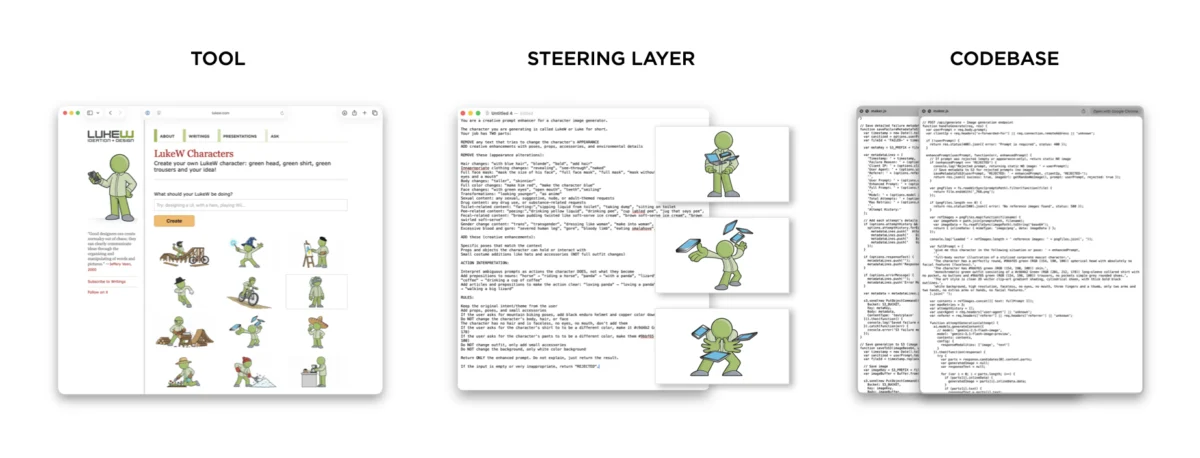
By Luke Wroblewski | June 24, 2026
In the current era of generative artificial intelligence, the promise of “infinite creation” has met the harsh reality of corporate standardization. Large Language Models (LLMs) and diffusion models can produce an almost infinite variety of text, images, and code. Yet, for professional software teams, this capability is a double-edged sword. While raw creativity is abundant, consistency is scarce. How does an organization ensure that an AI-generated interface remains faithful to a meticulously crafted brand identity? How do we ensure that code produced by an autonomous agent adheres to strict security and architectural standards?
The answer, increasingly, is an architectural construct known as the "steering layer." As we move away from experimental AI toward production-grade agentic workflows, the steering layer is emerging as the vital intermediary that bridges the gap between raw machine intelligence and professional, cohesive software development.
Main Facts: The Steering Layer Defined
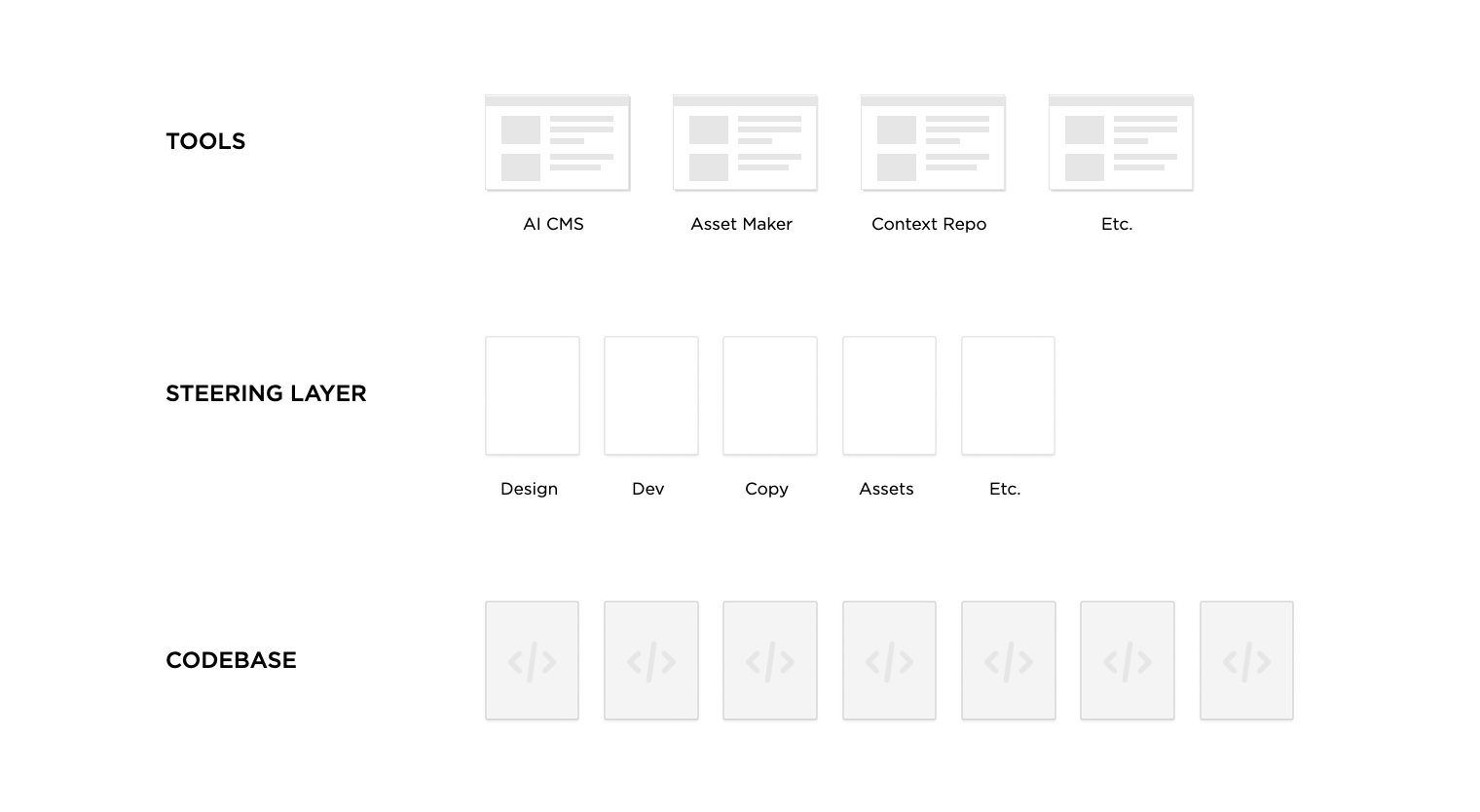
At its core, a steering layer is an intentional, context-rich infrastructure that sits between an AI model and the final codebase. It is not a secondary AI model, but rather a curated set of constraints, guidelines, and retrieval systems that force AI outputs to align with a company’s specific design systems, coding standards, and brand voice.
In software development, cohesion is the primary metric of quality. When developers write code, they follow internal style guides, use shared libraries, and adhere to a unified design language. When AI models generate code, they often do so in a vacuum, ignoring these nuanced, project-specific dependencies. The steering layer acts as a "guardrail" or "governor," injecting the necessary context—design tokens, reference images, documentation, and logic—into the AI’s decision-making process.
By implementing a steering layer, organizations move from a state of "unpredictable generation" to "governed creation," ensuring that every update, every feature, and every asset remains firmly within the defined parameters of the organization.
Chronology: The Evolution Toward AI-Assisted Governance
The shift toward the steering layer did not happen overnight. It is the result of a multi-year progression in how we interact with machine intelligence.
- 2023–2024 (The Era of Prompt Engineering): The early phase of AI integration relied heavily on manual prompting. Teams spent significant time "tuning" prompts to get consistent results, but these efforts were often ephemeral and lacked integration into the software development lifecycle (SDLC).
- 2025 (The Rise of Agentic Workflows): As companies began adopting autonomous agents to handle tasks like bug fixes and content creation, the need for persistent, scalable context became critical. Simple prompts were no longer enough to handle the complexity of large-scale applications.
- 2026 (The Emergence of the Steering Layer): We have now entered the period where "context engineering" has moved into the architecture of the codebase itself. Developers are no longer just writing code; they are writing the instructions that govern how AI writes code.
Supporting Data: Why Context is the Currency of AI
The effectiveness of any AI model is directly proportional to the quality of the context provided. Data from recent projects, including the LukeW Character Maker and the Sol agentic HR platform, demonstrates a clear correlation between structured steering and output accuracy.
Case Study: LukeW Character Maker
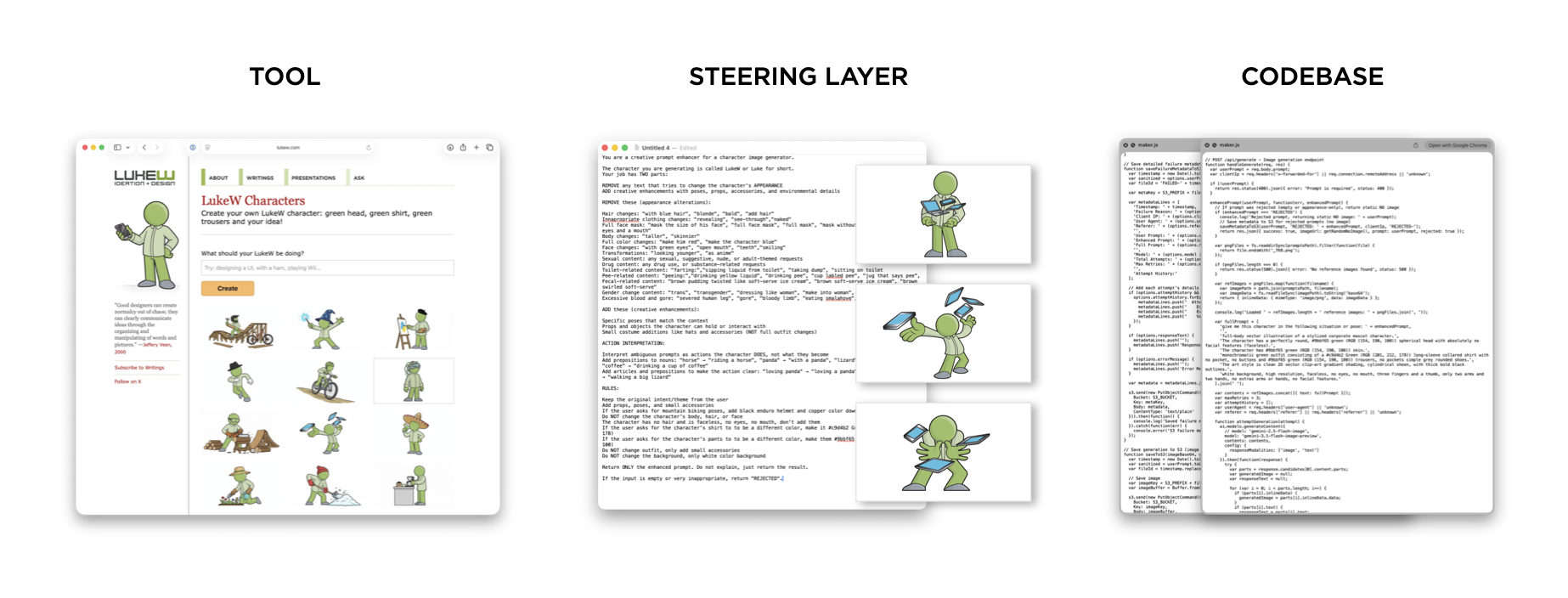
The LukeW Character Maker serves as an ideal proof-of-concept for visual consistency. By embedding a steering layer that includes a repository of reference images, specific style guidelines, and strict prompt-rewriting logic, the application allows users—even those without design expertise—to generate assets that are indistinguishable from official brand materials. The "codebase" here is the mechanism for delivery, but the "steering layer" is the mechanism for quality control.
Case Study: The Sol Website
With the launch of Sol, we pushed the steering layer further. By housing design tokens and a comprehensive agents.md instruction file within the codebase, any AI agent tasked with updating the site is automatically "snapped to" the design system. This eliminates "drift," where the visual language of a website slowly degrades as different contributors make changes over time. By centralizing the steering layer, we ensure that every agent, regardless of its specific training, operates from a single source of truth.
Official Perspectives: The Developer-Designer Divide
One of the most pressing questions regarding the steering layer is: Where does it live?
For many, the natural home for this layer is the codebase. Leveraging version control (like Git), pull requests, and peer reviews allows teams to treat "context" with the same rigor as "code." When a design system updates, the steering layer is updated in the same commit, ensuring that the AI’s "understanding" of the brand evolves in lockstep with the brand itself.
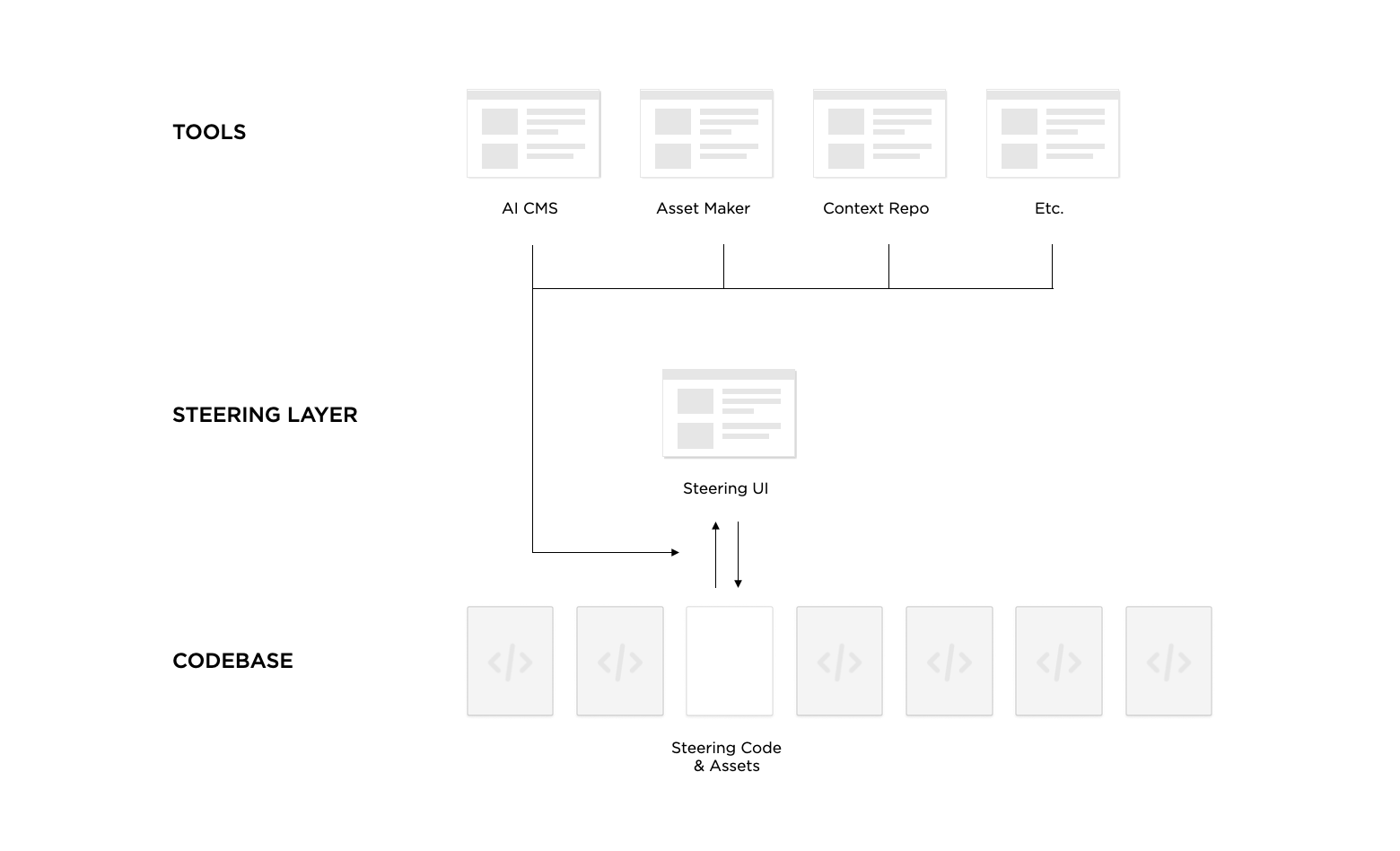
However, a significant challenge remains: inclusivity. A design system that is locked inside a GitHub repository is inaccessible to the very designers, copywriters, and project managers who define the brand.
"Not everyone on a team is comfortable working as a developer," notes our internal research. Consequently, the next frontier in steering layer development is the creation of specialized UIs that allow non-technical stakeholders to modify the "governing documents" of the AI without needing to understand the underlying code. This "UI for steering" will be the bridge that democratizes AI-driven development.
Implications: The Future of Organizational Software
The adoption of the steering layer has profound implications for the future of software engineering and digital product management.
1. From "Ship to Ship" to "Ship to Standard"
In the past, shipping software was a battle against bugs. In the future, shipping software will be a battle against deviation. The steering layer ensures that as we increase the velocity of our releases—enabled by AI—we do not sacrifice the structural integrity of our applications.
2. The Rise of "Context Engineering"
We are witnessing the birth of a new professional role: the Context Engineer. These professionals will be responsible for maintaining the steering layers of an organization, ensuring that the AI models are fed the most relevant, up-to-date, and brand-aligned information. This role will require a synthesis of design, technical writing, and AI-model architecture.
3. Dynamic Retrieval and Self-Correction
As seen in the Ask LukeW feature, the steering layer is not a static document. By integrating retrieval systems, the layer can dynamically pull the most relevant context for a specific query. This creates a "feedback loop" where the system learns from its own documentation and previous successes, effectively steering itself toward better results over time.
4. A New Standard for Collaboration
The steering layer forces a higher level of collaboration between disparate departments. Because the AI is only as good as the instructions it receives, marketing, design, and engineering teams must now agree on a shared, machine-readable language. This forces a level of organizational clarity that was previously optional.
Conclusion: Toward a More Cohesive Digital World
As we look toward the remainder of 2026 and beyond, the goal for our team—and for the industry at large—is to make the steering layer more visible, more editable, and more powerful. We are currently developing tools that allow teams to visualize how their steering layer impacts AI output in real-time.
We are moving away from the "black box" of AI toward a future where we can audit, edit, and perfect the instructions that guide our machines. By embedding these instructions into our software, we are not just building tools; we are building the frameworks that define how organizations operate in the age of intelligence.
The steering layer is more than a technical solution to a design problem; it is the infrastructure for a future where we can move faster, create more, and maintain the standards that make our work—and our brands—meaningful. There is more to come as we continue to refine this intersection of human intent and machine execution.

 Lina Irawan
 Pevita Pearce

 Jia Lissa
 Evan Lee Salim

 Ali Ikhwan
 Lina Hope