Ali Ikhwan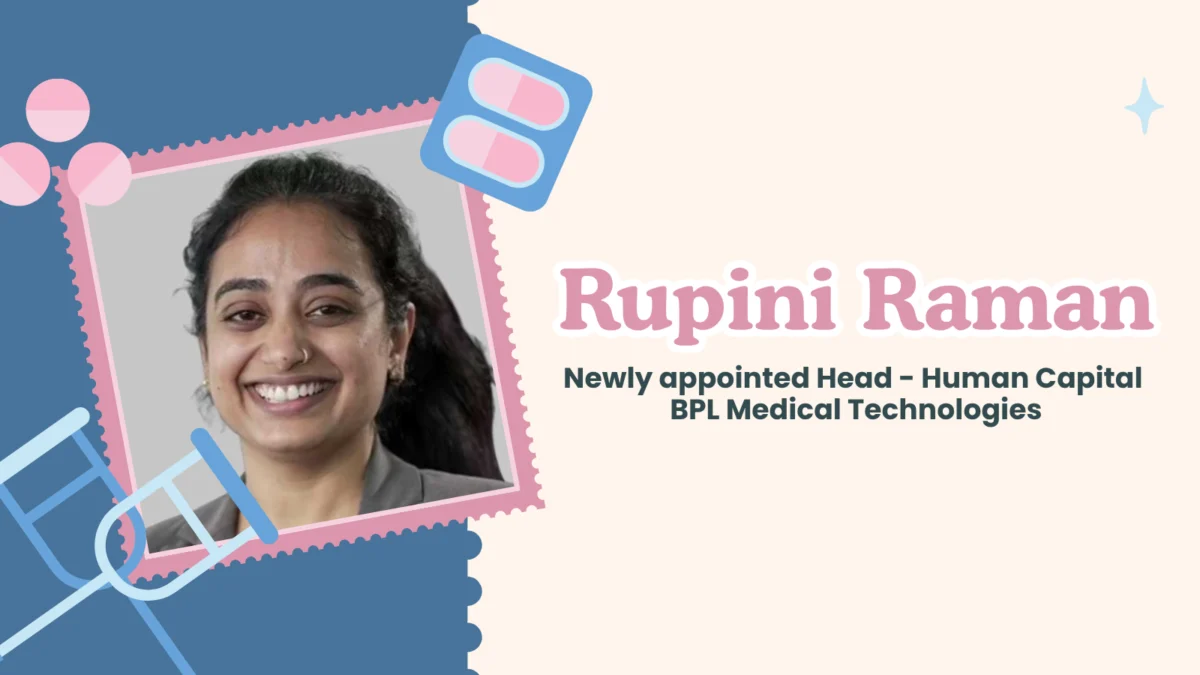
BANGALORE – In a strategic move signaling its commitment to organizational evolution and the integration of advanced technology within the healthcare sector, BPL Medical Technologies has announced the appointment of Rupini Raman as its new Head – Human Capital. This high-profile appointment comes at a pivotal juncture for the company as it seeks to harmonize its people strategy with an aggressive roadmap for business expansion and technological modernization.
Rupini Raman, a seasoned human resources professional with nearly two decades of experience, joins BPL Medical Technologies to spearhead a comprehensive talent strategy. Her mandate encompasses the critical pillars of modern HR: talent acquisition, employee retention, capability building, and the cultivation of a robust organizational culture. As the healthcare industry undergoes a paradigm shift—moving from traditional equipment manufacturing to integrated, technology-driven health solutions—Raman’s role will be central to ensuring the company’s workforce is not only prepared for this transition but is actively driving it.
Main Facts: A Strategic Alignment of Talent and Technology
The appointment of Rupini Raman is more than a standard leadership change; it represents a fundamental shift in how BPL Medical Technologies views its workforce. By designating the role as "Head – Human Capital" rather than a traditional HR title, the company underscores its view of employees as primary assets whose development is directly linked to the organization’s value and competitive edge.
Raman’s primary objectives include:
- Talent Integration: Attracting and onboarding professionals who possess a unique blend of domain expertise in healthcare and digital fluency.
- Organizational Culture: Strengthening the internal ethos to foster innovation, agility, and a "tech-first" mindset.
- Capability Building: Designing and implementing training programs that upskill existing employees to operate within a digitalized operational framework.
- Scalability: Aligning human resources with the company’s "high-growth phase," ensuring that the leadership pipeline is robust enough to support rapid expansion.
BPL Medical Technologies, a household name in the Indian medical device industry, is currently navigating a landscape where artificial intelligence (AI), the Internet of Medical Things (IoMT), and data analytics are becoming standard. Consequently, the company requires a human capital strategy that moves away from administrative HR toward a more strategic, business-partnering model.
Chronology: A Career Defined by Transformation and Agility
Rupini Raman’s professional trajectory over the past 18 years reflects a deep engagement with diverse corporate environments, ranging from high-stakes multinational corporations to the fast-paced, often volatile world of startups. This varied background is precisely what BPL Medical Technologies sought to navigate its current growth phase.
The Early Years and Multinational Foundations
Raman’s career began in environments where process, structure, and global standards were paramount. These early roles allowed her to master the fundamentals of HR operations, compliance, and large-scale talent management. Working within multinational frameworks provided her with a global perspective on human capital—understanding how diverse teams can be unified under a single corporate vision.
The Transition to Startups and FinTech
Seeking more agile environments, Raman moved into the startup ecosystem, where HR is often synonymous with "building from the ground up." She served as the Head of Human Resources at Vivriti Capital, a prominent player in the FinTech space. In this role, she was instrumental in managing the people side of rapid financial growth, ensuring that the culture remained intact even as the headcount surged.
Following her tenure in FinTech, she joined Yulu, a leader in the electric mobility and micro-mobility sector, as Head of Human Capital. At Yulu, Raman faced the challenge of managing a workforce that spanned both corporate technology roles and large-scale operational teams. This experience in a tech-heavy, operations-intensive environment mirrors the current needs of BPL Medical Technologies, which must manage both high-end engineering talent and a sprawling sales and operations network.
Strategic Advisory and Fractional Leadership
Immediately prior to joining BPL Medical Technologies, Raman operated an independent consulting practice. Serving as a Fractional CHRO and Strategic People Advisor, she provided high-level HR interventions for various organizations. This period of her career allowed her to sharpen her skills in "HR-as-a-strategy," helping companies solve complex organizational design problems without the constraints of a traditional full-time role. Her return to a corporate leadership position at BPL Medtech suggests a desire to apply these strategic insights to a long-term, transformative project.
Supporting Data: The MedTech Talent Gap and Market Evolution
The context for Raman’s appointment is a broader shift in the Indian and global MedTech markets. To understand the significance of her role, one must look at the data driving the industry’s change.
The Growth of the Indian MedTech Industry
The Indian medical devices market is estimated to be worth approximately $11 billion and is expected to grow to $50 billion by 2030, according to various industry reports. This growth is being driven by increased healthcare spending, a focus on indigenous manufacturing (under the "Make in India" initiative), and the integration of digital health technologies.
However, this growth faces a significant hurdle: a shortage of specialized talent. A report by the Association of Indian Medical Device Industry (AiMeD) has previously highlighted that the sector requires a workforce that understands both clinical requirements and advanced engineering.
The Digital Fluency Mandate
As BPL Medical Technologies expands its digital footprint, it enters a "war for talent" not just with other medical companies, but with tech giants and specialized health-tech startups. Data suggests that roles in MedTech are becoming increasingly multidisciplinary:
- Sales: Now requires the ability to sell "software-as-a-service" (SaaS) and integrated diagnostic solutions, not just hardware.
- Operations: Relies on real-time data analytics for supply chain optimization.
- R&D: Focuses heavily on firmware, AI algorithms for diagnostics, and cloud connectivity.
By bringing in a leader like Raman, who has experience in tech-centric firms like Yulu and Vivriti, BPL Medical Technologies is positioning itself to bridge this talent gap.
Official Responses: Leadership Vision for the Future
The leadership at BPL Medical Technologies has been vocal about the strategic importance of this appointment. Dr. Shravan Subramanyam, Managing Director of BPL Medical Technologies, emphasized that the company’s future depends on its ability to build a forward-looking organization.
"As we enter a high-growth phase, it is critical for us to proactively design our people strategy and leadership pipeline," Dr. Subramanyam stated. "Rupini’s experience in building agile, forward-looking organisations will play a key role in helping us scale with clarity and consistency."
His comments highlight a shift from "reactive" hiring to "proactive" design. The focus on a "leadership pipeline" suggests that the company is looking to cultivate internal talent for future roles, reducing reliance on external recruitment for senior positions during periods of expansion.
Rupini Raman herself expressed a clear vision for her new role, acknowledging the unique challenges of the healthcare-technology intersection.
"The opportunity lies in building teams that go beyond traditional roles; where even functions like sales and operations are increasingly tech-enabled," Raman noted. "I look forward to creating a talent framework that supports innovation, agility, and long-term growth."
Taking to LinkedIn to share her enthusiasm with her professional network, she added: "Looking forward to this new chapter, learning from an amazing team, and contributing meaningfully towards healthcare technology."
Implications: Reshaping the Legacy of BPL Medical Technologies
The appointment of Rupini Raman carries several long-term implications for BPL Medical Technologies and the wider industry.
1. From Legacy Brand to Tech Innovator
BPL is a brand with deep roots in the Indian consumer and medical electronics market. However, legacy brands often struggle with "organizational inertia." Raman’s background in startups suggests she will bring a sense of urgency and "lean" methodology to the HR function, helping the company shed legacy baggage and adopt more modern, flexible working practices.
2. The Hybridization of Roles
As Raman mentioned, the "tech-enablement" of traditional roles like sales and operations is a significant trend. We can expect to see BPL Medtech invest heavily in internal reskilling programs. This implies that the HR department will function more like an internal "learning and development" (L&D) hub, ensuring that a salesperson who sold traditional ECG machines five years ago is now capable of selling cloud-connected diagnostic platforms.
3. A Focus on Organizational Culture as a Competitive Advantage
In the MedTech sector, where products can often be replicated, culture becomes the true differentiator. Raman’s mandate to "strengthen organisational culture" suggests that BPL Medtech wants to create an environment that attracts high-tier engineers and data scientists who might otherwise choose to work in Silicon Valley-style startups. This involves implementing more transparent performance management, flexible work arrangements, and a clear sense of "purpose" driven by the company’s impact on patient care.
4. Strategic "Human Capital" Management
By moving away from the "Human Resources" nomenclature, the company is signaling to investors and stakeholders that it understands the economics of talent. In a high-growth phase, the "cost" of a bad hire or high turnover is astronomical. Raman’s role will likely involve using data analytics to predict attrition, measure the ROI of training programs, and ensure that the "Human Capital" is yielding maximum value for the organization.
Conclusion
The appointment of Rupini Raman as Head – Human Capital at BPL Medical Technologies is a calculated move designed to prepare the company for a future where healthcare and technology are inseparable. With her 18 years of experience across various sectors, Raman is well-positioned to transform BPL’s workforce into an agile, tech-fluent, and growth-oriented engine. As the company scales, the success of its business strategy will undoubtedly depend on the success of the people strategy Raman is now set to lead. For the Indian MedTech industry, this appointment serves as a bellwether for the increasing professionalization and strategic importance of the HR function in an era of digital disruption.


 Lina Hope
 Reynand Wu
 Nila Kartika Wati
 Jia Lissa
 Basiran
 Sagoh
Sagoh