
 Nana Wu
In the rapidly evolving landscape of local artificial intelligence, the quest to democratize LLMs (Large Language Models) and generative image tools has largely been dominated by NVIDIA-centric ecosystems. However, with the release of Lemonade, AMD is making a significant, albeit early-stage, play to capture the attention of developers and enthusiasts who favor AMD hardware, Ryzen NPUs, and open-standard interoperability.
Lemonade, a server application paired with a graphical user interface (GUI), is positioned as a local-first alternative to established players like LM Studio or ComfyUI. While it promises a streamlined experience for running models locally, our evaluation reveals a tool that is currently defined more by its potential for interoperability than its polish.
The Core Proposition: What is Lemonade?
At its heart, Lemonade is an orchestration layer designed to simplify the deployment of AI models on consumer-grade hardware. It serves as both a GUI-based desktop application and a headless server, providing a bridge between raw hardware acceleration and industry-standard AI APIs.
The software supports a wide array of back-end engines, including llamacpp, whispercpp, sd-cpp, kokoro, ryzenai-llm, and flm. By supporting these engines, Lemonade attempts to unify disparate workflows under a single, simplified umbrella. Crucially, it embraces open standards, offering interoperability with APIs from OpenAI, Ollama, Anthropic, and llama.cpp. This means that developers can, in theory, swap their local inference back-end for Lemonade without refactoring their entire application stack.
Chronology of Development and Market Context
The arrival of Lemonade comes at a critical juncture in the "local-AI-as-a-service" trend.
- Pre-2024: Local inference was largely the domain of command-line power users who were comfortable compiling C++ back-ends and managing complex environment variables.
- 2024–2025: The rise of user-friendly wrappers like LM Studio brought local AI to the masses, but these tools were predominantly built with CUDA (NVIDIA) optimization as the primary target.
- May 2026: AMD formally pushes into the space with Lemonade. The project aims to rectify the "AMD gap"—the frustration felt by Ryzen and Radeon users who found their hardware underutilized or unsupported by mainstream AI GUI tools.
Currently, Lemonade is in its "early-access" phase. It is an ambitious project that acknowledges that while hardware (ROCm and NPUs) is capable, the software stack is often the bottleneck that prevents mainstream adoption.

Supporting Data: Hardware Compatibility and Performance
Lemonade distinguishes itself by leaning heavily into the hardware diversity that AMD cultivates. Unlike tools that are strictly tied to a specific GPU architecture, Lemonade provides:
- AMD GPU Support: Native ROCm support for high-performance inference.
- Ryzen NPU Support: On Windows, it leverages the Ryzen AI software stack, while on Linux, it utilizes FastFlowLM.
- Vulkan/CPU Support: A "catch-all" fallback for hardware that does not meet the specific requirements for dedicated GPU or NPU acceleration.
The NVIDIA Omission
The most glaring limitation—and one that will restrict its user base—is the total absence of NVIDIA-specific GPU support. While Vulkan acceleration is present, it does not currently support the specialized architecture required for efficient StableDiffusion inference on NVIDIA hardware. For users with mixed hardware or those who prioritize the widest possible compatibility for image generation, Lemonade remains a non-starter.
The Model Catalog
Lemonade ships with a curated catalog of models. These include popular LLMs like Gemma, Qwen, and various GGUF/ONNX formats. For users, this is the "killer feature": the ability to download, configure, and launch a model via a simple UI without needing to hunt down specific quantization formats on Hugging Face.
Implications for Developers and End-Users
The "Black Box" Problem
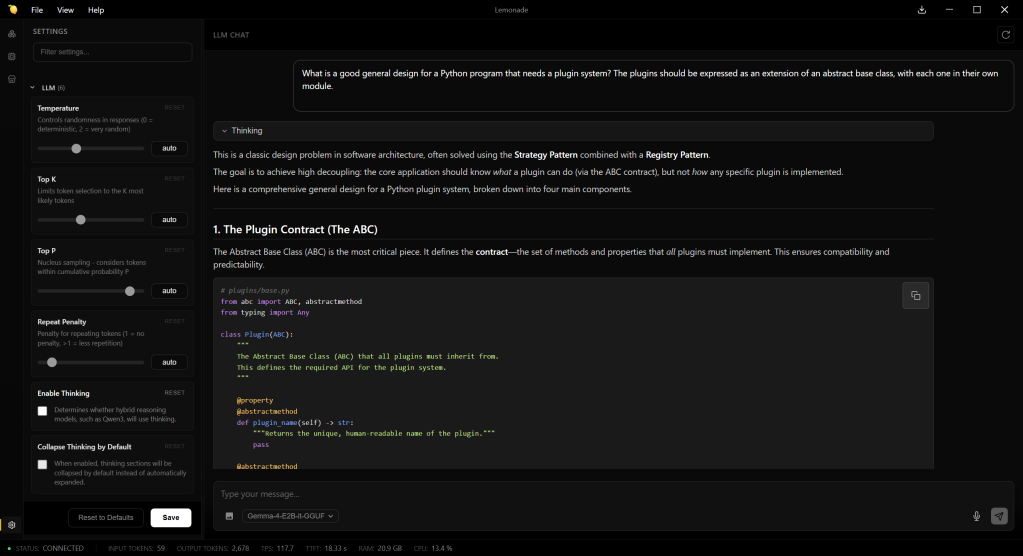
While the goal of Lemonade is simplification, it risks over-simplification. The current iteration of the GUI provides only the most rudimentary "knobs" for controlling inference: temperature, Top-K/Top-P sampling, repeat penalties, and a toggle for "thinking" modes.
For many power users, the inability to manually configure layer-offloading—choosing exactly how many layers of a model reside in GPU memory versus system RAM—is a dealbreaker. In many cases, if a model does not fit entirely within the VRAM, the application fails or defaults to a slow CPU fallback, rather than allowing the user to partition the workload.
Chat and Interaction Workflow
The user experience in the chat interface is currently suboptimal. The software lacks a robust history management system; starting a new session often results in the immediate purging of previous context. Furthermore, the "Save" functionality is unexpectedly archaic, requiring users to export an HTML representation of the entire UI rather than a clean, structured log of the text interaction.

These design choices suggest that the development team is currently prioritizing the server-side API functionality over the client-side user experience.
Official Stance and Future Roadmap
AMD has framed Lemonade not just as a consumer tool, but as an embeddable component. This is a strategic pivot. By allowing other developers to integrate the Lemonade server into their own applications via its API endpoints, AMD is building a foundation for an ecosystem rather than a walled garden.
Official documentation emphasizes that Lemonade is "model-agnostic," provided the model is in a compatible GGUF or ONNX format. This positions the tool to survive the rapid churn of new model architectures, as it relies on the underlying llama.cpp and related libraries to do the heavy lifting of format translation.
Expert Analysis: Is It Worth Using?
For the average user, Lemonade is currently an "early-adopter" tool. It is most valuable to:
- AMD Hardware Loyalists: If you own a high-end Radeon GPU or a laptop with a modern Ryzen NPU, Lemonade is one of the few tools that will actually utilize your specialized hardware acceleration.
- Developers Building Local AI Apps: If you are building a tool that needs a local LLM backend and you want to use a standard API (like OpenAI’s) without building your own inference server from scratch, Lemonade’s embeddable nature is a massive time-saver.
However, the "polish" is missing. The lack of chat history, the rudimentary GUI, and the absence of granular hardware partitioning make it less attractive than established alternatives for general-purpose users.
The Path Forward
To become a market leader, Lemonade must address three critical areas:
- Granular Control: Provide a "Pro" settings mode that allows manual offloading and memory management.
- Persistent Context: Introduce a database-backed chat history system that allows users to pick up where they left off.
- Hardware Parity: While NVIDIA support is unlikely to be a priority for AMD, the Vulkan implementation for image generation must be optimized to achieve parity with the performance found in tools like ComfyUI.
Conclusion: A Promising Foundation
AMD’s Lemonade is a significant step toward making local AI accessible to a wider demographic of hardware users. By embracing open standards and providing a headless server option, AMD is signaling that it understands the future of AI is local, modular, and interoperable.
However, in its current state, it is an incomplete project. It succeeds as an API server but falters as a desktop application. For those currently tethered to NVIDIA hardware, there is little reason to switch. But for the growing cohort of developers building on AMD’s stack, Lemonade is a tool to watch—a necessary, if still rough-hewn, piece of the puzzle in the transition away from centralized cloud-based AI services.
As the development team iterates on the feedback from early users, the focus should remain on stability and feature-parity with the CLI version. If they can bridge the gap between "convenient" and "capable," Lemonade could well become the standard for local AMD-based AI deployment. For now, it serves as a powerful, albeit limited, utility for those who know exactly what they need from their hardware.

 Neng Nana
 Evan Lee Salim
 Raul Delapena Setiawan
 Reynand Wu
 Sagoh
Sagoh

 Azzam Bilal Chamdy
 Ali Ikhwan