
 Nila Kartika Wati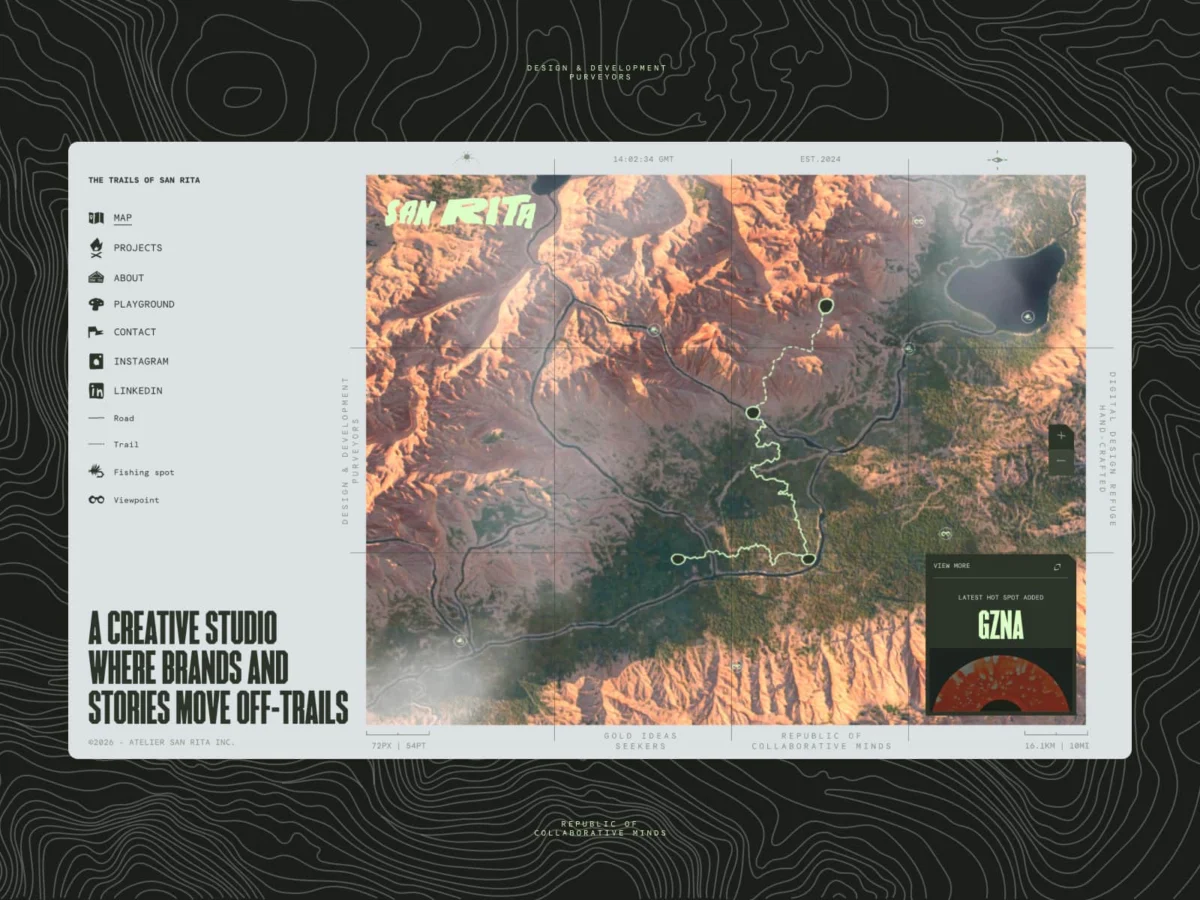
In an era defined by the homogenization of web design—where "clean" grids and sterile, minimalist layouts have become the industry default—a Montreal-based studio is charting a different course. Atelier San Rita has unveiled its new digital home, sanrita.ca, a project that rejects the cold efficiency of modern UI in favor of something far more tactile, nostalgic, and immersive.
By marrying the raw beauty of 1950s National Park topography with cutting-edge WebGL technology, the studio has transformed the traditional portfolio into a living, breathing landscape. It is not merely a website; it is a digital territory that captures the intersection of technical precision and an outdoor-centric philosophy.
The Genesis: Rejecting the "Default" Web
For the team at Atelier San Rita—comprising Julien Sister, Alexis Malin, and Martin Thienpont—the project began as an act of creative rebellion. The founders noted that the digital landscape was becoming increasingly predictable: perfectly white, perfectly static, and ultimately, profoundly uninspiring.
"As a studio, your website is often your only truly free space, a digital flagship," the team explains. "We saw so many sites in our industry that felt like cold, sterile galleries. We wanted to move away from that. We wanted to create a real territory."
Inspired by the contrast between Montreal’s urban creative grit and the vast, untamed wilderness just a few hours from the city, the studio sought to encode this dichotomy into their digital presence. They turned to the tactile charm of mid-century topographic maps—artifacts defined by sun-faded palettes, grainy textures, and hand-drawn elevations. This became their "North Star," guiding the project away from sleek, plastic aesthetics toward something that felt weathered, organic, and grounded.
Chronology of a Digital Expedition
The development of San Rita was not a linear sprint but a year-long, iterative expedition. The studio’s process followed a distinct path from conceptual mapping to high-performance implementation.
Phase 1: Topographic Modeling
The foundation of the site is an interactive 3D map acting as the primary navigation tool. Eschewing generic 3D assets, the team sourced real-world GPS data and heightmaps to generate the initial terrain. Using Blender, they sculpted bespoke landscapes, intentionally bridging the visual gap between the coastal warmth of California and the rugged, boreal textures of Canada.
Phase 2: The "Killing Your Darlings" Optimization
The project faced a significant technical bottleneck: performance. Initial high-poly models were visually arresting but proved catastrophic for mobile browser stability. The team had to adopt a rigorous "killing your darlings" philosophy, stripping away complexity to ensure fluidity. By utilizing Adobe Substance 3D Painter, they baked intricate high-resolution details onto low-poly meshes. This allowed the studio to preserve the tactile appearance of rocky ridges and valleys while maintaining high frame rates across devices.
Phase 3: Shaders and Sensory Detail
To combat the "plastic" look inherent in many 3D web experiences, the team authored custom GLSL shaders. These scripts injected artificial grain and noise into the materials, simulating the texture of vintage paper. The result is a surface that reacts to light in a way that feels physical, encouraging the user to "reach out" and interact with the digital space.
Supporting Data and Technical Architecture
The technical complexity behind sanrita.ca is hidden behind a veil of seamless interaction. The team faced the challenge of "nested scrolling"—the difficulty of allowing a user to scroll through a content-heavy list while the 3D environment responds in real-time.
- The Global Canvas: Unlike standard sites where the 3D scene reloads during navigation, the studio employed a "global" canvas mounted outside the Next.js App Router. This ensures the terrain remains constant, allowing for continuous, cinematic camera movements when transitioning between projects.
- Performance Metrics: To achieve high-fidelity rendering without compromising load times, the team implemented Draco compression for 3D assets and KTX2 for texture formats.
- Adaptive Quality: The site features an intelligent performance-tracking system. If the GPU detects a drop in frame rate, it dynamically scales back shadow density and grain intensity, ensuring the experience remains fluid even on lower-powered mobile hardware.
- The Tech Stack: The project utilizes React Three Fiber for the 3D orchestration, Lenis for smooth scroll-jacking, and GSAP to synchronize scroll position with camera kinematics.
The Studio’s Perspective: "Digital Craft"
When asked about the philosophy driving the project, the founders emphasize that "Digital Craft" is not about chasing the latest framework, but about using code as a narrative medium.
"There were dozens of features we built and then deleted because they felt like ‘too much,’" the team notes. "We had versions with animated birds, weather systems, and day-night cycles. We realized those things were distracting from the core story. We learned that the most powerful digital experiences aren’t the ones with the most features, but the ones with the most cohesive atmosphere."
This restraint reflects a broader shift in the design industry: a move away from "feature-bloat" and toward atmospheric design. By focusing on the "weight" of the scroll—fine-tuning the speed to ensure it feels like gliding over terrain rather than dragging a cursor—the team managed to make the technology disappear, leaving only the experience.
Implications: A Living Portfolio
The launch of sanrita.ca is not the end of the project, but the beginning of a living document. The studio views the site as an evolving product, with plans to integrate their headless CMS, DatoCMS, more deeply into the 3D environment.
The long-term vision is an automated system where every new client project added to the CMS manifests as a new landmark on the map. This approach turns the portfolio into a growing, self-updating archive—a living territory that matures alongside the studio.
The Human Element in an AI-Driven Era
The implications of this project are particularly relevant in the age of generative AI. While AI can produce standard layouts and generic design systems in seconds, it currently lacks the capacity for the "imperfect" design and deep-rooted intentionality demonstrated by the Atelier San Rita team.
"In an era where AI can generate a standard layout in seconds," the founders conclude, "we believe that human intuition and ‘imperfect’ design are more valuable than ever. San Rita is our way of stepping off the beaten path. It is an invitation to explore the intersection of our technical grit and our creative gut."
About Atelier San Rita
Atelier San Rita is a boutique design studio based in Montreal, led by Julien Sister, Alexis Malin, and Martin Thienpont. The studio specializes in branding, art direction, and high-performance digital experiences. Their methodology is rooted in the belief that effective digital design requires both a "raw, creative soul" and "deep technical mastery." By treating the screen as a canvas for storytelling, they continue to push the boundaries of what is possible in the modern browser, serving as a beacon for studios that prioritize craftsmanship over convenience.

 Sagoh
Sagoh
 Asep Darmawan
 Raul Delapena Setiawan
 Reynand Wu


 Azzam Bilal Chamdy
 Ali Ikhwan