
 Jia Lissa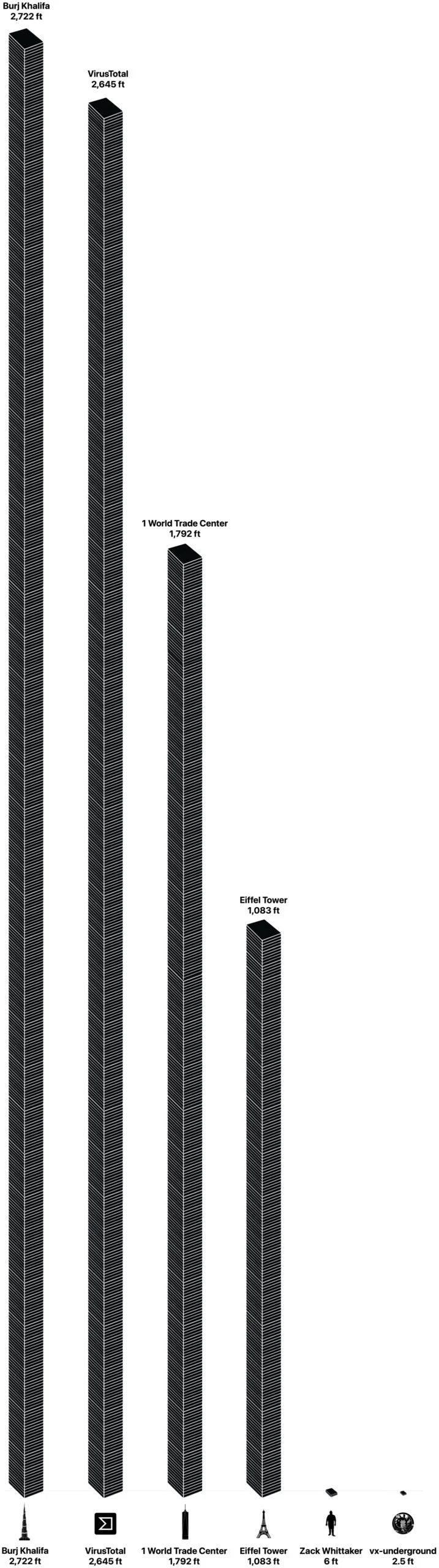
In the shadowy corners of the internet, where cybersecurity researchers and threat actors play a perpetual game of cat and mouse, the currency of the realm is data. Specifically, it is the raw, malicious code that powers the world’s most sophisticated cyberattacks. Recently, a fascinating conversation sparked on X (formerly Twitter) between the research collective vx-underground and Bernardo Quintero, the founder of the industry-standard malware scanning service VirusTotal.
The exchange, which centered on the sheer volume of malware samples collected by these organizations, offered a rare glimpse into the gargantuan scale of the global threat landscape. While these figures—measured in terabytes and petabytes—are commonplace in technical reports, they are notoriously difficult for the human mind to conceptualize. To better understand the sheer magnitude of these repositories, we decided to perform a thought experiment: what would this malicious data look like if it were physically manifested as a stack of standard hard drives?
The Magnitude of the Malicious Archive
The conversation began when vx-underground, widely recognized as the largest repository of malware source code on the internet, disclosed that their archive currently totals approximately 30 terabytes (TB). This data serves as a critical historical record, allowing researchers to trace the evolution of code from the earliest computer viruses to modern, polymorphic ransomware.
Shortly after this revelation, Bernardo Quintero provided a staggering counterpoint. VirusTotal, which functions as an aggregator for dozens of antivirus engines, hosts a repository of malware samples that has reached a massive 31 petabytes (PB). To put that into perspective, one petabyte is equivalent to 1,000 terabytes. Consequently, VirusTotal’s archive is roughly 1,000 times larger than that of vx-underground—a testament to the service’s role as the primary landing zone for security researchers and automated malware submissions globally.
For cybersecurity firms, AI researchers, and intelligence agencies, these datasets are not merely "data hoards." They are the foundational training sets for machine learning models designed to detect zero-day exploits, and they are the primary source of truth for understanding how cyberattack tactics, techniques, and procedures (TTPs) evolve over time.
Chronology of a Digital Arms Race
The growth of these datasets is directly proportional to the explosion of cybercrime over the last two decades.
The Early Days: Hand-Compiled Collections
In the late 1990s and early 2000s, malware collection was a cottage industry. Researchers maintained personal "virus zoos" on floppy disks and CDs. The objective was manual analysis: reverse-engineering code to understand how it spread.
The Rise of Aggregators
The mid-2000s saw the birth of services like VirusTotal. By creating a centralized platform where files could be uploaded and scanned against every major antivirus engine, the security community transitioned from isolated research to a collaborative, global effort. This shift allowed for the rapid cataloging of new variants, leading to the exponential growth of malware databases.
The Era of "Big Data" Security
Today, we are in the era of automated submission. With the rise of sandboxing technologies and automated threat hunting, organizations are feeding these databases at an unprecedented rate. Every time a new malware strain hits a corporate network, it is often uploaded to these repositories, fueling the growth of the 31-petabyte mountain that VirusTotal currently manages.
Visualizing the Invisible: A Physical Scale
When we asked an AI chatbot to visualize the physical dimensions of these datasets, the results were, frankly, laughable. The AI failed to account for the physical constraints of storage hardware, opting instead for abstract metaphors. To provide a grounded perspective, we conducted a back-of-the-napkin calculation using industry-standard hardware.
The Methodology
We chose the 3.5-inch internal hard drive as our unit of measurement. These drives are the workhorses of data centers and are standardized in size, with a height of exactly 1 inch. For this exercise, we assume each drive has a capacity of 1 terabyte.
While modern enterprise drives often boast much higher capacities, the 1TB standard provides a clear, 1-to-1 conversion for our visualization. We also ignored the "usable capacity" discrepancy (where a 1TB drive actually holds slightly less due to file system overhead) to keep the math clean.

The vx-underground Stack
With 30 terabytes of data, vx-underground’s repository would require 30 standard hard drives. Stacked one on top of the other, this would create a tower exactly 30 inches tall—or 2.5 feet. This is a manageable, almost domestic size; it would reach roughly to the knees of an average adult.
The VirusTotal Monument
The scale of VirusTotal’s 31-petabyte collection is, by comparison, astronomical. 31 petabytes equates to 31,000 terabytes.
- Total Hard Drives: 31,000 drives.
- Total Height: 31,000 inches.
- Conversion to Feet: 2,583 feet.
To put 2,583 feet into perspective, consider the world’s most iconic vertical structures. The Eiffel Tower, a marvel of engineering, stands at 1,083 feet. VirusTotal’s data, if stacked as hard drives, would reach two-and-a-half times the height of the Eiffel Tower. It would loom just below the Burj Khalifa, the tallest building in the world, which reaches 2,722 feet.
Implications for Future Cybersecurity
The sheer physical scale of this data underscores a critical challenge for the future of cybersecurity: the "Needle in the Haystack" problem.
As repositories grow into the tens of petabytes, the ability to effectively search, categorize, and identify threats becomes an engineering hurdle of the highest order. Traditional relational databases cannot handle this volume of information. Instead, firms are turning to distributed computing and advanced AI-driven indexing.
The Role of AI in Threat Detection
As these datasets continue to grow, the role of human analysts is becoming increasingly dependent on artificial intelligence. AI models are now required to "read" through these 31 petabytes of data to find patterns that a human eye would never catch. However, this creates a secondary risk: "data poisoning." If attackers can inject malicious samples that are designed to trick these AI models, they could theoretically render our automated detection systems blind.
The Ethics of Data Archiving
There is also a persistent debate regarding the ethics of maintaining such large repositories. While researchers argue that having access to "live" malware is essential for defense, critics argue that these repositories, if compromised, could provide a "one-stop-shop" for cybercriminals to refine their tools. Managing the security of these massive data banks—often called "honeypots" or "threat intel repositories"—is itself a high-stakes security operation.
A Warning from the Front Lines
The physical comparison—the 2.5-foot stack of vx-underground’s repository versus the 2,600-foot tower of VirusTotal’s—is more than just a fun math exercise. It serves as a reminder of the scale of the digital arms race.
For the average user, these numbers remain abstract. We interact with software, not the code behind it. But for the researchers, the developers, and the defenders, these numbers represent a living history of human creativity applied to malicious ends. The security industry has built a digital Burj Khalifa of malware, and it is growing taller every single day.
As we look toward the future, the question is no longer how we store this data, but how we effectively weaponize it for defense. With millions of new threats appearing annually, the ability to synthesize this vast, towering archive of malice into actionable intelligence will be the defining challenge for the next generation of cybersecurity experts.
Zack Whittaker is the security editor at TechCrunch and author of the weekly newsletter, "This Week in Security." For more updates on the evolving threat landscape, follow his work or reach out via encrypted message on Signal at zackwhittaker.1337.


 Reynand Wu
 Sagoh
Sagoh
 Raul Delapena Setiawan

 Azzam Bilal Chamdy
 Ali Ikhwan