
 Nana Wu
For the third consecutive year, the Python community has taken a deep dive into the evolving landscape of type safety. The 2026 Python Typing Survey provides a comprehensive look at how developers—from seasoned veterans to newcomers—are leveraging type hints, tools, and standards to navigate the complexities of modern software engineering. With 1,500+ respondents, the data offers a clear mandate: while static typing has become an integral part of the Python ecosystem, the next phase of evolution must address the challenges of AI integration, framework interoperability, and the "black magic" of dynamic code.
Main Facts: A Mature Ecosystem in Flux
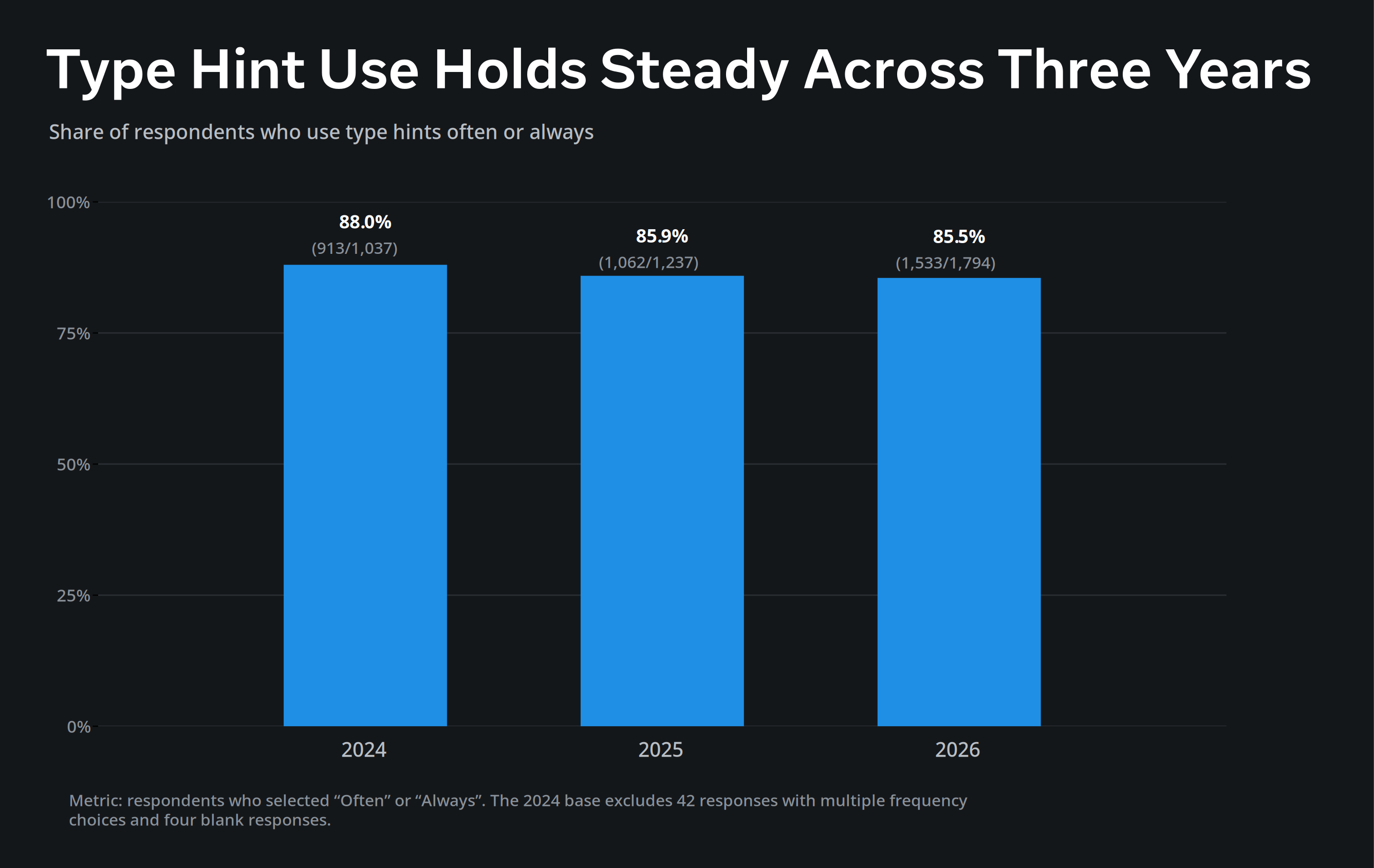
The 2026 survey results confirm that Python typing has moved past its "early adopter" phase and firmly into a period of maturation. Approximately 85.5% of respondents now report using type hints often or always, a figure that has remained remarkably stable over the last three years.
However, stability in usage does not mean stagnation in tooling. The survey highlights a significant shift in checker preferences. While Mypy remains a cornerstone, the rise of newer, high-performance alternatives has led to a more fragmented—and increasingly hybrid—workflow. Nearly half (49.9%) of developers now utilize two or more static type checkers, a notable increase from previous years. This multi-tool approach is driven by the need for speed, specific IDE integrations, and the handling of niche, complex patterns that some checkers manage better than others.
Chronology: Three Years of Evolution
To understand where the community is headed, one must look at the trajectory of the last three years:
- 2024: The conversation was dominated by performance concerns. A recurring theme was the "slowness of Mypy," which many developers argued was causing ecosystem fragmentation. The community was still largely relying on traditional forums like Stack Overflow for guidance.
- 2025: The focus shifted toward the ergonomics of typing. Developers began expressing frustration with the complexity of the type system, particularly for those using it only sporadically. This was the year that "missing library information" became identified as the primary hurdle for wider adoption.
- 2026: The narrative has been completely reshaped by the integration of Artificial Intelligence. AI is no longer a peripheral tool; it is now a primary participant in the typing lifecycle, frequently generating type hints, resolving errors, and even suppressing them. Simultaneously, the industry has begun to move away from general-purpose Q&A platforms like Stack Overflow in favor of direct, project-specific documentation and LLM-assisted troubleshooting.
Supporting Data: The AI Paradigm Shift
The most dramatic findings in the 2026 report concern the intersection of AI and type safety. The share of respondents who view AI as a tool for making code more "accurate and reliable" surged from 18.5% in 2025 to 38.4% in 2026.
AI in the Workflow
AI is now deeply embedded in the typing cycle:
- Generation: 42.5% of developers report using AI to write type hints.
- Optimization: 32.6% use AI to retroactively add types to improve the quality of AI-generated code.
- Automation: Roughly 24.4% of developers have an AI coding assistant that automatically invokes their type checker.
However, this convenience comes with a caveat. Respondents noted that AI agents can be "lazy," often defaulting to object types or overusing #type: ignore comments to bypass errors. This has created a new class of "type hygiene" tasks, where developers must spend time auditing and correcting AI-generated annotations. Furthermore, uncertainty remains high regarding the actual efficacy of these tools, with nearly 30% of developers stating they aren’t sure if typing actually improves their AI-assisted coding outcomes.
The "Black Magic" Challenge: Libraries and Frameworks
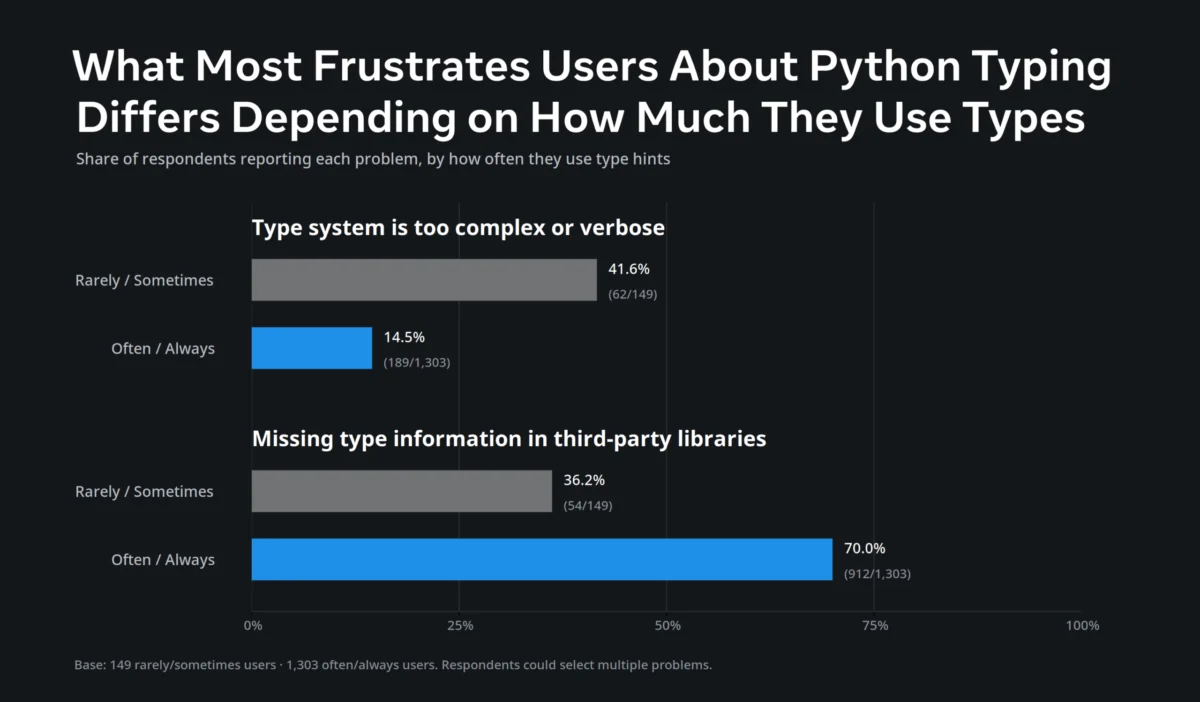
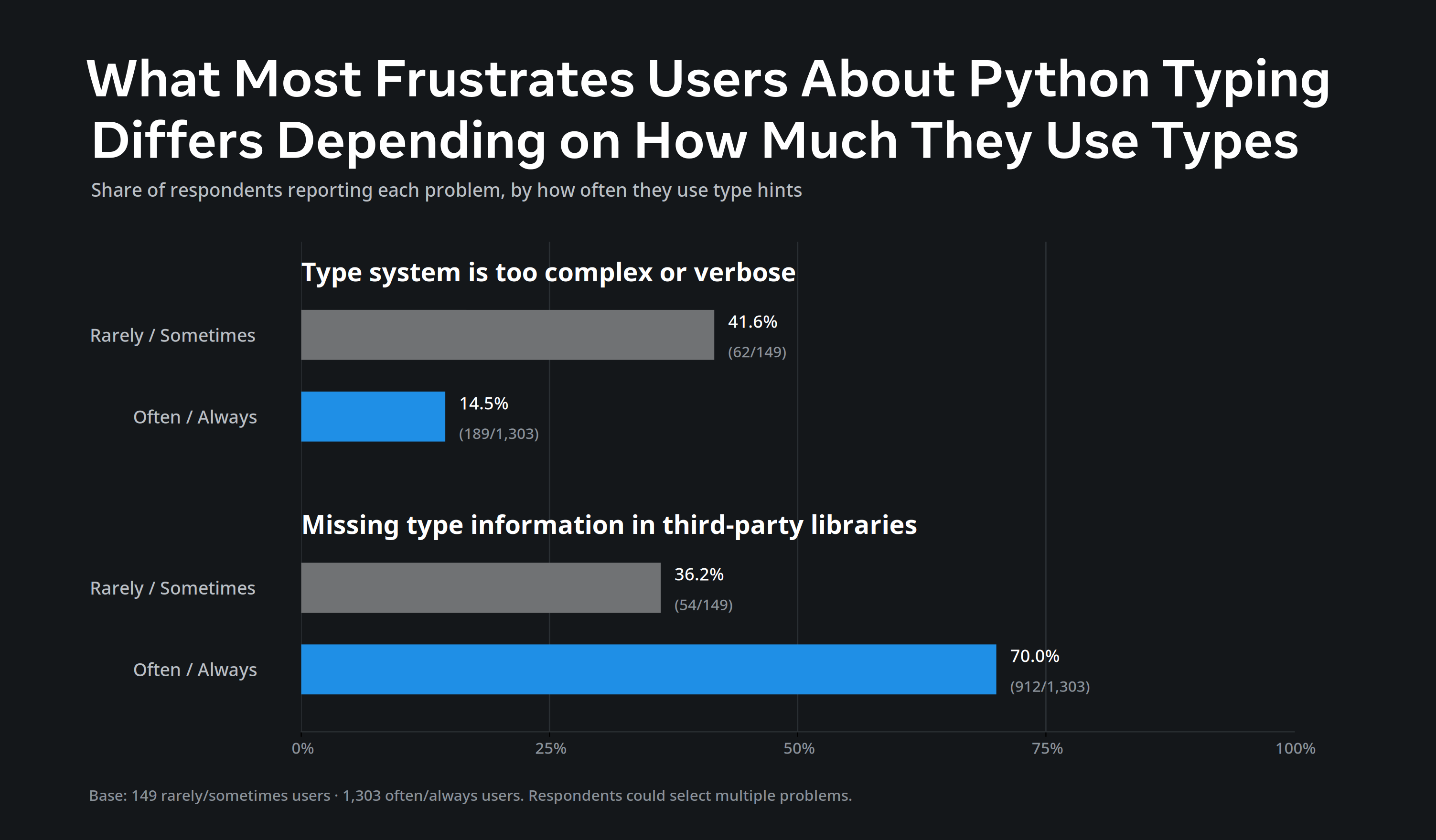
Despite the sophistication of modern checkers, the biggest barrier to a seamless experience remains third-party libraries. 65.1% of respondents identified "missing type information" in external packages as their primary difficulty.
The friction is most acute in the data science and web development sectors. Packages like Django, SQLAlchemy, Pydantic, NumPy, and pandas are frequently cited. The core issue is that these frameworks often utilize highly dynamic constructs—metaprogramming, custom decorators, and runtime-evaluated code—that traditional static analysis struggles to parse. As one respondent aptly put it, "Django does so much black magic it’s a wonder a type checker works at all."
This has necessitated a shift in focus for library maintainers. It is no longer sufficient to provide a library; the ecosystem now demands high-fidelity, machine-readable stubs that capture the nuances of dynamic framework behavior. Initiatives like the collaboration between Meta’s Pyrefly team and Quansight to improve pandas and NumPy stubs represent the necessary future of this ecosystem.
Official Responses and Strategic Implications
The survey serves as a roadmap for tool builders and standards contributors. Based on the 2026 data, the path forward involves four critical pillars:
1. Lowering the Barrier to Entry
For occasional users, the type system remains intimidating. 41.6% of low-frequency users find the system too complex or verbose. The recommendation is clear: tools should offer a "zero-config" experience that provides immediate, actionable feedback without requiring a deep dive into advanced typing concepts. Error messages should be human-readable, offering direct links to documentation and concrete examples rather than cryptic stack traces.
2. Improving Callable Syntax
The "missing feature" that resonated most strongly was the need for improved Callable syntax. 45.7% of respondents identified this as a priority. Simplifying how functions and callbacks are typed is seen as a "quick win" that would reduce cognitive load for both new and experienced users.
3. Integrating AI and Type Safety
The industry must move beyond treating AI as a "black box." The Pyrefly team is leading the charge in researching how AI coding agents and type checkers can form a symbiotic loop. The goal is to design tools where the type checker provides real-time constraints to the AI, and the AI, in turn, suggests fixes that are inherently compliant with the codebase’s type safety standards.
4. Improving Documentation Accessibility
As developers pivot away from Stack Overflow, the burden of education falls on official project documentation. The data shows a 10% increase in the reliance on typing-specific documentation. This places a premium on the quality, searchability, and interconnectedness of technical docs. Linking error codes directly to documentation is not just a convenience—it is a necessity for the modern, AI-augmented developer.
Conclusion: A Future of Hybrid Workflows
The 2026 Python Typing Survey depicts a community that has successfully adopted static typing but is now grappling with the complexities of scale and automation. The future of Python development will not be a singular, monolithic experience but a hybrid one—where multiple checkers coexist, AI assists in the heavy lifting, and the "black magic" of our most powerful frameworks is gradually brought under the umbrella of strict type safety.
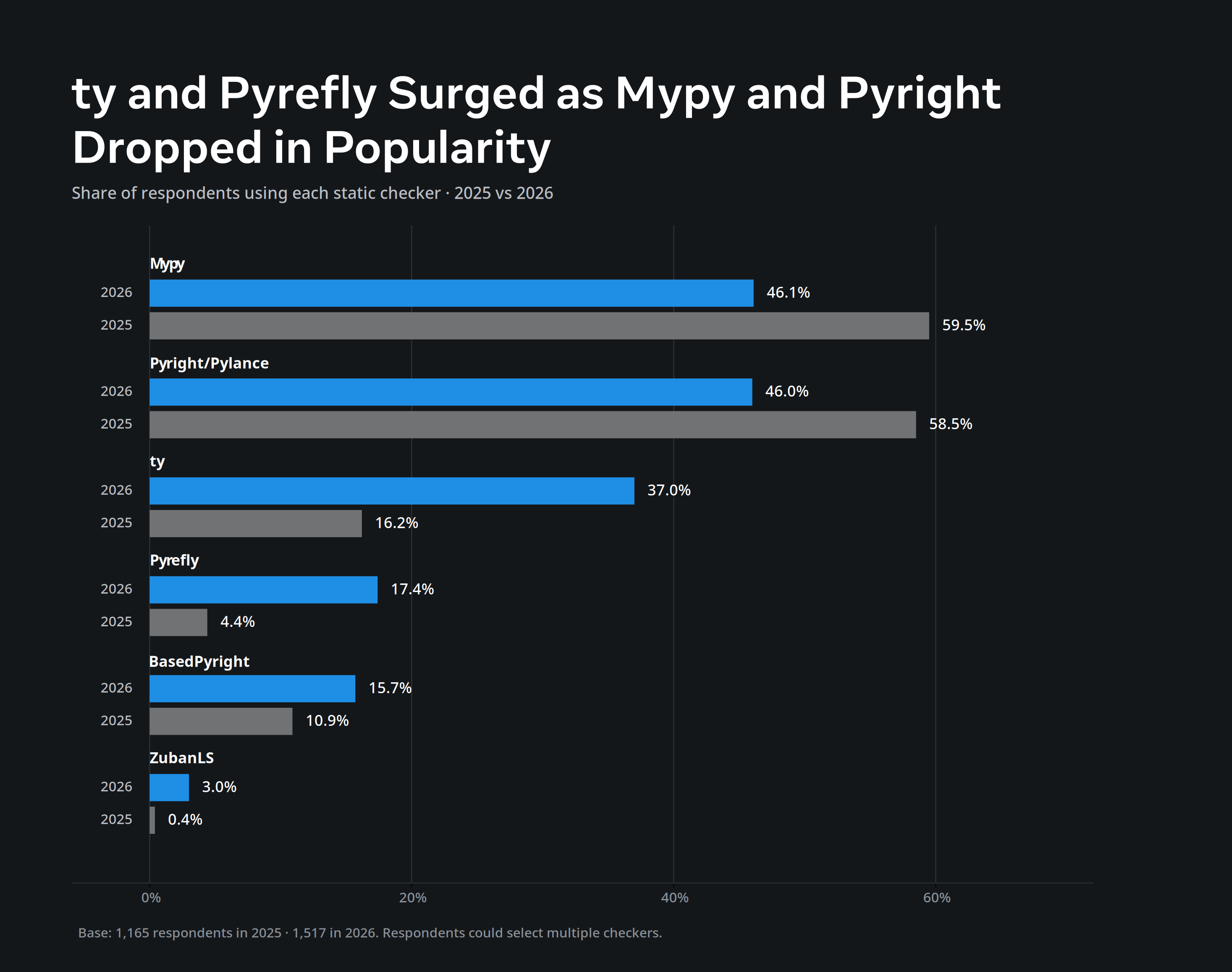
The takeaway for the broader community is clear: as we evolve the type system, we must prioritize the ergonomics of the user experience. By focusing on clearer documentation, more intuitive Callable syntax, and better support for dynamic frameworks, the Python ecosystem can ensure that type safety remains an enabler of productivity rather than a source of frustration. For those looking to shape the future of this space, the 2026 survey data provides the foundational evidence needed to build the next generation of Python developer tools.

 Iffa Jayyana
 Rifan Muazin

 Nila Kartika Wati

 Muslim
 Jia Lissa
 Pevita Pearce
