
 Neng Nana
In the high-stakes arena of UK political discourse, economic data is often treated as the ultimate arbiter of truth. However, a recent policy document released by the opposition Conservative Party has cast a long shadow over the reliability of the figures underpinning the "Net Zero" debate. The document, titled The Right Way, presents a robust argument for a "common sense" approach to governance, emphasizing that the public demands competence and accountability. Yet, buried within its pages is a stark, multi-billion-pound inaccuracy that appears to have originated from a simple, yet catastrophic, spreadsheet error.
By incorrectly citing the Climate Change Committee’s (CCC) 2020 estimates, the Conservative Party has claimed that the path to Net Zero carries a price tag of nearly £1 trillion—a figure that is exactly double the actual, intended estimate. This discovery has ignited a firestorm of criticism, raising questions about the due diligence performed by party researchers and the persistence of "zombie statistics" that gain traction despite being demonstrably false.
The Anatomy of an Error: Double-Counting the Future
At the heart of the controversy is a misunderstanding of a technical spreadsheet published by the CCC in 2020. The spreadsheet, designed to model the investment requirements for a Net Zero economy, categorized costs into two distinct buckets: Capital Expenditures (CAPEX)—the upfront cost of low-carbon technology like heat pumps and electric vehicles—and Operational Expenditures (OPEX), which reflect long-term savings and maintenance.
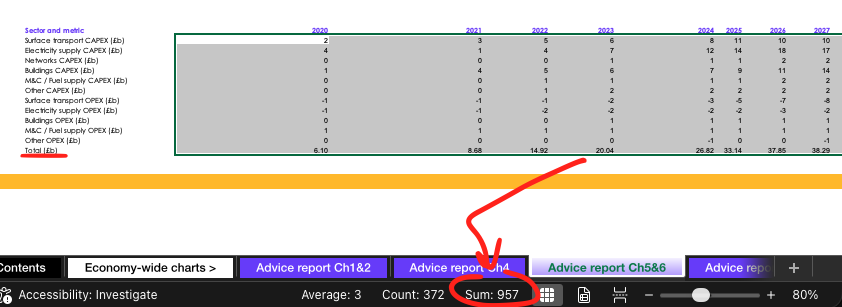
The original data showed that over the thirty-year period between 2020 and 2050, the total investment needs were balanced against operational savings. When correctly aggregated, the net cost was calculated at £478 billion. However, the CCC spreadsheet also included a line summarizing the annual total for every year.
It appears that analysts—first in independent think-tank circles and subsequently within the Conservative Party’s research team—failed to recognize that the annual totals were already inclusive of the line-item data. By adding the sectoral expenditures and the pre-calculated annual totals, the researchers effectively double-counted the entire cost of the transition. This arithmetic failure inflated the perceived cost of Net Zero from £478 billion to £957 billion.
A Chronology of Misinformation
The journey of the £957 billion figure from a misunderstood Excel file to a national policy pamphlet provides a fascinating, if troubling, case study in how misinformation propagates within political ecosystems.
The "Accidental Analyst"
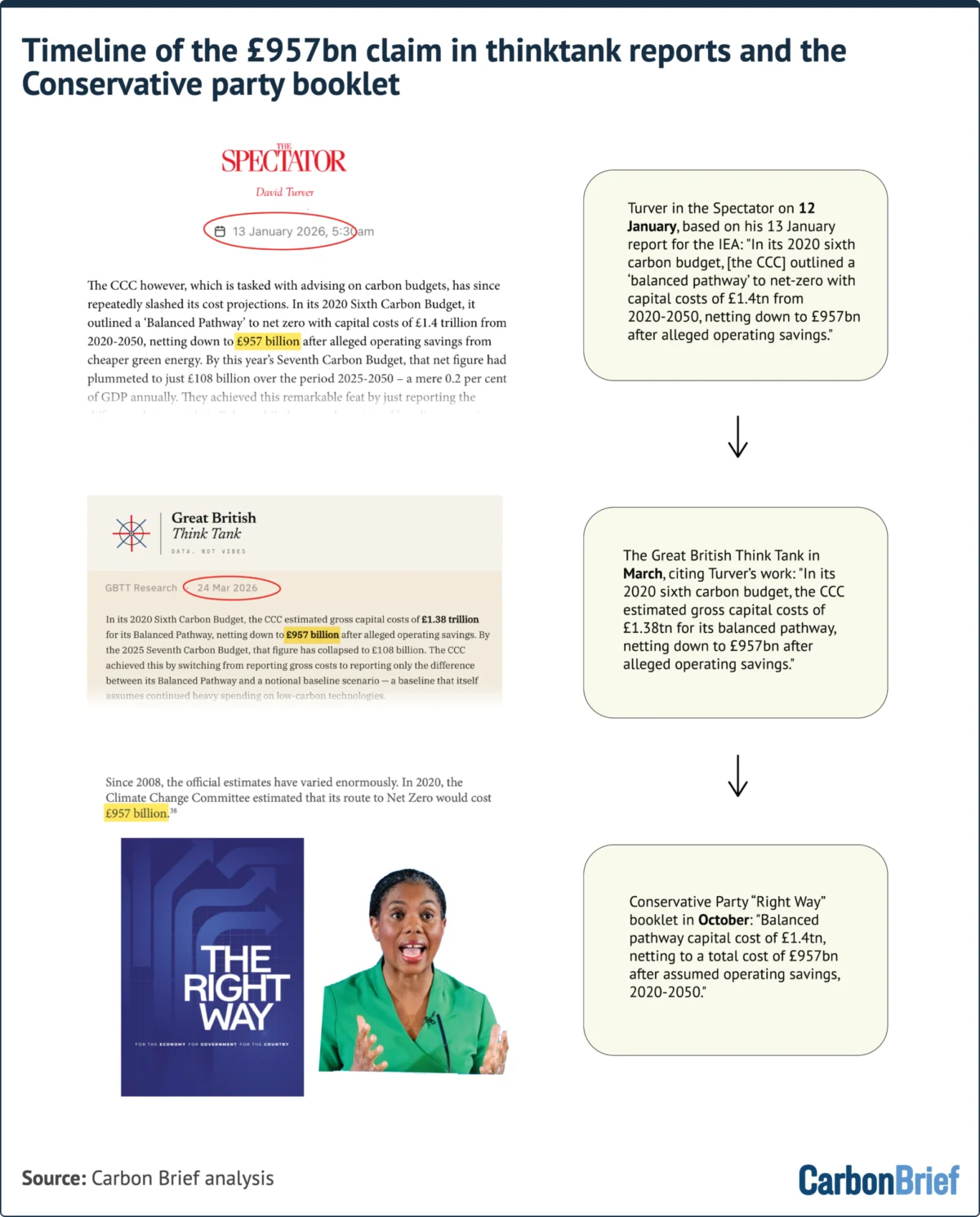
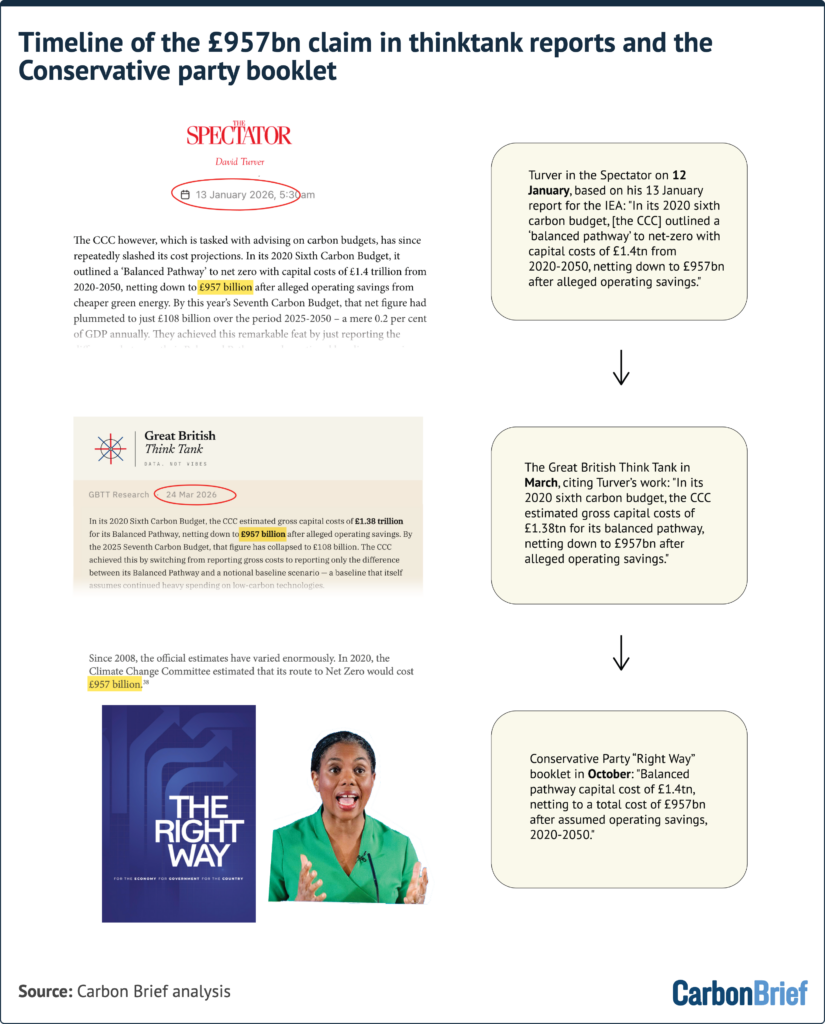
The earliest online appearance of the inflated £957 billion figure can be traced to January 12, 2026. David Turver, a retired engineer who describes himself as an "accidental energy analyst," published an article in The Spectator citing this figure as the official cost of the UK’s climate goals. Turver’s work was quickly picked up and amplified by the Institute of Economic Affairs (IEA), a prominent free-market think tank, which published a report just a day later using the same erroneous data.
The Echo Chamber Effect
Once the number entered the public domain via reputable-sounding think tanks, it gained a veneer of legitimacy. In March 2026, the "Great British Think Tank"—an organization that explicitly markets its work with the tagline "data, not vibes"—repeated the £957 billion claim. By relying on secondary sources rather than verifying the primary CCC spreadsheet, these organizations created an information loop.
The Political Endorsement
The final stage of this misinformation cycle occurred in October 2026, when the Conservative Party incorporated the figure directly into The Right Way. By including it in a formal policy document, the Party effectively laundered a calculation error into a foundational political claim, using it to disparage the "sophisticated modelling" of official climate advisers in favor of their own brand of "political judgement."
Supporting Data: What the Experts Actually Said
The irony of the Conservative Party’s document is that it mocks the very modelling that, if read correctly, provides a much more optimistic outlook for the UK economy.
When the CCC released its 2020 report, it explicitly stated that the £478 billion cost represented less than 1% of the UK’s GDP over three decades. Furthermore, the committee noted that the massive capital investment required would actually act as a stimulus, potentially boosting GDP by around 2% due to savings from reduced fossil-fuel reliance and the development of new green industries.
Since 2020, the data has become even more favorable. In 2025, the CCC published a major revision to its cost estimates. As the price of electric vehicles plummeted and energy efficiency technology matured, the projected cost dropped significantly to £108 billion—a mere 0.2% of GDP. In its most recent briefings, the committee has suggested that the cost of achieving Net Zero is now lower than the cost of a single fossil-fuel price shock, emphasizing that the benefits of the transition—amounting to roughly £110 billion per year—far outweigh the initial expenditure.
Official Responses and the "Zombie Stat" Phenomenon
The persistent life of the £957 billion figure illustrates the "Zombie Statistic" phenomenon: a piece of data that is killed by facts but continues to walk among the living because it serves a convenient political narrative.
When contacted for comment, the Climate Change Committee reiterated that its 2020 advice never contained the £957 billion figure and that its subsequent reports have provided transparent, updated data. However, for political parties and advocacy groups, the "high cost" narrative is often more valuable than the "low cost" reality.
Critics of the Conservative Party have pointed out that the reliance on such a demonstrably false figure undermines the party’s own stated goal of being "competent enough to solve the problems for which it takes responsibility." If a party cannot correctly read a primary spreadsheet from an official government body, observers ask, can they be trusted to manage the complex economic realities of a national energy transition?
Broader Implications: The Cost of Climate Skepticism
The fallout from this incident extends beyond a simple apology or a corrigendum in a pamphlet. It touches upon the integrity of the national debate regarding climate policy. When economic data is manipulated—whether through malice or incompetence—it creates a distorted public perception of what is achievable.

The Distrust in Expertise
By attacking "sophisticated modelling" and substituting it with "political judgement," the The Right Way document taps into a broader populist trend of distrusting technocratic institutions. While political judgment is indeed essential, it must be informed by accurate data. When the data is wrong, the judgment becomes fundamentally flawed.
Distorting the Public Interest
The public is currently grappling with high electricity bills and the challenges of the energy transition. By presenting inflated costs, political actors may be dissuading the public from supporting policies that could, in the long run, lower their household bills. Recent analysis has shown that expensive fossil fuels are responsible for nearly 90% of the recent rise in UK electricity bills. By framing the transition to renewables as an exorbitant, nearly trillion-pound burden, the Conservative Party is effectively steering the public away from the very policies that could provide relief from price volatility.
The Necessity of Rigor
The incident highlights an urgent need for higher standards of data verification in political policy-making. As the UK continues its path toward 2050, the decisions made will be some of the most expensive and consequential in the nation’s history. If policy is to be based on "common sense," that sense must be grounded in reality, not in the products of broken spreadsheets.
Conclusion: A Lesson for Future Policy
The error in The Right Way serves as a cautionary tale for all political actors. In an era where information travels instantly, the responsibility to verify data has never been higher. The Conservative Party’s failure to perform a basic check on the CCC’s 2020 spreadsheet is not merely an arithmetic mistake; it is a failure of institutional process.
Moving forward, the debate on Net Zero must return to the facts. The evidence suggests that the transition is not a reckless gamble with the nation’s finances, but a necessary and economically viable evolution. As the UK moves into the next decade of climate action, the focus should be on the tangible, updated figures—such as the plummeting costs of electric vehicles and the long-term benefits of energy security—rather than recycled, double-counted figures from years past.
The path to 2050 is complex enough without the weight of artificial costs. It is time for political discourse to shed the "zombie statistics" and engage with the reality of the economic transition, ensuring that voters are presented with the truth rather than the products of a spreadsheet malfunction. For the Conservative Party, the challenge now is to address this inaccuracy head-on and restore credibility to their economic platform—a task that requires far more than just a new calculation.


 Suro Senen

 Pevita Pearce

 Iffa Jayyana

 Basiran

 Azzam Bilal Chamdy

 Nila Kartika Wati
