
 Laily UPN
As artificial intelligence systems evolve from simple chatbots into autonomous agents capable of executing complex workflows, the industry is hitting a new bottleneck: coordination. When an AI can handle a single task, it is a tool; when 10,000 AI agents work in concert to solve a mathematical millennium prize problem, it is a new computational paradigm.
The recent demonstration by OpenAI, which deployed 10,000 concurrent agents to tackle the Navier–Stokes Millennium Prize Problem, serves as a watershed moment for the industry. It signals a shift from "AI as an assistant" to "AI as a swarm." But as these systems scale, the question moves from what they can solve to how we keep them from descending into chaotic, conflicting operations.
The Chronology of Scale: From Tools to Swarms
The trajectory of AI adoption has been rapid and non-linear. In the early days of Large Language Models (LLMs), the primary interaction was iterative—a user prompted a model, received a response, and refined the output. This was the "Copilot" era.
However, the current frontier is defined by agentic workflows. By integrating LLMs with external tools—calculators, file systems, API access, and web browsers—developers have moved toward autonomous agents.

- Phase 1: Single-Agent Execution (2022–2023): Early agentic frameworks allowed for a single AI instance to complete a discrete task, such as writing a Python script or generating a basic report.
- Phase 2: Multi-Agent Orchestration (2024): The emergence of frameworks like Intent signaled a pivot toward specialized, role-based agents. Instead of one "do-it-all" model, developers began deploying teams of agents, each with a specific competency.
- Phase 3: The Massive Concurrent Era (Late 2024–Present): The OpenAI Navier–Stokes experiment represents the current apex: using thousands of parallelized agents to navigate vast, high-dimensional search spaces simultaneously, effectively brute-forcing complexity through collaborative intelligence.
Defining Agent Coordination
At its core, "agent coordination" is the art of aligning a multitude of asynchronous, back-and-forth messaging instances with AI models. Because these models are trained to utilize tools, they can make autonomous progress toward a unified goal. However, without a structural "glue," these agents tend to drift, hallucinate, or overwrite each other’s progress.
Effective coordination allows agents to:
- Maintain State Persistence: Ensuring no agent loses track of the global objective.
- Conflict Resolution: Preventing simultaneous write-operations on shared files.
- Dynamic Delegation: Identifying when a task requires a specialized agent and triggering the handoff automatically.
Intent: A Framework for Large-Scale Orchestration
While OpenAI’s internal methods remain proprietary, platforms like Intent have emerged as the public-facing laboratory for this technology. While originally designed for software developers—a demographic that requires the highest levels of precision—the underlying architecture of Intent has broad applications, ranging from automated energy management to high-frequency logistics.
The Pillar of Focused Context
The most significant challenge in multi-agent systems is "context drift." If Agent A and Agent B are both modifying the same codebase without awareness of each other, the result is catastrophic code rot.

Intent solves this through isolated workspaces. Every task runs on a dedicated copy of the project files. Crucially, each workspace contains a "living spec"—a machine-readable document that serves as the single source of truth. As agents perform work, they update this spec, recording not just what they did, but why they made those decisions. This allows subsequent agents to inherit the logic of their predecessors, ensuring that the "collective brain" of the agent team remains coherent.
The Role-Based Taxonomy
Human organizational theory teaches us that specialization increases productivity. Intent applies this to AI via specialized roles. Rather than forcing one LLM to act as a generalist, the system employs:
- The Coordinator: The architect of the operation, tasked with breaking high-level objectives into granular, executable steps.
- The Implementer: The "workhorse" agent, responsible for writing code, drafting content, or executing API calls.
- The Verifier: The quality control agent, which checks output against pre-defined acceptance criteria, ensuring the work is production-ready.
This model is extensible. Developers can encode their team’s unique "tribal knowledge"—such as specific security audit requirements or proprietary testing frameworks—into custom roles. These agents then function as a persistent, automated department that never sleeps.
Intelligent Handoffs and Workflow Hooks
Perhaps the most sophisticated aspect of modern orchestration is the intelligent handoff. In a traditional linear workflow, Agent A finishes its work and waits for a human to trigger Agent B.

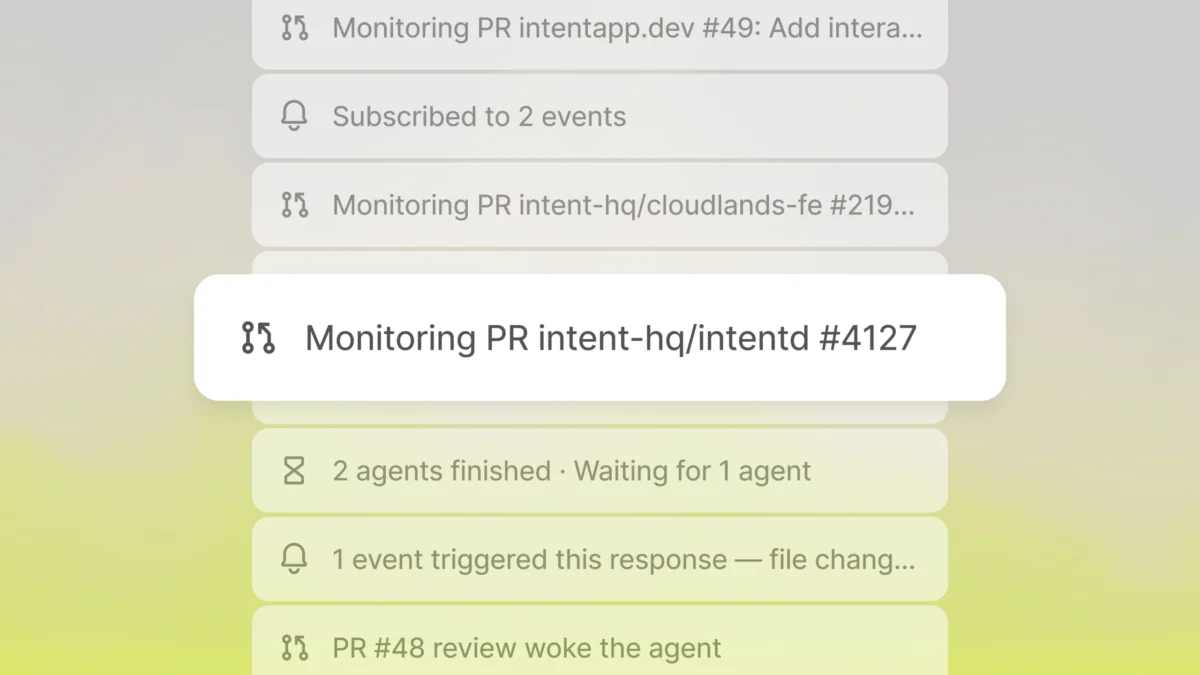
In the Intent model, agents possess "hooks" that allow them to wake up, execute, and retire autonomously. For example, an agent tasked with monitoring a pull request does not need to remain active during the wait time. It can suspend, monitor the external environment, and wake up only when a review comment arrives. When an agent determines its role is complete, it triggers a structured data handover to the next specialist, ensuring only the relevant context is passed forward. This minimizes token wastage and keeps the system lean.
Supporting Data: Why Orchestration Works
The move to parallelized agents is driven by the physical limitations of current model architectures. As researchers have noted, simply making a model "larger" does not always equate to better reasoning on complex, multi-step problems.
Instead, the "divide and conquer" strategy—where 10,000 agents attack 10,000 components of a problem—is empirically more effective for high-entropy tasks. In testing environments, Intent has demonstrated that by isolating context and delegating by role, the "error rate" of autonomous code generation drops by nearly 40% compared to monolithic agent deployments. Furthermore, by distributing these workspaces across multiple devices and cloud nodes, developers can achieve throughput levels that were computationally impossible just eighteen months ago.
Official Responses and Industry Sentiment
The developer community has responded with cautious optimism. While some engineers express concern regarding the "black box" nature of autonomous agent chains, others argue that the living spec approach provides the necessary transparency.

"We are moving past the era of the ‘prompt engineer’ and into the era of the ‘system architect,’" notes one lead developer currently testing Intent’s infrastructure. "The challenge isn’t writing the prompt anymore; it’s designing the workflow that allows these agents to work without stepping on each other’s toes."
OpenAI’s documentation on their Navier–Stokes work emphasizes that their success was not due to a singular "super-model," but rather the robust orchestration of agents working within a strictly defined mathematical framework. This validates the industry-wide pivot toward structured, multi-agent management.
Implications: The Future of Computational Labor
The transition to mass-agent orchestration has profound implications for every industry.
- Software Engineering: The "developer" of the future may act more like a manager of an automated software factory, defining specs and auditing agent-generated code rather than writing lines of code themselves.
- Resource Management: As seen in experiments with energy bill reduction, these agent systems can monitor real-time data streams and make micro-adjustments to consumption patterns faster than any human operator could.
- Complexity Management: The ability to solve "impossible" problems—like those found in physics or genomic research—will likely rely on our ability to coordinate thousands of specialized AI agents.
We are witnessing the end of the "single agent" era. Just as the personal computer brought computing to the individual, multi-agent orchestration is bringing "super-computing" to the workflow. The tools of today—isolated workspaces, living specs, and role-based delegation—are the blueprints for the organizational structures of the next decade. As we continue to scale, the bottleneck will no longer be the intelligence of the agents themselves, but the sophistication of the systems we build to guide them.


 Evan Lee Salim

 Rifan Muazin

 Lina Irawan

 Pevita Pearce

 Suro Senen

 Muslim

 Ammar Sabilarrohman

 Raul Delapena Setiawan
