
 Rifan Muazin

For years, the quarterly shareholder letters from Aaron Graft, CEO of Triumph Financial (NYSE: TFIN), have served as more than mere fiscal disclosures. They have functioned as a manifesto for a company attempting to reshape the plumbing of the American trucking industry. In his latest correspondence, a subtle shift in tone was palpable—a sense that the grueling, multi-year phase of capital expenditure is yielding to the promise of a victory lap.
While Triumph remains, at its technical core, a bank, its strategic evolution has been anything but conventional. Graft has spent years steering the organization toward becoming the preeminent supplier of financial support services for the trucking sector, catering to everyone from massive fleets to independent owner-operators. With the release of its third-quarter earnings, the company is finally providing the empirical proof that its long-term bet is beginning to pay off.
The Strategic Blueprint: Building the "Triumph Ecosystem"
Triumph Financial’s strategy has been defined by an aggressive expansion of its service portfolio, transforming from a traditional factoring firm into a comprehensive financial operating system for freight. This transition has been methodical and, at times, expensive.
Chronology of Expansion
- The Factoring Foundation: Historically, Triumph’s core business was invoice factoring—the process of buying accounts receivable from carriers to provide immediate liquidity.
- The Payments Pivot (2021): The acquisition of HubTran was a watershed moment. By integrating HubTran’s automation technology, Triumph began building a sophisticated payments system capable of processing invoices with unprecedented efficiency.
- Intelligence and Data (2023): The acquisition of Green Sheets provided the company with deep-market intelligence, allowing Triumph to offer data-backed insights to its clients.
- LoadPay Launch (2024): The introduction of LoadPay created a digital wallet for drivers and small fleets, closing the loop on the payment experience and addressing the chronic industry pain point of slow payments.
This multi-year effort has not been without friction. For investors, the journey has been turbulent, with TFIN stock down approximately 43.5% over the last five years. The market’s skepticism was largely driven by the compression of profitability caused by heavy reinvestment. However, the third-quarter report suggests that the "investment trough" is behind the company.
North Star Metrics: Validating the Vision
Two quarters ago, Triumph introduced a set of "North Star Metrics" to provide shareholders with a clear lens through which to evaluate progress. In the third quarter, these metrics demonstrated that the company’s internal infrastructure is not just functional, but increasingly scalable.
The significance of these metrics lies in their focus on operational efficiency rather than just gross revenue. By prioritizing the reduction of costs to service an invoice—which fell by roughly 20% in the last year—Triumph has demonstrated that its technology stack is effectively stripping friction out of the freight payment process.
"We told investors we would invest through the freight cycle, and we did exactly that," Graft wrote in his letter. "Not everyone agreed with the strategy, but we were true to our word."
Navigating the Inflationary Landscape: Diesel and Invoice Sensitivity
A recurring theme in Graft’s analysis is the impact of macroeconomic variables, particularly the volatile price of diesel, on the company’s bottom line. The relationship between fuel costs and invoice sizes is complex, as it hinges on carrier-specific fuel surcharge formulas and the broader inflationary pressures currently affecting the logistics industry.
The Impact of Macro-Headwinds
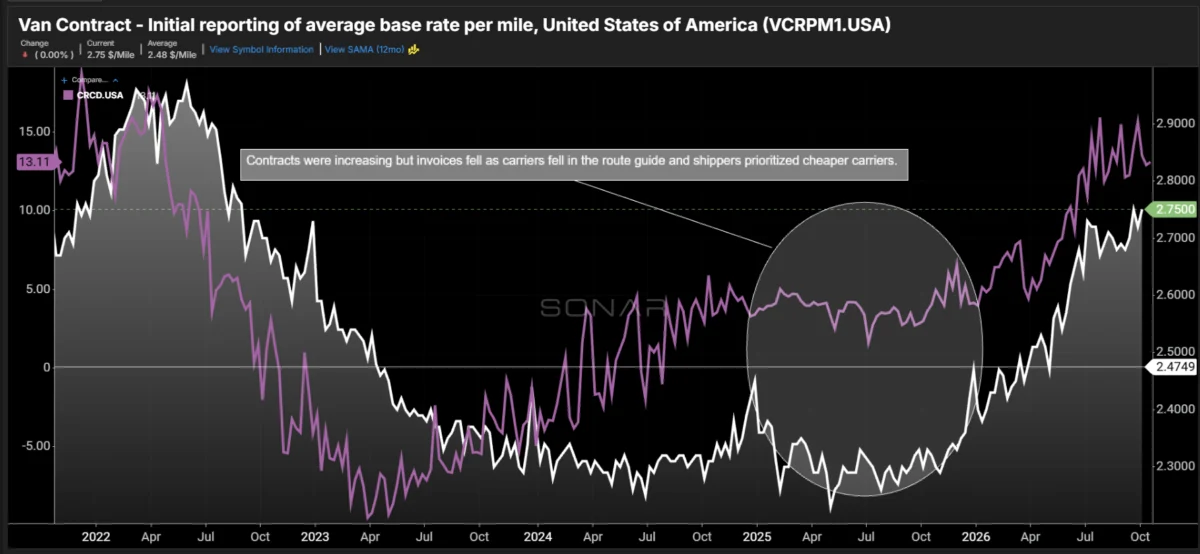
Graft highlighted a stark divergence: while dry van revenue grew by 40% year-on-year, diesel costs—measured at the pump—surged by 67%. Furthermore, driver costs have escalated to approximately 70 cents per mile. When combined with rising insurance premiums, elevated interest rates, and equipment financing costs, the environment for the average trucker is undeniably inflationary.
The implication for Triumph is significant. As the cost of operations rises, the average invoice size must increase to compensate. Graft noted that "the revenue per mile a trucker must generate and thus the average invoice size is almost certainly going to be double-digit percentages above historical norms until market forces change."
The Revenue Sensitivity Model
Graft provided a clear, if sobering, benchmark for investors: for every $100 increase in the average invoice price, Triumph expects to generate roughly $12 million in incremental annual revenue, $8.5 million in pretax earnings, and 27 cents in earnings per share. Conversely, he reminded stakeholders that "the inverse is also true when invoice sizes decline," underscoring the company’s exposure to the cyclicality of the freight market.
The Resurgence of Factoring: A Strategic Gateway
While the market has been enamored with the "Payments" sector, Graft used the third-quarter letter to re-emphasize the importance of the factoring business. Far from being a legacy burden, factoring serves as the "principal carrier-acquisition gateway."
Triumph currently services approximately 8,000 of the 90,000 "factored carriers" in the U.S., with a net growth rate of 78 new clients per month. This acquisition engine is the catalyst for cross-selling the rest of the Triumph suite.
"When we win a factoring relationship, we have an opportunity to serve that carrier through LoadPay, equipment finance, insurance, fuel, and Intelligence," Graft explained. "The economic value of Factoring therefore extends beyond the margin earned on an individual receivable. That broader relationship is one reason renewed growth in this business remains a strategic priority."
This synergy model suggests that Triumph is building a "moat" around its clients. By becoming the primary financial utility for a carrier, Triumph increases switching costs and deepens its revenue potential per customer, effectively transforming a commodity financial product (factoring) into a platform-based ecosystem.
Implications: Translating Potential into Performance
As Triumph Financial moves into the final quarter of the fiscal year, the narrative has shifted from what they are building to how they will monetize it. The transition from capital-intensive development to earnings performance is the company’s next major milestone.
What Lies Ahead
- Earnings Consistency: The company’s stated goal is to "translate that potential into earnings performance consistent with our historical results and beyond."
- Margin Expansion: With the 20% reduction in invoice servicing costs, Triumph is positioned to see significant margin expansion if freight volumes stabilize or grow.
- Market Leadership: By continuing to capture market share among the 90,000 factored carriers, Triumph is positioning itself to become the standard-bearer for financial technology in the trucking space.
The skepticism that haunted TFIN for the past five years is being replaced by the cold, hard data of a business model that is finally hitting its stride. While macroeconomic volatility remains a constant threat—as evidenced by the unpredictability of diesel prices and freight demand—Triumph Financial has successfully built the infrastructure required to navigate these storms.
For Aaron Graft, the message to investors is clear: the era of "building" is concluding, and the era of "returning value" has begun. Whether the market rewards this transition with a re-rating of the stock remains to be seen, but the fundamental argument for Triumph’s relevance in the modern logistics economy has never been stronger. As the company continues to leverage its factoring gateway to drive adoption of its payments and intelligence services, it remains a critical entity to watch for anyone invested in the future of freight finance.

 Evan Lee Salim

 Jia Lissa


 Nana
 Asep Darmawan

 Asro

 Nila Kartika Wati

 Muslim
