
 Siti Muinah
In an ongoing effort to distinguish itself from the chaotic landscape of modern social media, Meta’s Threads has officially launched "Gems," a new recognition feature designed to spotlight high-value content. By identifying and awarding posts—and direct replies—that foster meaningful discussion, Threads is attempting to steer its algorithmic focus away from mere viral reach toward the quality of human connection. As the platform matures, this move signals a broader shift in how Meta intends to manage its ecosystem: by gamifying positive engagement and rewarding users who contribute positively to the "town square."
The Mechanics of Gems: How It Works
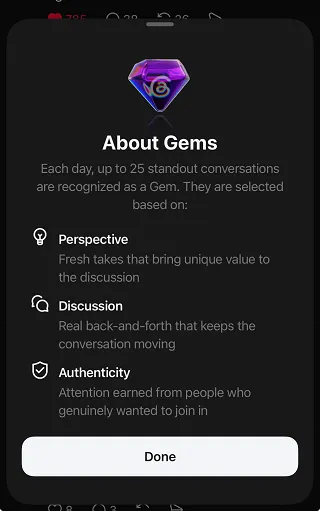
The concept of "Gems" is fundamentally algorithmic. Rather than relying on human moderators to manually select the most insightful content, Meta has implemented a systematic detection process. This automated infrastructure evaluates posts based on their ability to spark conversation and provide value.
When a post is tagged as a "Threads Gem," the creator receives an immediate notification. The user is then presented with the option to share a dedicated post acknowledging the achievement, essentially allowing the creator to wear the recognition as a badge of honor. Meta has confirmed that users maintain agency over this process; if a creator prefers not to be recognized, they have the option to decline the designation.
To keep the user experience clean, Gems are visually represented by a unique icon that appears in-stream. This icon serves as a signal to other users, denoting the content as a "key engagement driver." Crucially, the program is currently limited to public posts and direct replies to original posts; it does not extend to "replies-to-replies," maintaining a focus on primary discourse rather than buried side-conversations.
A Chronology of the Development
The road to the official launch of Gems has been a deliberate, iterative process.

- August 2024: The first hints of the feature surfaced when app researcher Alessandro Paluzzi shared leaked screenshots of the notification interface. These early images provided the public with its first look at what would eventually become the Gems dashboard.
- Late 2024: Internal testing expanded as Meta refined the algorithms responsible for identifying "valuable" content, moving away from purely quantitative metrics (like likes and shares) toward qualitative sentiment analysis.
- December 2024: Meta officially rolled out the feature, initially restricting eligibility to users located within the United States.
- The Future Roadmap: As of today, Threads has not provided a concrete timeline for a global rollout, though the restriction to U.S. users is standard practice for Meta’s early-stage feature launches as they calibrate for cultural nuances and linguistic variations in sentiment detection.
The Algorithmic Challenge: Can Machines Define "Meaningful"?
At the heart of the Gems initiative lies a significant technical hurdle: defining "meaningful." Traditionally, social media algorithms have prioritized "engagement," which often acts as a euphemism for polarizing content. Algorithms are notoriously efficient at identifying conflict, as anger and controversy reliably trigger high volumes of replies.
By shifting the focus to "Gems," Meta is attempting to train its AI to distinguish between constructive dialogue and inflammatory bait. This requires sophisticated natural language processing (NLP) that can weigh the tone, vocabulary, and thread structure of a conversation. If successful, this could mark a paradigm shift in how social platforms rank content. If it fails, Meta risks a scenario where the algorithm inadvertently rewards "high-engagement" arguments that are technically meaningful but ultimately toxic.
Meta has suggested that a combination of factors will weigh into the selection process, though the specific criteria remain proprietary. Industry observers suggest that factors such as the "depth" of replies, the diversity of the participants, and the absence of inflammatory keyword clusters are likely key variables in the detection model.
Comparison: The "Banger" Legacy
The introduction of Gems inevitably invites comparisons to X’s (formerly Twitter) "Bangers" experiment in 2025. During that period, X experimented with a dedicated account designed to amplify the most engaging posts on the platform. However, the X initiative was largely viewed as a fleeting experiment, lacking a permanent, integrated feature set.
Threads appears to be taking a more robust approach by baking the recognition directly into the user interface. While X relied on manual or semi-automated editorial curation that fizzled out after a single month, Threads is betting on a scalable, automated system. The success of this approach will depend on consistency; if the Gems program feels sporadic or mysterious, users may disregard it. If it remains a reliable, consistent presence, it could become a primary driver of retention for high-value content creators who feel marginalized by other, more chaotic platforms.

Implications for Content Strategy
For the creator economy, the introduction of Gems changes the stakes of posting. Previously, the primary goal was to maximize visibility through hashtags and high-frequency posting. Now, there is a tangible incentive to foster a comment section that is substantive.
Potential Benefits
- Incentivized Quality: Creators are now incentivized to write posts that encourage thoughtful responses rather than one-word reactions.
- Platform Health: By surfacing high-value content, Threads effectively filters the noise for the average user, creating a more pleasant browsing experience.
- Creator Motivation: The "Gem" badge provides a psychological reward, reinforcing the behavior of high-value contributors.
Potential Risks
- The "Vetting" Dilemma: The biggest risk is the potential for the algorithm to surface content that is technically engaging but socially or ethically problematic. Meta has acknowledged that while the process is automated, the potential for error exists. The company is expected to implement a layer of human-in-the-loop oversight to ensure that Gems do not highlight hate speech or harassment.
- The "Echo Chamber" Effect: If the algorithm only rewards posts that follow a specific "meaningful" template, it could inadvertently homogenize the type of content that succeeds on the platform, discouraging unconventional but valuable perspectives.
The Role of Human Vetting
While Meta has touted the automation of the Gems process, industry analysts emphasize that full reliance on AI for content moderation is historically fraught with difficulty. The nuance of human language—sarcasm, irony, and cultural context—often evades even the most advanced models.
To prevent a public relations crisis, Meta will likely need to employ a hybrid system. Under this model, the algorithm acts as the first filter, identifying high-engagement content, while a secondary, human-led verification layer checks for policy compliance before the "Gem" badge is officially applied. This adds a layer of operational cost to the feature, but it is a necessary investment if Meta wants to maintain the "safety and kindness" brand identity that it has cultivated for Threads since its inception.
A Strategic Pivot for Meta
Threads is currently operating in a unique space. As X continues to lean into a more combative and unfiltered environment, Threads is positioning itself as the "kinder" alternative. The Gems program is a manifestation of this strategy. By rewarding positive discourse, Meta is not just building a feature; it is building a community standard.
However, the question remains: will users actually care? In the early days of social media, digital badges and "top contributor" statuses were highly coveted. In today’s oversaturated market, users are more cynical. For Gems to be truly effective, they must provide more than just a digital icon. Many are speculating that Meta might eventually tie Gems to broader platform benefits, such as increased reach in the "For You" feed or even potential monetization opportunities.
Conclusion: The Path Forward
The launch of Gems is a bold, if risky, step toward algorithmic curation. It reflects a sophisticated understanding that the future of social media is not just about the volume of content, but the quality of the interactions that content generates.
As the program expands beyond the United States and the algorithm is refined through real-world usage, the industry will be watching closely. If Meta succeeds, Gems could become the gold standard for rewarding positive online behavior. If it fails, it will serve as another cautionary tale about the limits of artificial intelligence in defining the complex, messy, and deeply human art of conversation. For now, the "Threads Gem" represents a hopeful experiment—a way to find the diamonds in the rough that is the modern internet.

 Asep Darmawan
 Rifan Muazin
 Laily UPN
 Iffa Jayyana

 Suro Senen
 Lina Hope
 Lina Irawan