
 Lina Irawan
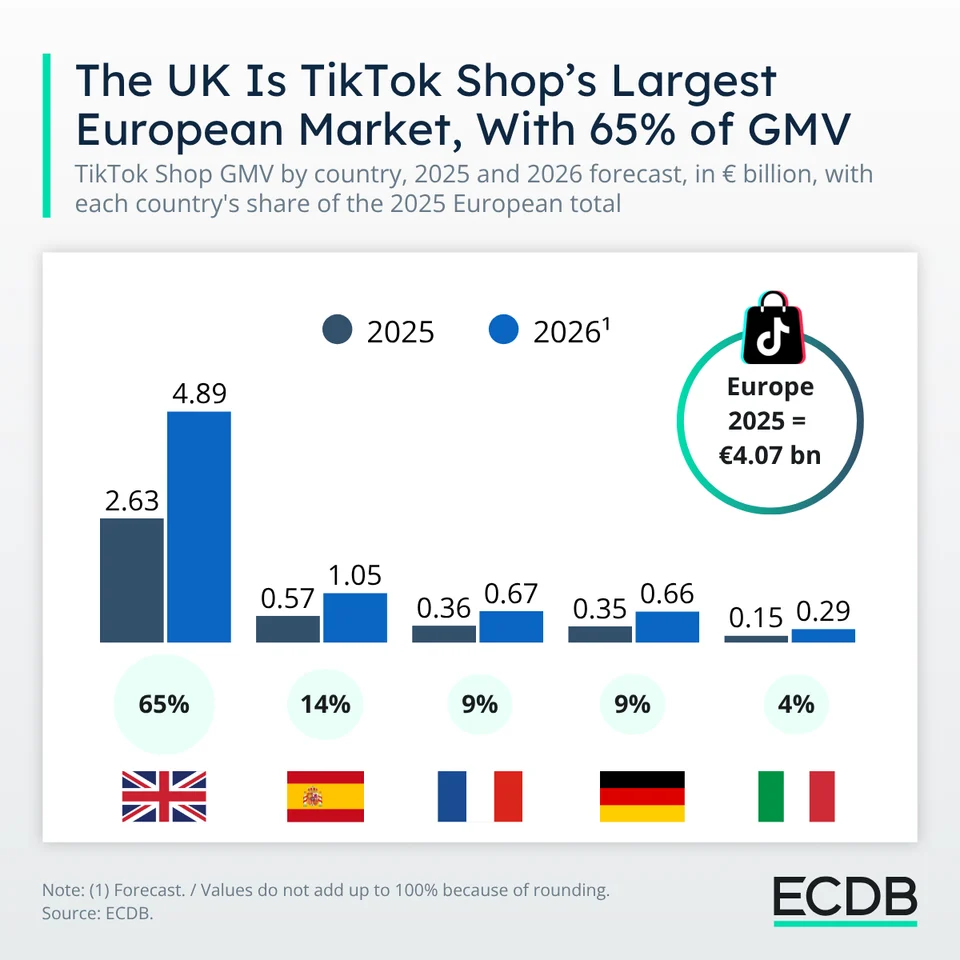
The convergence of entertainment and retail has reached a fever pitch in Europe, with TikTok Shop cementing its position as a formidable force in the continent’s digital economy. According to fresh data from the German ecommerce analytics provider ECDB, the platform is not merely growing; it is fundamentally altering consumer behavior across European borders. While TikTok Shop is expanding its footprint rapidly, the United Kingdom remains the undisputed engine of this growth, generating a massive portion of the platform’s total European Gross Merchandise Value (GMV).
As the platform transitions from a niche social media experiment into a pan-European marketplace, stakeholders are closely watching how this "shoppertainment" model scales. With projected GMV figures for the UK approaching 5 billion euros this year, the platform has moved well beyond its initial trial phase, proving that social commerce is no longer a peripheral trend but a central pillar of modern retail.
The Core Facts: A Market in Hyper-Growth
The data provided by ECDB paints a clear picture: TikTok Shop is experiencing a trajectory that most traditional ecommerce platforms took decades to achieve. The United Kingdom, having served as the pilot market since 2021, acts as the primary barometer for the platform’s success.
Last year, the UK accounted for a staggering 65% of all European spending on TikTok Shop, netting a GMV of 2.63 billion euros. This dominance is bolstered by an ecosystem of over 300,000 British small-to-medium enterprises (SMEs) that have integrated their operations directly into the TikTok interface. By leveraging the platform’s algorithm to push products directly to users as they consume short-form video content, these businesses have successfully bypassed the traditional customer acquisition funnel.
Looking toward the remainder of 2025, the outlook remains bullish. Analysts expect the UK’s GMV to nearly double, pushing toward the 5-billion-euro mark. This growth is not isolated to the UK; it is reflected across the entire European portfolio, suggesting that as the "shoppertainment" flywheel spins faster, the platform’s ability to convert viewers into buyers is increasing exponentially.
Chronology: The Evolution of a Pan-European Giant
TikTok Shop’s entry into Europe was calculated, strategic, and remarkably rapid. The following timeline outlines the key milestones that have led to the current state of the platform:
- 2021: The UK Beta Launch. TikTok officially introduces the shopping feature in the United Kingdom, utilizing the market as a high-spending testbed to refine logistics, influencer partnerships, and user interface design.
- Late 2024: Strategic Expansion. Recognizing the appetite for social commerce in Southern Europe, TikTok Shop launches in Spain and Ireland. This move signaled a shift from testing to scaling.
- March 2025: The Triple Launch. A major turning point occurs as the platform simultaneously opens its doors in France, Germany, and Italy. These markets immediately began contributing to the total European GMV, albeit at lower levels than the UK.
- June 2025: Benelux, Poland, and Austria. The platform expands into the Netherlands, Belgium, Poland, and Austria, solidifying its status as a true pan-European marketplace.
- September 2025: The Cross-Border Pilot. On September 21, TikTok initiates a pilot program for cross-border sales between the EU and the UK, removing friction for merchants trying to reach consumers outside their domestic markets.
- October 2025: Broadened Rollout. Scheduled for October 19, the full rollout of cross-border capabilities marks the end of isolated national markets and the birth of a unified, transnational shopping experience.
Supporting Data: Comparative Market Performance
To understand the scale of the UK’s dominance, one must look at how other European nations compare. Despite being newer to the ecosystem, countries like Spain, France, and Germany are gaining traction, yet they remain in the shadow of the British market.
Market Share Breakdown (2024 Figures)
- United Kingdom: 65% share (2.63 billion euros)
- Spain: 14% share (570 million euros)
- France: 9% share (360 million euros)
- Germany: 9% share (350 million euros)
- Italy: 4% share (150 million euros)
The data reveals a "maturity gap." The UK, having benefited from four years of optimization, shows significantly higher conversion rates. However, the most compelling takeaway from the ECDB data is the growth rate prediction for 2025. Despite the disparity in how long the feature has been live, the platform is seeing near-universal doubling of GMV across all markets. This suggests that the "learning curve" for European consumers is shortening; users in France and Germany are adopting the shopping behavior at a much faster rate than the early UK adopters did in 2021.
Official Responses and Strategic Pivot: "Sell Across Europe"
TikTok’s leadership has been vocal about its ambition to create a seamless, borderless shopping experience. The introduction of the "Sell Across Europe" initiative is the company’s definitive answer to the fragmented nature of the European retail landscape.

By enabling merchants to reach consumers in twelve different countries through a single interface, TikTok is positioning itself as a competitor not just to Instagram or Pinterest, but to global giants like Amazon and Zalando. The company has focused heavily on the logistics and compliance hurdles inherent in EU trade, with the new cross-border pilot between the EU and the UK being the most significant logistical update to date.
Industry experts note that by removing the barriers for cross-border trade, TikTok is effectively creating a single market for social commerce. This allows a boutique fashion brand in Italy, for example, to broadcast its products to a massive audience in the UK or Poland without having to establish local legal entities or disparate warehouse operations in every jurisdiction.
Implications: The Future of the Retail Landscape
The meteoric rise of TikTok Shop carries profound implications for the traditional retail sector, digital advertising, and the creator economy.
1. The Death of the "Click-Through" Funnel
For years, social media marketing relied on a multi-step process: see the ad, click the link, load a browser, add to cart, and checkout. TikTok Shop collapses this into a one-tap experience within the app. This friction-less journey is forcing traditional e-commerce players to rethink their mobile strategies. If they cannot provide an equally seamless experience, they risk losing market share to the "in-stream" shopping environment.
2. The Rise of the "Creator-Merchant"
The barrier to entry for brands has been lowered significantly. Small businesses no longer need massive advertising budgets to reach an audience; they need high-quality, authentic video content. This shift is empowering a new class of creator-merchants who use their personality to drive sales, turning the influencer marketing model into a direct-sales model.
3. Challenges and Regulatory Scrutiny
With such rapid growth comes significant responsibility. As TikTok Shop handles larger transaction volumes and personal data, it faces increasing scrutiny from European regulators regarding consumer protection, product safety, and data privacy. The platform’s ability to navigate the Digital Services Act (DSA) and other regional regulations will be the primary limiting factor in its continued expansion.
4. Pressure on Traditional Retailers
Physical retailers and legacy e-commerce sites are feeling the heat. As younger demographics shift their spending toward social platforms, the "discovery" phase of shopping is moving away from Google Search and toward TikTok’s "For You" page. Retailers who fail to establish a presence on these platforms risk becoming invisible to Gen Z and Alpha consumers.
Conclusion: The Path Ahead
As we look toward the end of 2025, the trajectory of TikTok Shop is clear: it is evolving from a viral video app into a comprehensive retail ecosystem. The United Kingdom’s lead is a testament to the power of early adoption, but the rapid acceleration in the EU suggests that the platform is finding its footing on a continental scale.
The upcoming months, defined by the expansion of the "Sell Across Europe" program and the integration of cross-border commerce, will be the true test for the platform. If TikTok can maintain this growth without sacrificing user experience or regulatory compliance, it will undoubtedly become the dominant force in European retail, forcing every competitor to adapt to the new reality of social-first commerce. The data is definitive: the store of the future is not on a high street or a static website—it is in the palm of our hands, served in sixty-second clips.


 Asro

 Muslim

 Ammar Sabilarrohman

 Asep Darmawan

 Layla Zulfa

 Nila Kartika Wati
