
 Dwi Wanna
By Staff Reporter
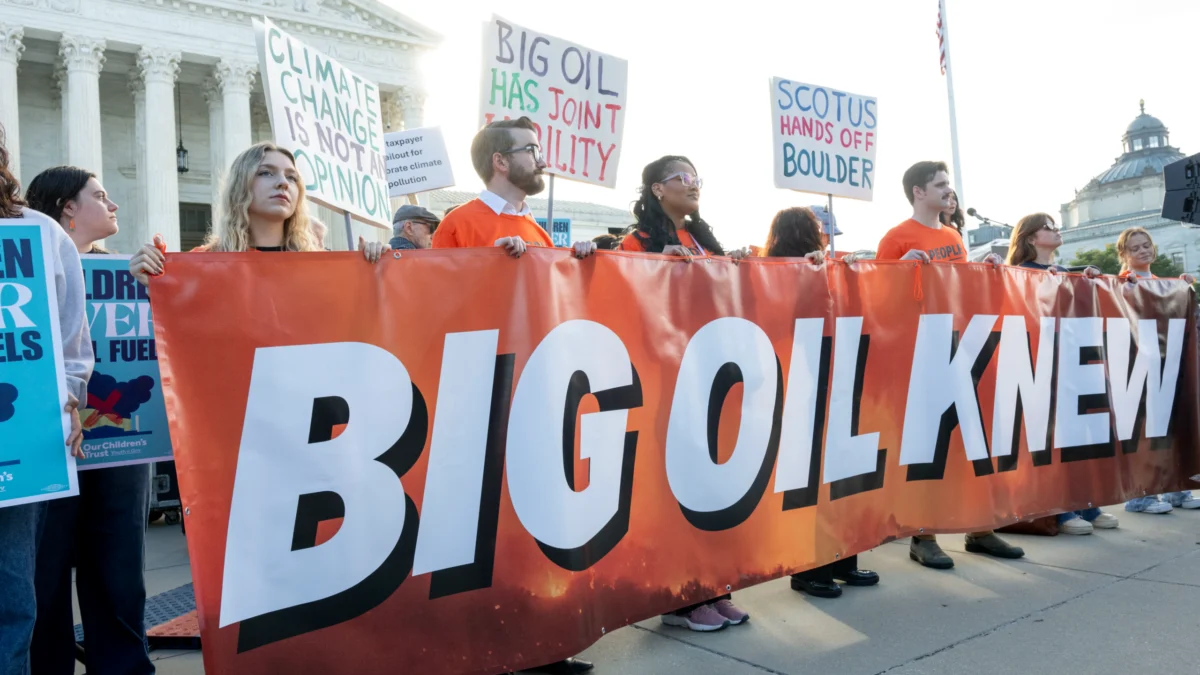
As autumn leaves began to turn in the nation’s capital, the marble steps of the United States Supreme Court became the stage for a dramatic intersection of judicial procedure and human suffering. On Monday, October 5, 2026, while the nine justices inside weighed the fate of a landmark climate liability lawsuit, a coalition of disaster survivors, farmers, and climate advocates stood outside in a unified display of defiance.
The case at hand, Suncor Energy v. Boulder, represents a critical juncture in American environmental law. At its core is a fundamental question: Can local governments hold multinational fossil fuel giants financially accountable for the localized destruction wrought by a warming planet?
The Main Facts: The Battle of Suncor v. Boulder
The litigation, which originated in 2018, finds the City and County of Boulder, Colorado, seeking damages from energy conglomerates Suncor and ExxonMobil. The core argument put forth by the plaintiffs is that these corporations engaged in a decades-long campaign of deception, willfully obscuring the known dangers of carbon emissions to protect their bottom lines.
Boulder’s legal team contends that the catastrophic climate-related events currently plaguing the region—including record-shattering heat waves, historic droughts, and devastating wildfires—are not merely acts of nature. Instead, they argue, these are the foreseeable, scientifically predicted consequences of fossil fuel production, exacerbated by a corporate strategy that prioritized profit over public safety.
The industry’s defense, currently being tested at the highest level, rests on the assertion that state courts lack the jurisdiction to hold global entities accountable for phenomena that are, by definition, global. They argue that the regulation of carbon emissions and the adjudication of climate harm are federal issues that exceed the scope of local municipal lawsuits. Should the Supreme Court rule in favor of the energy companies, it could effectively terminate this case and shutter dozens of similar state-level climate liability lawsuits currently pending across the country.
Chronology of a Crisis: From Deception to Destruction
The roots of this legal confrontation stretch back more than half a century. Internal documents and investigative journalism have long suggested that fossil fuel executives and their staff scientists were aware as early as the 1970s that the combustion of their products would lead to significant global temperature increases. Rather than pivot their business models or warn the public, critics allege these companies invested millions into campaigns designed to sow doubt about established climate science, effectively delaying the transition to renewable energy.
The current legal momentum in Colorado was catalyzed by the escalating physical reality of climate change. In 2021, the Marshall Fire decimated parts of Boulder County, displacing hundreds and destroying lives. Since then, the region has faced a cycle of drought and smoke-choked air that has made traditional agriculture increasingly difficult.
Following the 2018 filing by the City and County of Boulder, the case spent years winding through lower courts, with industry giants fighting every step of the way to move the litigation to federal courts—a move widely seen as an attempt to ensure the case would be dismissed or buried. The Supreme Court’s intervention now marks the final, decisive chapter in determining whether these suits will ever reach a jury.
Supporting Data: The Human and Economic Toll
The rally outside the Supreme Court was not merely a political demonstration; it was a testament to the visceral impact of climate-induced disasters.
Louie Delaware, a resident who lost his home in the 2021 Marshall Fire, spoke with a somber authority. For Delaware and the roughly 50 families on his street, the fire was not a theoretical risk—it was a life-altering event that left his family displaced for over two and a half years.
“No company or industry should gain an advantage by hiding facts that people need to protect their health, their communities, and their future,” Delaware told the crowd. “The bottom line is that they knew, they lied, and they must be accountable.”

The tragedy extended beyond Colorado. Zaire Calvin, who lost his sister, Evelyn McClendon, in the 2025 Eaton Fire in Altadena, California, brought a harrowing perspective to the gathering. “The Eaton Fire took my sister and eighteen other people,” Calvin said. “From Altadena to Boulder, we carry different stories. Today, we stand together in one demand: Let the evidence be heard.”
The economic ripple effects were further highlighted by the presence of regenerative cattle ranchers Deirdre Macnab and Dr. Kathryn Bedell from Rio Blanco County. Their testimony shifted the focus from urban disasters to the collapse of food security. Dr. Bedell, a sixth-generation rancher, revealed she has been forced to sell her herd due to the combined effects of extreme heat and drought.
“If you can’t grow food, we have to import it, and we won’t have any food security or control over the price,” Bedell warned. “People should be terrified. It terrifies me.”
Official Responses and Advocacy
The rally drew support from high-profile political figures, most notably former Washington State Governor Jay Inslee. Known for his climate-focused governance and the signing of the Climate Commitment Act, Inslee did not mince words regarding the conduct of the oil and gas industry.
“The fossil fuel industry malignantly and maliciously lied to the American people,” Inslee declared to the assembled crowd. “I’ll be damned if I let them take away an American right to hold industries accountable and have their day in court.”
Inside the chambers, the legal battle remained highly technical, focused on the division of powers between state and federal courts. However, the external advocacy groups—including the Center for Climate Integrity and Fossil Free Media—ensured that the human element remained present in the discourse. By highlighting the history of previous corporate accountability cases, such as those involving the tobacco and pharmaceutical industries, advocates reminded the public that “huge entities” have been held responsible in the past for the societal damage caused by their products.
Broader Implications: The Future of Accountability
The implications of Suncor v. Boulder extend far beyond the borders of Colorado. Across the United States, dozens of municipalities, counties, and states have filed similar litigation against Big Oil. These cases are currently hanging in the balance, with many judges opting to pause proceedings until the Supreme Court issues its ruling in the Boulder case.
If the Court finds that state courts have the authority to hear these claims, the fossil fuel industry faces the prospect of prolonged discovery processes and jury trials that could expose internal communications and potentially result in massive financial damages. Such an outcome could fundamentally alter the economic landscape of the energy sector, forcing companies to account for the "externalities" of their production in a way that has never been done before.
Conversely, a ruling that shields these companies from state-level litigation would effectively grant the fossil fuel industry a form of judicial immunity, potentially insulating them from the financial repercussions of the climate crisis they helped create.
As the rally concluded, the sentiment among the participants was one of grim resolve. For survivors like Jenny Singer-Rupp, the fight is not just about the past—it is about the legacy left for the next generation. “My kids talk to me about climate change and natural disasters, and they’re worried about their future,” she said. “I never thought I’d be standing in front of the Supreme Court. But I’m doing everything I can to protect that future for them.”
As the justices continue their deliberations, the nation watches, waiting to see if the law will finally catch up to the realities of a changing world, or if the "Goliath" of Big Oil will successfully evade the consequences of a half-century of deception.


 Raul Delapena Setiawan

 Laily UPN

 Reynand Wu

 Sagoh


 Azzam Bilal Chamdy

 Ali Ikhwan
