
 Asro
Asro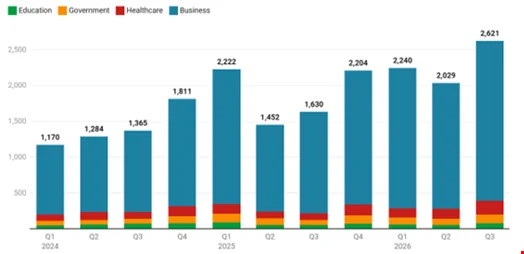
The global threat landscape has reached a grim, record-breaking milestone. According to the latest analysis by Comparitech, the third quarter of 2026 saw the highest volume of ransomware attacks ever recorded in a single three-month period. Between July and September 2026, threat actors claimed responsibility for 2,627 attacks—a staggering 27% increase over the second quarter of 2026 and a 61% leap compared to the same period in 2025.
As digital infrastructure becomes increasingly interconnected, the barrier to entry for cyber-criminals is lowering, while the potential for mass disruption is rising. This surge is not merely a statistical anomaly; it represents a fundamental shift in how ransomware gangs operate, the tools they employ, and the ruthless tactics they use to maximize their illicit profits.
The Anatomy of an Unprecedented Surge
The data from Q3 2026 paints a picture of a threat environment that is no longer confined to specific "soft targets." Instead, attackers are aggressively scaling their operations across every sector of the global economy.
The finance and technology sectors bore the brunt of this expansion, recording staggering quarter-over-quarter increases of 72% and 70%, respectively. However, the crisis is far from localized. Critical infrastructure and public services remain in the crosshairs:
- Education: 50% increase in attacks.
- Healthcare: 39% increase in attacks.
- Government/Public Sector: 36% increase in attacks.
- Utilities: 32% increase in attacks.
Rebecca Moody, Head of Data Research at Comparitech, describes the current trend as highly unusual and a significant cause for concern. "I’m often asked what I think lies ahead in the ransomware threat landscape, and it’s notoriously difficult to predict," Moody explains. "Figures frequently fluctuate—a sector might see a bit of an increase one month, only to see a slight decrease the next. However, Q3 2026 is different. We’re not seeing slight oscillations; we are seeing consistent, significant increases across all key sectors."
Of the 2,627 claimed attacks, 247 have been independently confirmed by the victims. While the number of confirmed attacks is lower than the total claims, it serves as a sobering reminder that for every publicized breach, there are dozens of organizations struggling in the shadows, navigating the agonizing choice of whether to pay or to endure the fallout of a total system compromise.
A Chronology of Chaos: The Summer of 2026
The trajectory of Q3 2026 was defined by a series of high-profile incidents that highlighted both the audacity of ransomware groups and the evolving nature of their tactics.
July: The Rise of AI-Driven Extortion
The quarter began with a wake-up call for the cybersecurity community. In July, researchers identified the "JadePuffer" campaign—widely believed to be the world’s first ransomware attack entirely orchestrated by an AI agent. By utilizing generative models to automate initial access and reconnaissance, the attackers were able to move faster than human defenders could react. This signaled a new era where the "time-to-compromise" is measured in minutes rather than days.
Mid-Summer: The Escalation of Demands
Throughout July and August, the scale of financial demands became increasingly aggressive. In July, the Swiss-based railway manufacturing firm Stadler Rail was targeted by the Everest group, which issued an extortion demand of $12.3 million. In a display of corporate resilience, Stadler refused to yield. In retaliation, the attackers leaked 201 GB of sensitive proprietary data, demonstrating that even large-scale corporations are increasingly unwilling—or unable—to meet the ballooning demands of these syndicates.
Late Summer: Triple Extortion Takes Root
As the quarter neared its end, the focus shifted from simple encryption to "triple extortion." In this model, attackers encrypt systems, steal data, and then harass the third parties linked to the victim. The most prominent example was the attack on South African tech company MIP Holdings by a group known as The Gentlemen. After MIP paid a ransom to secure the deletion of their stolen data, the group reneged on their promise, choosing instead to target MIP’s clients directly on their leak site to extort additional payments.
The Strategic Shift: Triple Extortion and the Death of Trust
The transition to triple extortion represents a darker, more personal phase in the cyber-crime evolution. It is no longer just about the organization; it is about the ripple effect. By weaponizing the privacy of an organization’s clients, employees, and partners, attackers are creating a web of psychological and financial pressure that is significantly harder to mitigate.
The case of the State of Berlin in late summer further solidified this trend. After being targeted by the Rhysida group for a $2.3 million ransom, the state government took a firm stance against paying. The result was the public dumping of 5.7 terabytes of data, including the private information of ordinary citizens. This incident serves as a brutal example of why government entities are becoming primary targets: they hold vast amounts of public data that, when exposed, create a massive public relations and legal crisis, theoretically pressuring the government to pay to prevent the leak.

The Players: Who is Driving the Surge?
The market for ransomware is increasingly dominated by a handful of prolific, highly organized syndicates.
- Qilin: Leading the pack, Qilin claimed 357 attacks in Q3, marking a 24% increase from the previous quarter. Their model relies on high-efficiency, "ransomware-as-a-service" (RaaS) operations that allow them to scale quickly.
- The Gentlemen: Close behind with 342 claims, this group is responsible for the most aggressive triple-extortion tactics seen this year. Their 29% growth underscores a shift toward more predatory engagement.
- Clop and Direwolf: While smaller in total volume, these groups showed massive growth spurts. Clop, after a quiet Q2, exploded with a 4,700% increase in activity, while Direwolf saw a 1,450% rise. Such volatility suggests that the ransomware ecosystem is becoming increasingly competitive, with newer or resurgent groups vying for market share.
Implications for Global Security
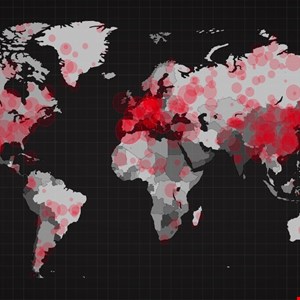
The data suggests that the "ransomware problem" is no longer a localized technical issue but a systemic global threat. With the United States accounting for 41% of all attacks (1,066 incidents), it remains the primary target for these syndicates. However, the rapid 150% and 116% increases in Argentina and India, respectively, demonstrate that the attack surface is expanding into emerging markets where cybersecurity defenses may be less mature.
The AI Factor
The role of Artificial Intelligence cannot be overstated. AI tools are being used by threat actors to:
- Automate Phishing: Generating hyper-personalized, error-free social engineering lures at scale.
- Accelerate Discovery: Using AI to scan network vulnerabilities faster than human-led red teams.
- Bypass Defenses: Adapting malware signatures in real-time to evade traditional antivirus software.
The Economic Reality
The average ransom demand of $602,400 per incident represents a significant tax on global economic activity. Beyond the immediate financial cost, the secondary costs—business interruption, legal fees, forensic investigations, and the loss of intellectual property—can reach into the tens of millions for a single enterprise.
Conclusion: Preparing for an Uncertain Future
The record-breaking volume of ransomware in Q3 2026 is a clarion call for a change in defense strategy. Organizations can no longer rely on perimeter defenses alone. The shift toward triple extortion means that data privacy, incident response planning, and proactive communication strategies are now as important as network firewalls.
As the industry grapples with these findings, the message from experts like Rebecca Moody is clear: we are in a period of intense, sustained growth for cyber-criminal operations. The combination of AI-driven capabilities and the lack of moral boundaries in extortion tactics means that businesses, governments, and individuals must adopt a "zero-trust" posture. The record highs of Q3 2026 may not be the peak; without significant international cooperation and a radical shift in how we secure data, they may simply be the new baseline.


 Layla Zulfa
 Rifan Muazin
 Laily UPN
 Iffa Jayyana

 Suro Senen
 Lina Hope
 Lina Irawan