
 Suro Senen

As the international community prepares to convene in Yerevan, Armenia, for the COP17 biodiversity summit, a critical snapshot of global environmental commitment has emerged. New analysis by Carbon Brief reveals that 58% of nations have finally submitted their National Biodiversity Strategies and Action Plans (NBSAPs), marking a significant, albeit delayed, step forward in the global effort to stem the tide of nature loss.
This progress arrives two years after the original deadline, highlighting the immense bureaucratic and financial challenges that continue to hamper the implementation of the Kunming-Montreal Global Biodiversity Framework (GBF). With the summit in Armenia set to host the first-ever global review of the GBF, the focus is shifting from target-setting to the harsh reality of implementation.
Main Facts: A Global Ledger of Commitment
The Kunming-Montreal Global Biodiversity Framework, adopted in 2022, serves as the "Paris Agreement for Nature." Its central mission is to halt and reverse biodiversity loss by 2030, a goal supported by 23 specific targets ranging from ecosystem restoration to the redirection of harmful subsidies.
The primary mechanism for tracking this progress is the NBSAP—a comprehensive roadmap for how individual countries intend to meet these international targets. While only 15% of nations met the initial deadline, the landscape has improved significantly. Today, 113 out of 196 parties have submitted their plans, a substantial increase from the 55 nations that had done so a year ago.

However, the "biodiversity gap" remains stark. Among the nations yet to publish their NBSAPs are several "megadiverse" countries, including Papua New Guinea, Peru, South Africa, and the United States. The omission of the U.S. is particularly notable; as a non-signatory to the UN Convention on Biological Diversity (CBD), the world’s largest economy operates outside the formal treaty framework, complicating global coordination efforts. Similarly, Russia, which holds the world’s largest landmass, has yet to formalize its national strategy.
A Chronology of Compliance and Delay
To understand the current state of play, one must look at the timeline of the GBF since its inception in Montreal in 2022.
- December 2022: The Kunming-Montreal GBF is adopted, setting a 2030 deadline for halting nature loss. Countries agree to submit their first round of updated NBSAPs by the COP16 summit in October 2024.
- October 2024 (COP16): The deadline passes with only a fraction of countries meeting their obligations. In a bid to maintain momentum, delegates agree to a new, urgent text, pleading with nations to submit their plans "as soon as possible."
- February 2025: The deadline for the seventh national reports—essential documents for tracking environmental indicators—arrives. While progress is slow, half of the countries meet this goal.
- October 2026 (Present Day): The number of countries with submitted NBSAPs reaches 113 (58%). As preparations for COP17 in Yerevan conclude, the international community prepares for the first formal "global review" of progress.
This chronology reveals a pattern of ambition frequently tempered by capacity constraints. While the political will to protect nature is present, the mechanics of turning that will into national legislation have proved far more difficult than negotiators anticipated in the optimism of 2022.
Supporting Data: Mapping the Biodiversity Landscape
The data surrounding the NBSAPs tells a story of geographic disparity. The past year has seen a surge in submissions from across the African continent. Nations including Algeria, Botswana, Cameroon, Côte d’Ivoire, the Democratic Republic of Congo, and Ethiopia have all filed their strategies. This wave of activity indicates that many developing nations, once they secure the necessary technical and financial support, are eager to align their national agendas with global biodiversity goals.
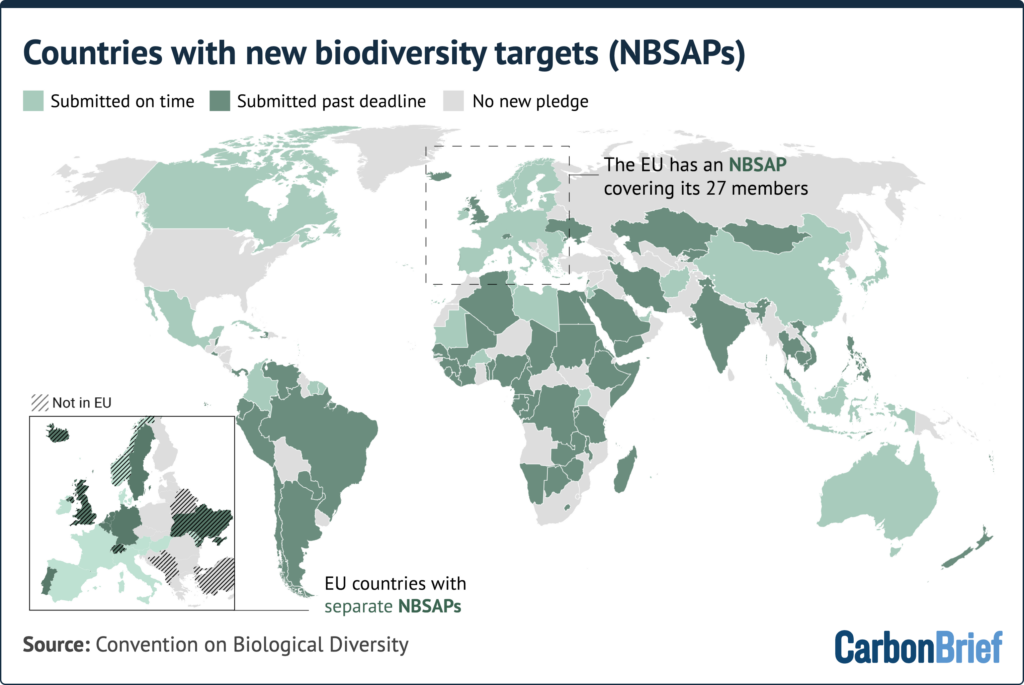
In South America, the momentum is equally visible. Brazil, which hosts the most biodiverse ecosystem on Earth, has joined the ranks of those with new NBSAPs. This is a critical development, as the health of the Amazon rainforest is intrinsically linked to global climate stability and biodiversity targets.
Yet, for those who cannot yet produce a full NBSAP, the UN introduced a "national target" option—a simplified list of goals without the accompanying implementation plan. This mechanism has been highly successful, with 175 countries (89%) now having published at least one national target. While these targets lack the robustness of an NBSAP, they represent a vital "placeholder" that keeps countries within the orbit of the GBF’s monitoring systems.
Official Responses and the Finance Bottleneck
The primary obstacle cited by developing nations for their failure to meet deadlines is a chronic lack of funding. The transition from planning to action requires significant upfront investment, which many nations cannot afford without external assistance.
The Global Environment Facility (GEF), the primary multilateral fund tasked with supporting these efforts, has been under intense pressure. According to a GEF spokesperson, 120 out of 139 countries that requested financial support post-COP16 have successfully accessed it. However, 19 countries remain in a "waiting room" of sorts, where financial bottlenecks persist.
The UN Environment Programme (UNEP) has confirmed it is working to resolve these outstanding issues. However, the frustration expressed by developing nations at COP16 remains a defining feature of the current discourse. The argument is simple: without adequate finance, the ambitious 2030 targets are mathematically impossible to achieve. As COP17 approaches, the conversation around "nature finance" is expected to be as contentious as the debate over climate finance in the UNFCCC process.
Implications: The High Stakes of the Global Review
COP17 in Yerevan represents the "halfway point" for the 2030 nature targets. The implications of the upcoming global review are profound.
If the review indicates that the current trajectory is insufficient to "halt and reverse" biodiversity loss, the pressure on developed nations to increase funding and technology transfer will become overwhelming. Furthermore, the reliance on national reporting means that if the data submitted by countries is inaccurate or incomplete, the entire global review process risks being a hollow exercise.
The lack of participation from major powers like the United States and Russia creates a structural vulnerability in the GBF. Global biodiversity does not adhere to political boundaries; the loss of species in the Amazon or the decline of soil health in the Eurasian steppe affects the entire biosphere. When major emitters and land-holders are not fully integrated into the reporting framework, the "global" nature of the review is compromised.

Moreover, the transition from "national targets" to "fully realized NBSAPs" is the next major hurdle. A target without a plan is merely an aspiration. The international community is now moving into a phase where the "how" matters more than the "what." The COP17 summit will be judged not by the number of pledges made, but by the tangible progress recorded in the UN’s global report.
Looking Ahead
As delegates descend upon Yerevan, they face a world where nature is in retreat. The increase in NBSAP submissions from 55 to 113 is a testament to the persistence of the UN framework, but it is not enough to declare victory. The next few years will determine whether the Kunming-Montreal Global Biodiversity Framework remains a landmark agreement or fades into the history of well-intentioned but under-resourced international treaties.
The success of COP17 will depend on three factors: closing the finance gap for the remaining 19 countries, ensuring that national targets are translated into concrete policy, and fostering a level of transparency that holds all nations accountable. The planet’s biological future, in all its complexity, depends on the ability of these 196 parties to move beyond the bureaucratic delay and into an era of urgent, funded, and verifiable action.


 Raul Delapena Setiawan

 Laily UPN

 Reynand Wu

 Sagoh


 Azzam Bilal Chamdy

 Ali Ikhwan
