
 Neng Nana
In the competitive landscape of modern commerce, pricing is rarely just about the math. While business owners often focus on margins, overhead, and market competition, the most successful brands understand that price is fundamentally a psychological signal. How a price is presented—or "framed"—can be the difference between a stalled inventory and a record-breaking sales quarter.
For decades, behavioral economists and marketing psychologists have been pulling back the curtain on how the human brain processes numbers. From the "left-digit effect" to the paradox of choice, science suggests that consumers are far less rational than traditional economic models once assumed. By understanding these cognitive biases, businesses can implement subtle, low-cost changes to their pricing strategies that yield significant shifts in customer perception and revenue.
The Magnitude Effect: Why Smaller Digits Feel Like Better Deals
The intersection of mathematics and human perception is not always linear. A landmark 2007 study by Coulter and Coulter unveiled a counterintuitive phenomenon regarding how we perceive discounts.
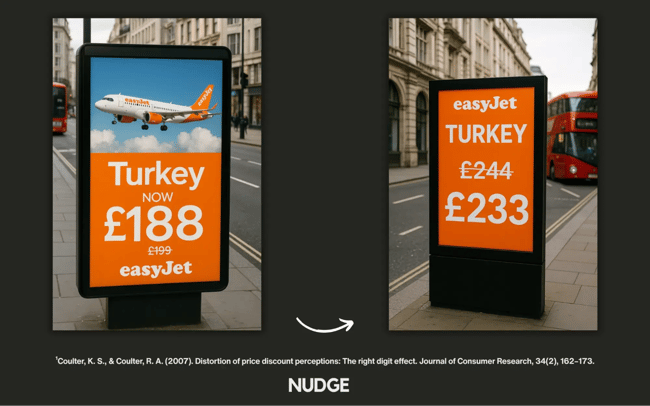
Researchers presented two groups of consumers with advertisements for flights to Turkey. The baseline prices were set, and a £10 discount was applied. One group saw a reduction from £188 to £178, while the other saw a reduction from £233 to £223. Despite the discount being identical in nominal value, the perception of the "deal" varied wildly.
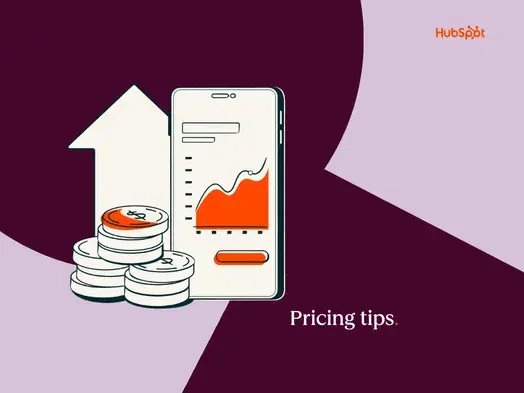
The study revealed that customers perceived the £233 to £223 drop as a significantly better value than the £188 to £178 drop. The reason lies in how our brains process numerical distance. Humans find it easier to differentiate between smaller numbers; the gap between 4 and 3 feels psychologically "wider" than the gap between 9 and 8. Consequently, when the digits in a price are smaller, the perceived magnitude of the discount increases.
Key Takeaway: When running a sale, aim to keep your sale price digits below five. This minor aesthetic adjustment triggers a psychological sense of a more substantial reduction, making the offer more salient to the shopper.
Break Down the Price: The Power of Unit Framing
One of the most effective ways to lower the "pain of paying" is to change the scope of the transaction. When consumers are presented with a large, aggregate sum, their brains often shift into a defensive, analytical mode, calculating the total cost against their budget. By breaking that price down into smaller, per-unit segments, businesses can reframe the cost as a manageable, everyday expense.
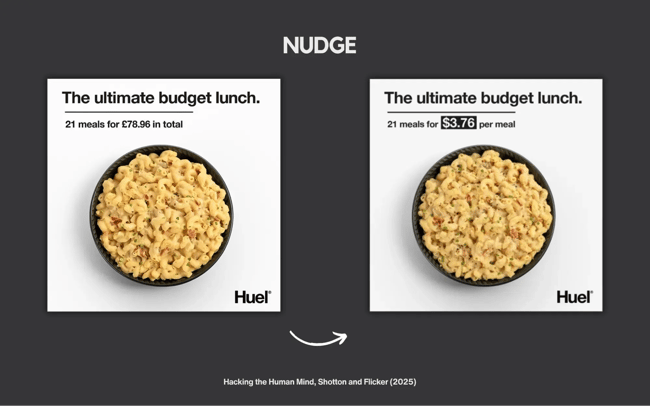
This strategy was highlighted in a test involving budget meal kits from Huel. When the price was presented as a total for 21 meals (£78.96), conversion rates lagged. However, when the price was reframed as a cost per individual lunch (£3.76), consumers perceived the product as a much more affordable, high-value investment.

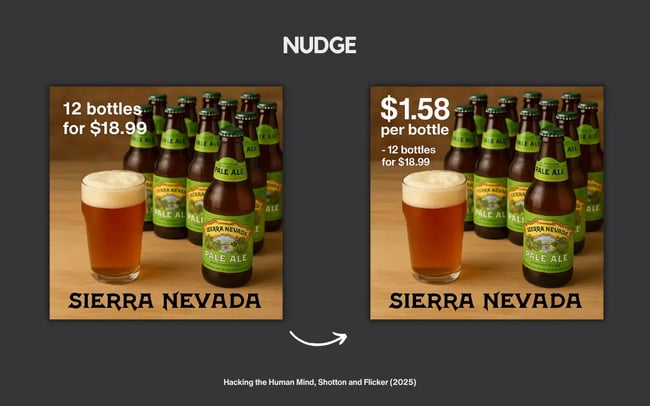
A similar study, referenced in the book Hacking the Human Mind by Richard Shotton and Michael Aaron Flicker, tested this on craft beer sales. When shoppers were shown a price of $18.99 for a 12-pack, interest was moderate. But when the price was framed as $1.58 per bottle, the percentage of shoppers who rated the product as "good" or "very good" value more than doubled—rising from 13.7% to 28.6%.
By shifting the frame from the "total" to the "unit," companies effectively bypass the psychological resistance associated with large expenditures.
Differential Price Framing: The Art of the Upsell
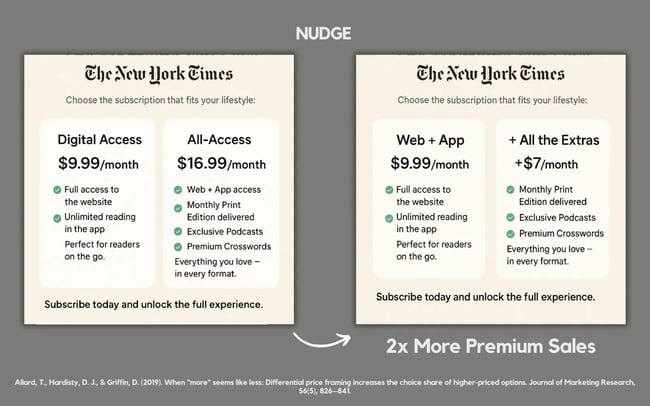
For companies looking to move customers toward premium tiers, the framing of the price difference is crucial. A 2019 experiment conducted by David Hardisty at the University of British Columbia demonstrated the efficacy of "differential price framing" in the context of subscription services.
When researchers offered two tiers of a New York Times subscription, one group saw the base plan at $9.99/month and the "All the Extras" plan at $17/month. A second group saw the same base plan at $9.99/month, but the premium tier was advertised as "an additional $7/month."
The results were stark: the second group chose the premium plan at double the rate of the first. The logic is simple yet profound: $7 feels much smaller than $17. By focusing on the surcharge rather than the total price, businesses reduce the friction involved in upgrading. It is a classic example of framing, where the focus is shifted from the cost of the luxury to the cost of the convenience.
Transparency as a Competitive Advantage
For years, the conventional wisdom in retail was to hide the "sausage-making" process—keep costs opaque and margins hidden to avoid sticker shock. However, recent evidence suggests that the modern consumer values transparency, provided it is framed correctly.
A 2020 Harvard study, which gained significant traction on social media, tested the effect of displaying cost breakdowns on items in a university canteen. When customers were shown the specific costs of ingredients and the final profit margin on a bowl of soup, sales actually increased by 21%.
This suggests that consumers are not necessarily opposed to paying a premium; they are opposed to feeling exploited. By being transparent about costs, businesses build trust. When a customer understands the labor, quality, and overhead that go into a product, the final price is no longer an arbitrary figure—it becomes a justified exchange of value.
The Paradox of Choice: Easing Decision Paralysis
The psychological barriers to purchase aren’t always about the price itself; sometimes, they are about the lack of differentiation between choices. In a study conducted in South Korea, researchers offered participants a choice between two identical packs of gum at the exact same price (630 won). The result? Decision paralysis. Only 46% of participants made a purchase.
When researchers slightly adjusted the prices—setting one at 620 won and the other at 640 won—the purchase rate jumped to 77%. The tiny 20-won difference provided the "nudge" necessary for the brain to break the stalemate.
This confirms a fundamental truth of consumer behavior: when options feel identical, the effort required to choose them becomes exhausting, leading the consumer to walk away. By creating slight, even arbitrary differences between products, businesses can simplify the decision-making process, making it easier for the customer to commit to a purchase.
Implications for Modern Marketing
The cumulative evidence from these studies provides a roadmap for businesses of all sizes. The most critical implication is that pricing is a communication tool. Every time a price is displayed, it is telling a story—either of a bargain, a premium experience, or an overwhelming cost.
1. The Strategy of "Less than Five"
Small price digits create a higher perception of value. Businesses should audit their pricing menus and, where possible, adjust numbers to ensure they end in digits lower than five.
2. The Per-Unit Pivot
For high-volume or subscription-based businesses, shifting the focus from the total sum to the unit cost reduces buyer anxiety. It makes the cost feel "smaller" and more consistent with daily spending habits.
3. Surcharge Framing
When offering tiered services, avoid listing the total price of the premium tier. Instead, highlight the price difference between the standard and premium options. This minimizes the perceived "loss" associated with spending more.
4. Radical Transparency
In an era of skepticism, honesty is a powerful differentiator. Showing the breakdown of costs can humanize a brand and justify higher prices, moving the conversation from "why is this expensive?" to "why is this worth it?"
5. Differentiation as a Nudge
Never present two identical products with identical prices if you want to drive a purchase. Differentiate them—even by a small margin—to help the consumer feel they are making an informed, active choice rather than a random selection.
Conclusion: Small Nudges, Significant Impact
The beauty of these strategies lies in their simplicity. None of these tactics require a change in product quality, manufacturing costs, or target demographics. They are "nudges"—subtle adjustments in the architecture of choice.
As we look toward the future of retail and digital commerce, the businesses that succeed will be those that respect the cognitive limitations of their customers. By understanding the psychology behind the numbers, brands can move away from the "race to the bottom" on pricing and instead focus on how to best communicate the value they provide. Whether through the clever use of decimals or the transparency of a cost breakdown, the way a price is presented is, and will remain, the most powerful tool in the marketer’s arsenal.


 Reynand Wu
 Iffa Jayyana
 Raul Delapena Setiawan

 Sagoh
Sagoh

 Azzam Bilal Chamdy
 Ali Ikhwan