
 Azzam Bilal Chamdy
In the modern digital landscape, "personalization" has become the north star of marketing strategy. Brands spend billions on sophisticated algorithms designed to predict consumer behavior, serve dynamic content, and shorten the path to purchase. Yet, while these engines are becoming exceptionally adept at guessing what a customer might want next, they are increasingly failing at a more fundamental human need: making the customer feel truly understood.
Recent research from SheerID and Censuswide highlights a widening chasm between operational efficiency and genuine customer connection. While 55% of consumers acknowledge that tailored offers are useful, a mere 36% believe those offers actually recognize something meaningful about their identity—such as their profession, their current life stage, or their community affiliations. Even more concerning for brand loyalty, nearly 30% of consumers view these attempts at personalization as intrusive, often citing that the offers are based on flawed, inaccurate assumptions.
The Limits of Inference: When Data Becomes a Barrier
For years, the marketing playbook has relied heavily on inference. By tracking browsing history, purchase velocity, and campaign engagement, companies have built massive "intent models." If you browse for high-end laptops, the site will show you more laptops. If you abandon your cart, you will likely receive a series of emails nudging you back to the checkout page.

However, this reliance on behavioral signals often hits a ceiling. The algorithm knows what you looked at, but it rarely understands who you are. It may not realize that the student browsing for a laptop is looking for a budget-friendly machine for their degree, or that a long-time customer’s purchase history suggests they are a loyalist deserving of exclusive recognition rather than a one-off discount.
When personalization stops at "guessing," it creates a cold, transactional experience. Consumers are becoming increasingly aware of the difference between an algorithm that follows them around the web and a brand that acknowledges their specific role in the world.
Bridging the Gap: The Hybrid Approach
The goal for marketers is not to abandon inference, but to integrate it with explicit consent. According to the study, consumers are not strictly binary in their preferences: 30% prefer a blend of inferred and consented data, while roughly equal shares (28% and 26%, respectively) prefer either total inference or total consent-based data.

The takeaway is clear: marketers must learn to distinguish between moments that require passive tracking and moments that require a conversation. If a customer is browsing, inferred data is appropriate for content optimization. However, when the time comes to deepen the relationship—such as verifying a customer’s status as a veteran, teacher, or healthcare worker—the brand should shift to a consent-based approach. By asking the customer for this information, brands gain a verified fact that allows them to move beyond assumptions and provide authentic, meaningful experiences.
The Friction of Intent: Why Customers Walk Away
While marketers often obsess over "frictionless" checkout flows—reducing the number of clicks or the length of a form—the research suggests the real problem is not the process, but the purpose.
Consumers are perfectly willing to share personal information, provided the value exchange is clear. The primary drivers for data sharing are tangible: one-time savings, loyalty rewards, and future discounts. Interestingly, exclusivity alone is often not enough to compel a user to share data; the benefit must be immediate and relevant.

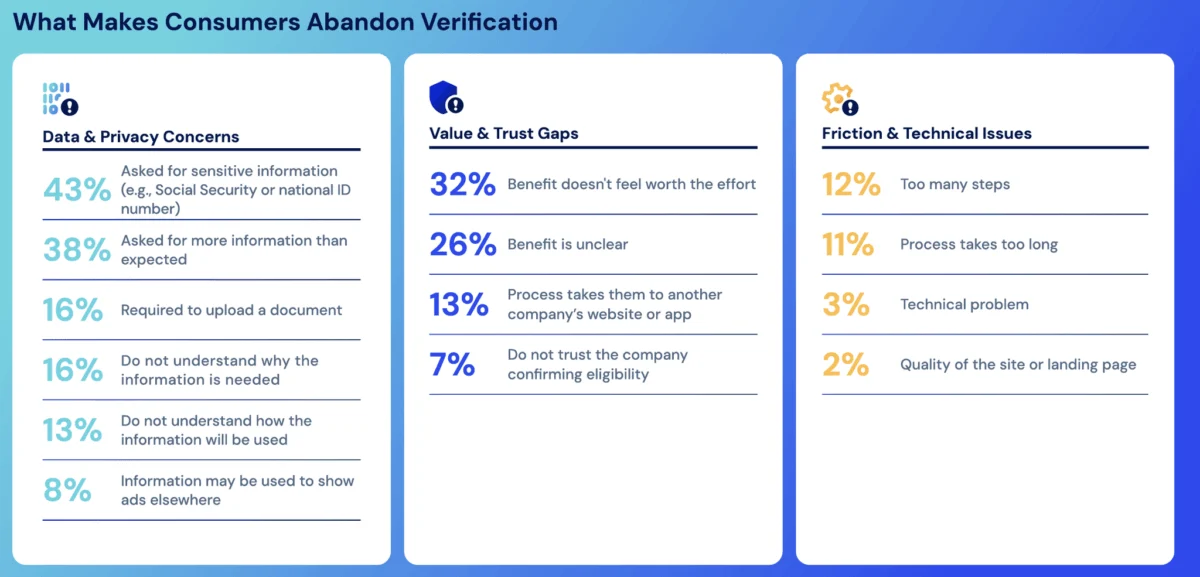
Conversely, the reasons for abandonment are rooted in a lack of transparency and trust. 43% of consumers stated they would abandon a verification process if asked for sensitive information that seemed unnecessary, and 38% would quit if the data request felt like an overreach.
The "surprise factor" is the silent killer of conversion. When a user is asked for information without a clear explanation of why it is needed or how it will be used, they become suspicious. Shaving a few seconds off a form is a moot point if the customer doesn’t understand why they are filling it out in the first place. 57% of respondents prioritize knowing the benefit before they start, while 45% want explicit confirmation regarding data privacy.
The Sensitivity Threshold: Balancing Utility and Privacy
Marketing operations teams face a delicate balancing act. There is a clear "comfort threshold" when it comes to data sharing. Most consumers are at ease providing an email address, a name, or an age range. However, as requests escalate to include official documents, ID numbers, or employment verification, comfort levels plummet.

A useful rule of thumb for modern marketers is the "Materiality Test": If the information requested won’t fundamentally improve or change the experience for the user, why are you asking for it?
Furthermore, the context of the request is critical. 67% of consumers prefer to confirm their status or eligibility directly on the brand’s own site or app. Being redirected to a third-party site is a significant friction point that triggers anxiety: "Who has my data now?" "Why did I leave the brand’s site?" "Is this interaction still secure?" These questions erode confidence and almost always result in a drop in conversion.
Recognition: The Engine of Long-Term Loyalty
While the initial sale is important, the value of recognition grows exponentially over time. The data shows that 62% of consumers are more likely to make a purchase if they feel recognized by a brand, and an identical percentage would choose that brand again in the future.
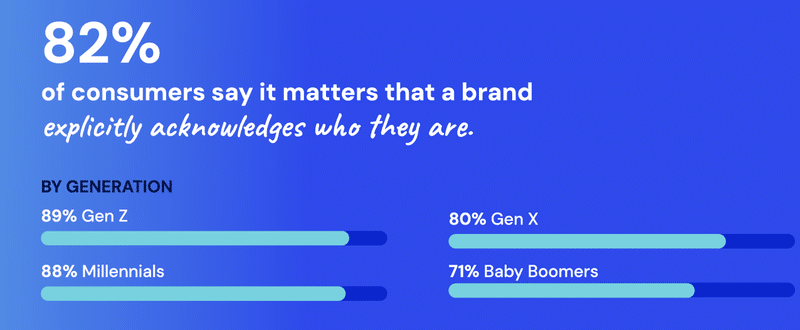
This recognition manifests in ways that go beyond simple "personalization." When asked what makes them feel truly seen, 61% of consumers cited automatic loyalty rewards. 33% valued the brand remembering their history and preferences, and 23% appreciated the restraint of not being served irrelevant advertisements for products they have no intention of buying.
This final point—the power of not sending an offer—is perhaps the most underutilized tool in the marketing stack. Personalization teams are often incentivized to increase volume, but silence is sometimes the most powerful signal of a brand that truly understands its customer. By curating what to omit, brands can demonstrate a level of respect for the consumer’s time and attention that is rarely seen in today’s hyper-competitive digital market.
Conclusion: A Future of Intentional Engagement
As the digital landscape continues to evolve, the brands that win will be those that shift their focus from "guessing" to "knowing." This requires a fundamental rethink of the relationship between data, technology, and the human at the other end of the screen.

By prioritizing transparency, respecting the boundaries of sensitive data, and focusing on the value exchange, brands can transform their personalization efforts from a series of algorithmic guesses into a meaningful dialogue with their customers. In an era of AI-driven noise, the ability to make a customer feel understood is not just a marketing tactic—it is the ultimate competitive advantage.
For those interested in exploring the full scope of these findings, the complete research report from SheerID and Censuswide is available for download, with no registration required.


 Raul Delapena Setiawan
 Laily UPN

 Ammar Sabilarrohman

 Asep Darmawan

 Asro

 Layla Zulfa

 Nila Kartika Wati

 Muslim
