
 Nila Kartika Wati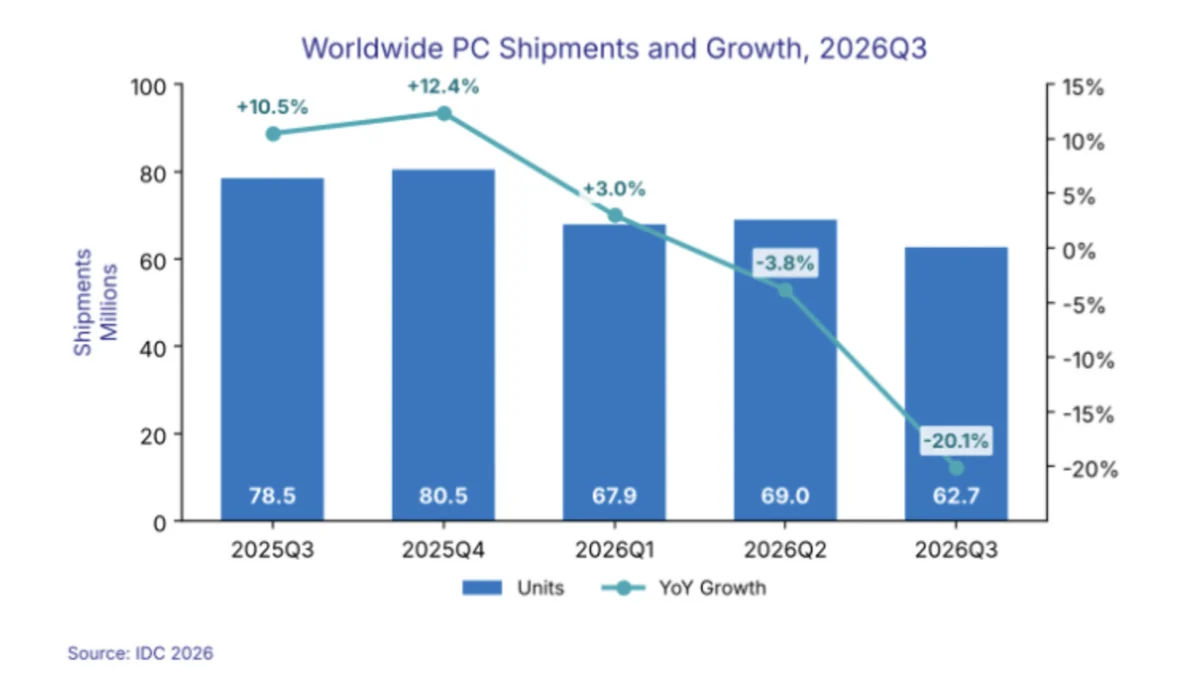
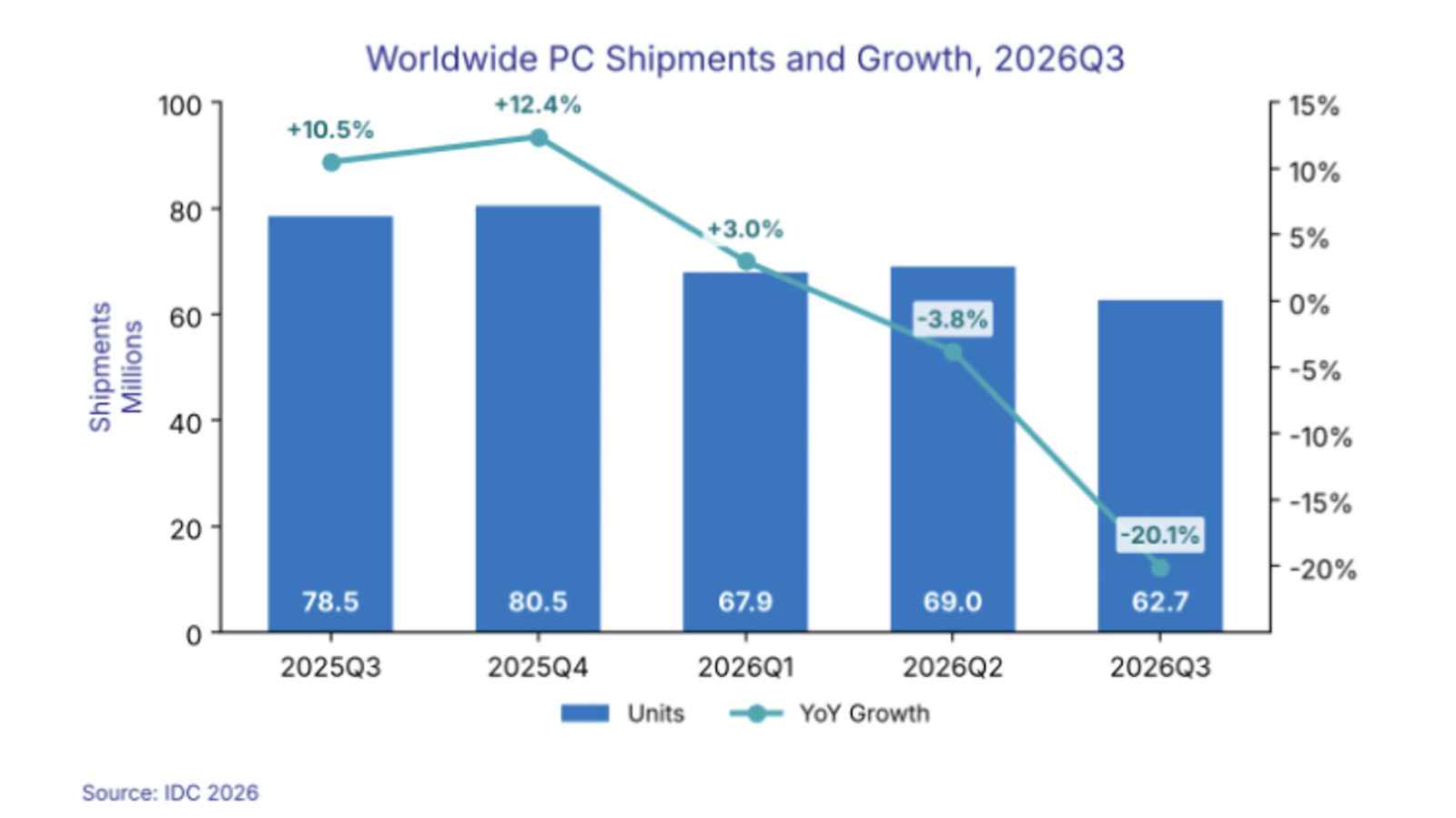
The global personal computer market is currently navigating its most turbulent period in recent memory. According to the latest data released by the International Data Corporation (IDC), global PC shipments for the third quarter (Q3) of 2026 plummeted to 62.7 million units. This figure represents more than a statistical dip; it is a profound 20.1 percent year-over-year contraction compared to the same period in 2025. As the industry grapples with what has been colloquially dubbed "RAMaggedon," the dream of a post-pandemic PC boom has officially evaporated, replaced by a reality of supply constraints, inflated component costs, and cooling consumer appetite.
The Core Data: Quantifying the Contraction
The numbers provided by the IDC report paint a grim picture for hardware manufacturers and retailers alike. The 62.7 million units shipped in Q3 2026 do not exist in a vacuum; they represent a 9.1 percent sequential decline from the second quarter of 2026. This trend signifies that the deceleration of the market is not a singular event but a persistent downward trajectory.
To contextualize this, consider the historical performance of the market over the last five quarters. Following nearly two years of unprecedented growth fueled by remote work mandates and educational digital transformation, the market hit a structural ceiling. By July 2026, IDC confirmed the first decline in PC shipments in nine quarters, signaling the end of the pandemic-era hardware super-cycle. The Q3 2026 data serves as the confirmation that this decline is not merely a correction but a long-term adjustment to a new, significantly more expensive economic environment.
Chronology of a Crisis: How We Arrived at "RAMaggedon"
The current crisis did not emerge overnight. It is the result of a complex interplay between geopolitical instability, supply chain fragility, and the semiconductor industry’s struggle to keep pace with demand for high-bandwidth memory (HBM) and DDR5 modules.
Early 2026: The Warning Signs
As early as the first quarter of 2026, analysts began to sound the alarm regarding the scarcity of critical memory components. The moniker "RAMaggedon" gained traction as major manufacturers faced production yield issues and raw material shortages. By the spring of 2026, IDC had already issued a downward revision for its full-year market forecast, suggesting that the initial projections of a stable year were overly optimistic.
Q2 2026: The Shift in Momentum
The second quarter of 2026 served as the turning point. As costs for memory, processors, and logistics climbed, these expenses were inevitably passed down to the consumer. This triggered a psychological shift in the market: buyers, already feeling the pinch of broader global inflation, began to delay non-essential upgrades.
Q3 2026: The Correction
The third quarter data confirms that the "wait and see" approach adopted by consumers and enterprise IT departments alike has evolved into a full-scale freeze on hardware procurement. The market is now witnessing a inventory bottleneck where manufacturers are burdened with stock that is too expensive for the current consumer base to justify.
Supporting Data and Economic Drivers
Beyond the headline shipment numbers, the underlying economic drivers provide a deeper understanding of why this slump is so severe. The IDC report highlights two primary culprits: supply chain volatility and pricing pressure.
The Component Bottleneck
At the heart of the issue is the memory market. As artificial intelligence (AI) and data center demand continue to monopolize the most efficient memory production lines, the PC consumer market has been relegated to the bottom of the priority list. This has created a scarcity that artificially inflates prices for everyday laptops and desktops.
Macroeconomic Headwinds
The broader global economic climate cannot be ignored. With interest rates remaining high in many regions and consumer confidence hovering near multi-year lows, the purchase of a new PC—often considered a discretionary luxury for many households—has fallen off the priority list. Enterprise buyers, who previously fueled the market with massive fleet upgrades, are similarly extending the lifecycle of their existing hardware by an additional 12 to 18 months.
Official Responses and Industry Outlook
The industry’s leadership is now shifting from a growth mindset to one of inventory management and survival. Jitesh Ubrani, IDC’s research director for consumer devices, provided a candid assessment of the landscape in the organization’s latest release.
"Channels are now worried about carrying too much inventory into a market where high prices are suppressing demand," Ubrani noted. He points out a paradoxical situation: while consumers might see localized promotions as retailers try to clear warehouse space, these "deals" are misleading. "That could translate into promotions and some short-term relief for consumers, but we don’t expect pricing anywhere near what it was a year ago. Prices will remain elevated."
The industry’s message to stakeholders is one of managed expectations. The expectation is that the market will not see a "V-shaped" recovery. Instead, stakeholders are bracing for a prolonged period of consolidation. The risk, as noted by Ubrani, is that with worsening macro conditions, the outlook for the next several quarters could deteriorate further before the market finds a new, lower floor.
Implications for Consumers and Businesses
For the average user, the implications of this market shift are significant and require a change in purchasing strategy.
For the Individual Consumer
If you are currently in the market for a new computer, the current advice from market analysts is binary: either buy now if the necessity is urgent, or wait. If you do not have an immediate need, the consensus is to hold off on purchases for at least another 12 to 18 months. While it is unlikely that prices will return to pre-2025 levels, the hope is that by late 2027, the supply chain will have stabilized, and competitive pricing will return to a state of normalcy. If you must buy, prioritize machines with high repairability and upgradeability, as extending the life of current hardware is the most effective hedge against current price volatility.
For Business and Enterprise
For IT procurement managers, the strategy must pivot toward asset lifecycle management. Rather than pursuing a "refresh-and-replace" cycle, organizations should invest in maintenance and software optimization. The focus should be on squeezing maximum performance out of existing hardware until the market reaches a point of price stability.
Conclusion: The Long Road to Recovery
The 20.1 percent decline in PC shipments during Q3 2026 is a sobering reflection of a market undergoing a painful transition. The days of rapid, pandemic-driven hardware adoption have come to an end, giving way to a period of caution and fiscal discipline.
While "RAMaggedon" may eventually subside, the ripple effects on the PC market will be felt for years to come. The industry is currently in a state of recalibration, moving away from the irrational exuberance of the early 2020s toward a more tempered, high-cost reality. For now, the best strategy for all participants—from casual users to large-scale enterprise buyers—is to remain patient, monitor the supply chain developments closely, and prepare for a market that is fundamentally different from the one we knew just a few short years ago. The path forward is not marked by growth, but by resilience in the face of persistent, structural challenges.


 Lina Irawan
 Suro Senen
 Laily UPN
 Iffa Jayyana
 Rifan Muazin

 Lina Hope