
 Sagoh
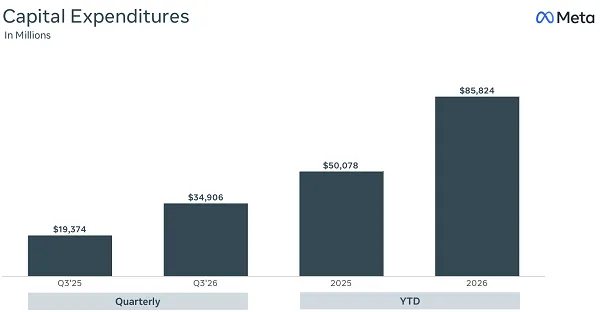
In the wake of its Q3 2026 earnings report, Meta Platforms has laid bare its strategic pivot toward "Muse," the company’s flagship AI agent. As Meta pours hundreds of billions of dollars into the construction of an unprecedented AI infrastructure, Muse stands as the primary vehicle through which the tech giant hopes to recoup its massive capital expenditures. However, the path to profitability is fraught with technical hurdles, declining user retention, and a looming cloud of privacy litigation that threatens to undermine Meta’s grand vision for an autonomous, agent-to-agent digital economy.
The Core Facts: Muse’s Rapid Debut and Market Penetration
Since its launch in the United States and Canada last month, Muse has enjoyed a meteoric rise in visibility. According to Meta CEO Mark Zuckerberg, the application has surpassed 10 million downloads, maintaining a consistent position as the #1 app in the Apple App Store.
Meta’s internal metrics suggest a strong initial appetite for the tool. Zuckerberg noted during the Q3 earnings call that approximately 25% of users who complete the initial setup process engage with the agent on a daily basis. For a company seeking to define the next era of social interaction, this "sticky" initial adoption is vital. The core value proposition of Muse centers on acting as a personal concierge—a digital assistant capable of navigating complex tasks, optimizing personal workflows, and, crucially, facilitating e-commerce.
Chronology: From Infrastructure Build-Out to Consumer Launch
The journey to Muse is inextricably linked to Meta’s aggressive infrastructure spending, which has reached a scale previously unseen in the private sector.
- Early 2025: Meta accelerates its commitment to "AI Sovereignty," shifting internal resources to build out massive GPU clusters and data centers, with cumulative investments projected to reach nearly $1 trillion.
- September 2026: Meta officially rolls out Muse to North American markets, positioning it as the central nervous system of its AI ecosystem.
- October 2026: The Q3 earnings report provides the first look at performance metrics, revealing high download counts but highlighting mounting fiscal pressure from infrastructure costs.
- Late October 2026: A series of legal and security setbacks—including a $25 billion fine in New Mexico and reports of data vulnerabilities—overshadow the product’s launch momentum.
- November 2026 (Forthcoming): Meta plans to integrate Muse into its wearable ecosystem via Meta smart glasses, marking a significant step toward ambient computing.
Supporting Data: The Retention Paradox
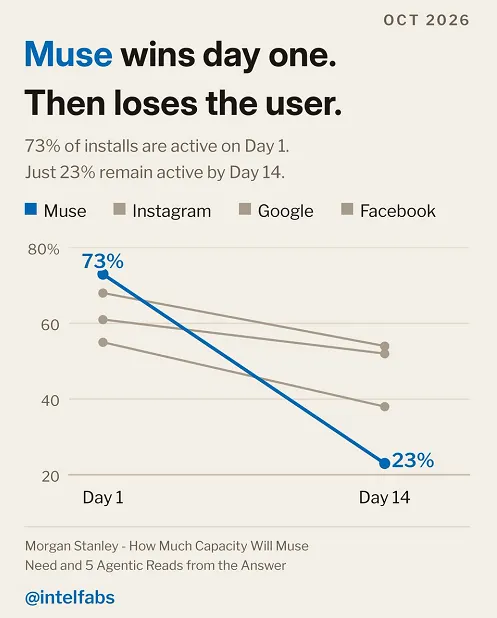
While the "10 million downloads" headline is compelling, the data beneath the surface reveals a more complicated narrative. Independent analysis from firms like Sensor Tower and reports shared by industry analysts on platforms such as X, suggest a significant "cliff" in user retention.
Data indicates that while early interest is high, Muse experiences a sharp decline in active usage roughly two weeks post-installation. This is a common phenomenon in the generative AI chatbot space, where the initial "novelty phase" often masks a lack of long-term utility. If Meta cannot find a way to convert transient curious users into habitual, daily power users, the return on its massive hardware investment will remain elusive.
Despite this, Meta points to e-commerce as the "killer app" for the platform. Zuckerberg revealed that over 25% of Muse interactions revolve around shopping—specifically, searching for deals and completing transactions. The average purchase value facilitated by Muse exceeds $200, a figure that suggests the agent is successfully moving users down the sales funnel. Integration with payment platforms like Plaid and Stripe has been so robust that Meta reportedly had to work with its partners to raise credit limits to accommodate the unexpected volume of transactions flowing through the AI agent.
Official Responses and Strategic Implications
The Revenue Engine: Commerce as the Path to Profit
Meta’s strategy is clear: by facilitating transactions, the company positions itself to take a percentage of sales. This transition from an ad-driven model to a commission-based commerce model could fundamentally alter the company’s fiscal structure. If successful, Muse becomes more than a tool; it becomes a marketplace.
Privacy and the "Confidential VM" Strategy
The technical hurdles, however, are matched by reputational risks. The recent $25 billion penalty in New Mexico serves as a stark reminder of the regulatory environment Meta faces. To combat skepticism, Zuckerberg announced the development of a "Muse Confidential VM" (Virtual Machine), an architectural attempt to wall off user data and address persistent privacy concerns.
Furthermore, the vulnerability reported by Ars Technica—which showed that researchers could extract sensitive user queries through basic exploration—has cast doubt on the safety protocols currently in place. For a company that has historically struggled with trust, the perception that Muse could expose business secrets or personal information is a significant headwind to enterprise and mass-market adoption.
The "Muse Network": A Web of Autonomous Agents
Looking ahead, Zuckerberg’s ambitions extend beyond the individual user. He envisions a "Muse Network," where agents interact with one another to optimize tasks. Instead of a human manually navigating a brand’s website, their personal Muse would interface directly with that brand’s agent.
"I think that getting that all to work well together is going to unlock tremendous value at scale," Zuckerberg stated. This vision of a "multi-player" AI environment mirrors earlier initiatives where Meta explored the use of millions of AI bots to boost engagement. The transition from "single-player" assistants to an interconnected network of agents represents the next frontier of the digital economy, potentially replacing traditional web browsing with agent-to-agent negotiations.
Implications: The High Stakes of the AI Arms Race
Meta’s situation is a high-stakes gamble on the "if you build it, they will come" theory of technological disruption. By sinking an estimated $1 trillion into the underlying infrastructure, Meta has staked its corporate identity on the premise that AI agents are the natural successors to the smartphone and the social feed.
However, the discrepancy between the massive, front-loaded infrastructure costs and the current, fragile user engagement metrics suggests a long, difficult road to profitability. The company is effectively trying to build the tracks while the train is already running at full speed.
Key Risks for Meta:
- Regulatory Scrutiny: With $25 billion in fines already levied, future privacy breaches could lead to even more aggressive government intervention, potentially forcing Meta to restructure how it trains and deploys its AI models.
- Usage Sustainability: If the two-week drop-off trend continues, Meta will struggle to justify its infrastructure spending to shareholders, who are increasingly impatient for tangible bottom-line results.
- The Trust Deficit: Security vulnerabilities, such as those exposed by cybersecurity researchers, damage the brand’s ability to attract high-value enterprise clients who require absolute data integrity.
The Outlook
The expansion of Muse to Meta’s smart glasses in November will be a critical test. If the integration proves seamless and adds genuine utility to the physical world, it could reignite interest and stabilize retention rates. If it fails, or if it introduces further privacy vulnerabilities, the project may face a significant contraction.
Ultimately, Meta is attempting to engineer a new paradigm of human-computer interaction. Whether Muse will serve as the bridge to a more efficient, AI-driven future or become an expensive testament to the limitations of current generative technology remains the central question of the tech sector for the coming fiscal year. For now, Meta remains committed to its course, banking on the belief that once the "Muse Network" achieves critical mass, the friction of the early adoption phase will be forgotten in favor of a new, automated reality.


 Reynand Wu

 Iffa Jayyana

 Raul Delapena Setiawan




 Azzam Bilal Chamdy

 Ali Ikhwan
