
 Raul Delapena Setiawan
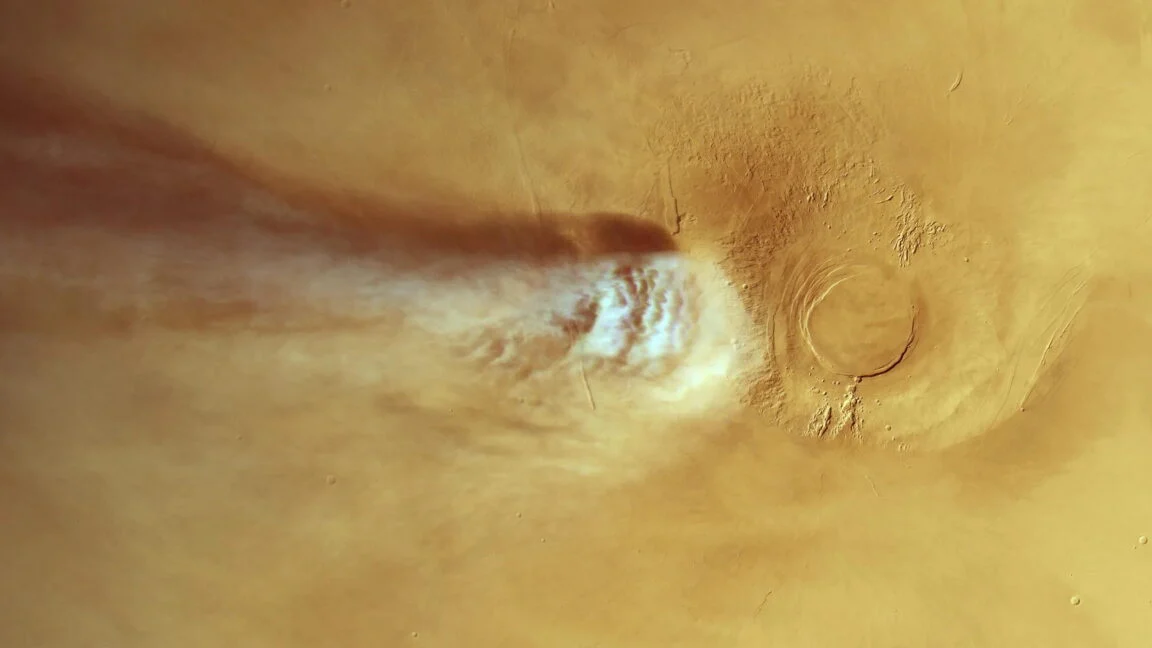
High above the rust-colored plains of Mars, near the equator, a colossal cloud stretches its gossamer fingers across the thin atmosphere. Known as the Arsia Mons Elongated Cloud (AMEC), this recurring meteorological marvel has long puzzled scientists. Measuring up to 1,800 kilometers in length, it dwarfs the terrestrial cloud formations we observe on Earth. Now, a groundbreaking study published in Nature Geoscience suggests that this Martian behemoth is governed by a physical process never before witnessed in the solar system: homogeneous nucleation.
Main Facts: The Anatomy of a Martian Mystery
On Earth, the recipe for a cloud is relatively standard. Water vapor requires a "seed"—a microscopic piece of debris like dust, sea salt, or smoke—to latch onto before it can condense into droplets or ice crystals. This process is known as heterogeneous nucleation. However, the AMEC operates under an entirely different, and far more exotic, set of physical laws.
The new research indicates that the AMEC forms through "homogeneous nucleation," a phenomenon where vapor transitions directly into ice crystals without the assistance of any foreign particulate matter.
"It’s akin to droplets of condensation appearing in the middle of a room, rather than on a window," explains Jorge Hernández-Bernal, the lead researcher on the study. "It’s wholly unexpected."
The formation of these clouds is tied intimately to Arsia Mons, a gargantuan shield volcano that stands roughly 65,000 feet tall—nearly two and a half times the height of Mount Everest. As wind currents encounter this massive topographical barrier, they are forced upward, generating powerful atmospheric waves. These waves launch moist air into the upper reaches of the Martian atmosphere in a matter of minutes, triggering a sudden, violent drop in temperature of approximately 30° Celsius. This extreme cooling, combined with massive levels of relative humidity, forces the ice to crystallize spontaneously out of the thin Martian air.
A Chronology of Discovery
The study of the AMEC is not a new endeavor, but the ability to model it with such precision marks a turning point in planetary science.
- The Early Observations: For years, orbital probes including the European Space Agency’s (ESA) Mars Express have captured images of the AMEC as it stretches out like a ribbon during the Martian solstice. Its size and seasonal regularity made it a target of intense curiosity.
- The Modeling Breakthrough: Scientists previously struggled to account for the cloud’s rapid formation. Early climate models failed to reach the threshold of saturation necessary to explain the ice crystal density observed by satellites.
- The Recent Simulation: Using advanced global climate models, researchers successfully simulated the atmospheric conditions required for AMEC’s birth. The model revealed that the interaction between the volcano’s elevation and the Martian wind current was sufficient to create the "flash" cooling needed for homogeneous nucleation.
- The Publication: The findings, recently detailed in Nature Geoscience, have effectively bridged the gap between raw observational data and theoretical meteorology, proving that such extreme processes are not only possible but likely consistent in the Martian environment.
Supporting Data: When Humidity Hits Extremes
To understand the rarity of the AMEC, one must look at the atmospheric conditions of Mars compared to Earth. The model developed by Hernández-Bernal and his team identified a requirement for relative humidity levels that, by terrestrial standards, seem physically impossible.
The humidity required for homogeneous nucleation on Mars is more than 100,000 times greater than any value ever recorded on Earth. Before this study, the scientific community operated under the assumption that such levels of atmospheric saturation were impossible to sustain on the Red Planet.
"We don’t have nearly as much information about Mars’ atmosphere as we do about Earth’s," says Hernández-Bernal. "So, reproducing the AMEC to this degree is a big success. The result is truly remarkable."
The data suggests that the Arsia Mons volcano acts as a "cold trap." By forcing air upward so rapidly, it bypasses the slower processes of traditional cloud formation. The air essentially "freezes" into a cloud before it has the chance to interact with the dust-laden lower atmosphere, effectively creating a high-altitude ice display that is devoid of the debris typically found in clouds.
Official Responses and Scientific Consensus
The scientific community has greeted the study with a mix of surprise and excitement. While homogeneous nucleation has been theorized in laboratory settings for decades, observing it—or successfully modeling it—in a planetary atmosphere is a milestone.
Dr. Hernández-Bernal’s team emphasizes that while the model is robust, it highlights a persistent gap in our knowledge of Mars. "The AMEC is a window into the extreme potential of Mars’ atmosphere," one researcher noted in a supplemental statement. "It shows us that we have been underestimating the complexity of Martian weather."
The findings have also prompted a re-evaluation of data from other planetary missions. Scientists are now looking back at archival imagery from the Curiosity and Perseverance rovers, as well as high-altitude data from orbiting satellites, to see if smaller, localized versions of this phenomenon might be happening elsewhere on the planet, hidden from plain sight.
Implications: The Search for Similar Phenomena
The discovery that the AMEC forms via homogeneous nucleation has far-reaching implications for planetary science, particularly in the search for similar phenomena on other worlds.
The Venus Connection
Venus, with its dense, sulfuric acid-laden atmosphere, has long been a subject of speculation regarding homogeneous nucleation. If the process can occur in the thin, cold air of Mars, it might be occurring in the high-altitude haze layers of Venus. The implications for understanding the energy balance of these planets are significant, as clouds are primary drivers of heat retention and atmospheric circulation.
The Earth Comparison
Could this happen on Earth? While the study notes that Earth’s atmosphere generally lacks the specific humidity levels required, researchers suggest that extreme events, such as massive volcanic eruptions or high-altitude atmospheric disturbances (like those seen in pyrocumulonimbus clouds during wildfires), might theoretically approach these conditions. However, the study confirms that it has never been definitively observed on our home planet.
Future Martian Exploration
The ability to predict and model the AMEC is more than just an academic exercise. As humanity looks toward future human exploration and potential colonization of Mars, understanding the behavior of water vapor and ice in the atmosphere is critical. These clouds represent a significant part of the Martian water cycle, and their behavior influences the distribution of moisture across the planet.
Conclusion: A New Chapter in Planetary Meteorology
The Arsia Mons Elongated Cloud is more than a scenic Martian feature; it is a laboratory for the extreme. By proving that homogeneous nucleation is a driving force behind this massive structure, the recent Nature Geoscience study has expanded the boundaries of what we consider "normal" in planetary meteorology.
As we continue to refine our models of the Red Planet, the AMEC serves as a humbling reminder of how much we have yet to learn. The Martian atmosphere, often dismissed as a thin, static veil, is in fact a dynamic, violent, and highly complex system capable of defying the conventional wisdom established by Earth-bound physics. With the success of this modeling, we are one step closer to decoding the mysteries of the solar system, one cloud at a time.
This story originally appeared on WIRED Czech Republic and Slovakia and has been translated from Czech. The findings represent a collaborative effort in international planetary science, reinforcing the importance of global cooperation in understanding the environments of our celestial neighbors.


 Reynand Wu

 Sagoh



 Azzam Bilal Chamdy

 Ali Ikhwan
