
 Ali Ikhwan

In the modern enterprise, the "Advanced Planning System" (APS) has long been regarded as the crown jewel of supply chain management. From legacy platforms to modern cloud-native suites, these tools promised the holy grail: perfect synchronization of demand, supply, and logistics. However, a growing chorus of industry experts, practitioners, and consultants are now challenging this orthodoxy.
The central thesis is stark: as currently architected, APS solutions are struggling to survive. Beset by legacy design flaws, a lack of cross-functional integration, and a failure to adapt to the realities of the modern, non-linear supply chain, these platforms are approaching an existential crossroads.
The Structural Crisis: Why APS is Failing the Enterprise
The debate was recently crystallized in an inquiry from a senior professional at a major global consulting firm, identified here as "Joe." In a candid exchange, Joe posited that the "untidy application overhead" required to invoke solvers makes the traditional APS model unsustainable.
According to this perspective, APS providers are currently trapped in a binary trap: they must either evolve into "headless" solvers—stripped-down engines that exist purely to execute logic—or attempt the Herculean task of becoming a true enterprise platform. The latter, however, seems increasingly unlikely. The prevailing criticism is that APS vendors lack a fundamental understanding of enterprise ontology, master data management, and the realities of cross-functional decision-making.

Even the industry’s latest obsession—Agentic AI—is being viewed with skepticism. Critics argue that current AI implementations in the planning space are not grounded in the actual mechanics of how work is performed or how decisions are executed across departmental silos.
The Functional Silo Paradox: A Chronology of Stagnation
To understand why APS platforms are faltering, one must look at the history of their deployment. Since the 1980s, APS solutions were designed to deliver "functional excellence." They were built to optimize specific nodes within the supply chain: procurement efficiency, manufacturing throughput, or transportation utilization.
The Era of Optimization (1990s–2005)
During this period, the focus was on the "Solver." Companies invested heavily in engines designed to squeeze costs and improve reliability within a single function. The assumption was that if every function operated at peak efficiency, the enterprise would naturally thrive.
The Interoperability Dream (2005–2015)
As supply chains grew more complex, the industry attempted to bridge the gaps between these functional silos. Analysts and vendors alike pushed for "horizontal process integration," building common data models intended to link planning across the enterprise. However, as industry veteran Lora Cecere notes, this was largely an uphill battle against corporate culture. Organizations were—and remain—incentivized by functional metrics rather than holistic outcomes.

The Modern Era: Reactive Heroics (2015–Present)
Today, we have entered an era defined by high volatility. Instead of building resilient architectures, many companies have turned to "control towers" and reactive crisis management. When a supply chain shock occurs, the response is often a "hero culture"—a manual, reactionary scramble to patch over the inefficiencies of the legacy planning system.
Supporting Data: The Latency Problem
A critical component of this failure is the persistent gap between theoretical planning and operational reality. Data latency remains the "silent killer" of modern supply chain planning.
While consultants frequently evangelize the benefits of "real-time data," the empirical reality is far more sobering. Industry data indicates that only 30% to 40% of critical data—such as warehouse management status or contract manufacturing updates—is available on a same-day basis.
- The Disconnect: Most APS platforms are designed to operate on a "tactical" horizon (outside of lead time).
- The Reality: Companies are increasingly forced to use these tactical tools to manage the "operational" horizon (within lead time), where volatility is highest.
- The Consequence: Because the tools are not designed for real-time agility, planners end up chasing ghosts, reacting to events that occurred days ago, rather than shaping outcomes for the future.
Official Perspectives: The Path Forward
The prevailing view among those questioning the status quo is that the current approach is "planner-centric." In a large-scale enterprise, expecting a human planner to manually manage the complexity of thousands of variables is a fundamentally flawed premise.
Redefining the Architecture
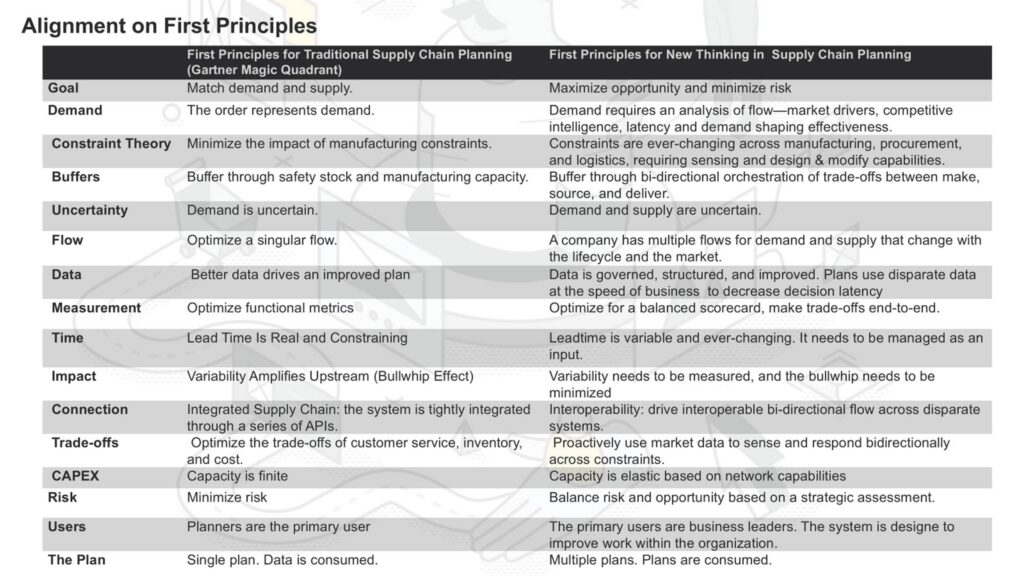
The future of APS cannot be a mere upgrade of existing interfaces. It requires a fundamental shift in first principles:
- From Functional to Outcome-Based: Metrics must be aligned across the enterprise. If the CFO is only looking to squeeze costs while the supply chain head is trying to drive growth through reliability, the APS will never function as a single source of truth.
- Addressing Data Latency: Before automating with Agents, enterprises must solve the data ingestion problem. An AI agent is only as good as the latency of its input; if the data is stale, the agent simply automates the wrong decisions faster.
- The Outside-In Value Network: Rather than a rigid enterprise application, the next generation of planning should function as a value network. This approach prioritizes external signals, semantic reconciliation, and ontological frameworks over internal, siloed processes.
Implications for the C-Suite
The implications for executives are clear: the era of buying a "comprehensive" APS suite and expecting it to solve cross-functional misalignment is over. The "lipstick on a pig" approach—where vendors add marketing gloss to legacy code—is no longer masking the underlying architectural debt.
For the modern enterprise, the path forward involves three distinct steps:
- Experimentation with the Data Layer: Companies should focus on building a unified data model that accounts for external data sources—PMI data, freight indices, and commodity shifts—rather than just internal ERP data.
- Design Thinking for the Organization: Instead of designing for the "planner," organizations must design for the "process." This means mapping how work is actually performed across boundaries and building systems that support that flow, rather than forcing the process to conform to the software’s constraints.
- The End of "Build Your Own": While off-the-shelf software has flaws, the "roll your own" approach creates massive long-term technical debt. Companies lack the core competency to build supply chain engines, and attempting to do so usually leads to catastrophic maintenance issues.
Conclusion: The "Agentic" Mirage
While "Agentic AI" is currently the most popular buzzword in the sector, it is not a panacea. Without first reconciling the data latency issues and the fundamental misalignment of organizational goals, AI agents will simply become very efficient at propagating errors.
The future of supply chain planning lies not in bigger, more complex APS suites, but in simpler, more resilient architectures that accept the reality of non-linear systems. The "hero culture" must be replaced by systemic, data-driven alignment. Until companies address the foundational disconnects in their organizational goals and data integrity, the next generation of APS will be just as fragile as the last.
For those looking to navigate this shift, the focus must move away from the "platform" and toward the "network." The goal is not to control the supply chain through a centralized engine, but to orchestrate value through an agile, responsive, and deeply integrated ecosystem. The transition will be difficult, but for the modern enterprise, it is no longer optional.


 Sagoh


 Raul Delapena Setiawan

 Reynand Wu



 Azzam Bilal Chamdy

