
 Nana
Nana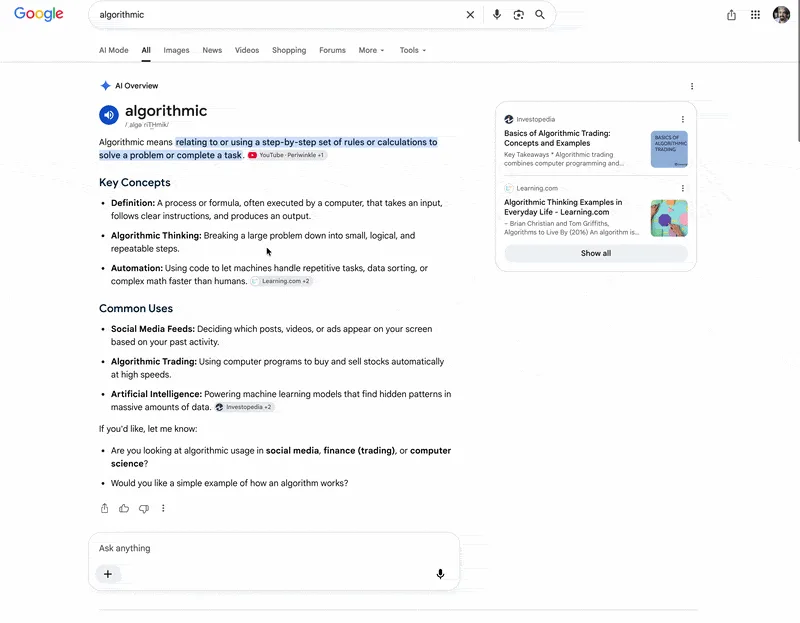
In a move that signals a seismic shift in how users interact with the world’s most popular search engine, Google has officially confirmed a new behavior for its AI Overviews. For a growing subset of search queries, Google is now automatically expanding its AI-generated responses to their "full state" upon arrival. This transition effectively eliminates the "Show more" button that previously acted as a gatekeeper for detailed information, pushing traditional "ten blue links" and organic search results further down the page—or, in some cases, out of immediate view entirely.
This development, first observed by search industry analysts and subsequently confirmed by Google, marks a departure from the company’s previous strategy of offering AI summaries as an optional, secondary layer. By defaulting to a full, expanded response, Google is aligning the standard Search interface more closely with its dedicated "AI Mode," fundamentally altering the ergonomics of the search experience.
The Chronology: From Optional Snippets to Default Immersion
To understand the magnitude of this update, one must look at the rapid evolution of Google’s Generative AI integration over the past eighteen months.
The Experimental Phase
When AI Overviews (formerly Search Generative Experience) were first introduced, they were designed as a tentative experiment. Users were presented with a concise summary of their query, followed by a prominent "Show more" button. This design choice served two purposes: it preserved screen real estate for publishers and advertisers, and it allowed users to opt-in to the AI’s deep-dive analysis.
The Shift Toward Automation
As of late August 2026, industry observers like Chris Long began noting a change in behavior. Users searching for specific information found that the AI Overview no longer required an interaction to display its full depth. Instead, the page would load with the AI response already fully expanded.
Google’s engineering teams have implemented a "politeness" failsafe to mitigate user frustration: if a user begins scrolling the page immediately upon the results loading, the system cancels the automatic expansion to prevent the content from "jumping" and causing the user to lose their reading position. This nuance highlights Google’s delicate balancing act: wanting to be the primary source of information while avoiding a jarring user experience.
Supporting Data: Why This Matters to the Ecosystem
The implications for the SEO and publishing communities are profound. For years, the primary metric of success for websites has been the "click-through rate" (CTR) derived from organic search rankings.

The Erosion of Organic Visibility
By expanding AI Overviews by default, Google is effectively increasing the "zero-click" potential of the search results page (SERP). When an AI response occupies the entire upper half of a mobile screen—or a significant portion of a desktop display—the traditional search results are pushed below the fold.
Industry analysts suggest that this is not a temporary A/B test but a long-term strategic pivot. While Google recently introduced "link carousels" for developing topics within AI Mode to encourage traffic to external sites, the efficacy of these carousels remains a subject of intense debate. When a user receives a comprehensive, synthesized answer directly from Google’s LLM, the perceived utility of clicking through to an external website diminishes significantly.
The "AI Mode" Convergence
Chris Long, a prominent voice in the SEO community, captured the industry’s alarm in a viral post on X: "Holy moly SEOs: Google is now revealing the AI Mode prompt box BY DEFAULT for some queries. This is how Google continues to push AI Mode as the default search experience."
This sentiment echoes a broader industry fear: that the distinction between "Search" and "AI" is vanishing. If AI-generated summaries become the default, the web becomes a training ground for Google’s models rather than a destination for traffic.
Official Responses and Corporate Strategy
When reached for comment, Google representatives framed the update not as a detriment to the web ecosystem, but as a feature designed to enhance user convenience and information density.
The User-Centric Narrative
Google’s official stance emphasizes that users prefer receiving the most relevant information as quickly as possible. By removing the "Show more" interaction, the company claims it is streamlining the path to knowledge. A spokesperson noted that the goal is to reduce the friction between a query and a comprehensive answer, allowing users to reach the heart of their information needs without unnecessary navigation steps.
The Strategic "Baby Steps"
While Google did not provide specific metrics regarding the percentage of queries impacted by this change, it is widely understood that this is a phased rollout. Sources close to the project suggest that the expansion is currently limited to queries where the AI can provide a high-confidence, comprehensive summary. However, history suggests that as the model’s reliability and speed improve, this behavior will likely expand to a larger percentage of total search traffic.

Implications: A New Era for SEO and Digital Publishing
The move to a "fully expanded by default" model creates a new reality for digital stakeholders.
The Decline of the "Middle-of-the-Road" Content
Websites that rely on providing basic facts or summarized information—the "what is" and "how to" content—are most at risk. If Google’s AI can synthesize this information into a high-quality, fully expanded answer, the organic traffic to these pages will likely see a significant decline.
To remain relevant, publishers may need to shift their focus toward:
- Unique Perspectives and Analysis: Content that offers a viewpoint or proprietary insights that an AI cannot replicate through synthesis.
- Community and Experience: Fostering engagement that AI cannot provide, such as forums, interactive tools, and expert-led discussions.
- Brand Authority: Becoming a destination where users go specifically for a creator’s voice, rather than just raw information.
The Monetization Conflict
As organic traffic patterns shift, the digital advertising landscape faces a reckoning. If Google captures more user attention within its own interface, the traditional display ad model—which relies on high-volume traffic to publisher websites—may face further pressure. While Google has begun experimenting with ads within AI-generated responses, this remains a nascent and potentially volatile area for publishers who rely on Google’s ad tech ecosystem.
The Future of Search Intent
We are moving toward a future where "Search" is synonymous with "Answer Engine." The days of treating search as a directory of external links are rapidly fading. For developers, marketers, and business owners, the directive is clear: you must adapt to a world where your content is either synthesized by an AI or forced to compete for attention below the fold.
Google’s decision to prioritize the AI Overview experience is a testament to the company’s belief in the supremacy of generative models. As this update continues to roll out, the metrics of success will shift from "clicks" to "influence" and "presence" within the AI’s response window. The web is not dying, but it is certainly being restructured—and the architects of that change sit firmly within the halls of Mountain View.
As the digital community watches these changes unfold, one thing is certain: the era of the "ten blue links" is entering its twilight, replaced by a fluid, conversational, and highly automated information ecosystem that promises to change the internet forever.


 Reynand Wu
 Iffa Jayyana
 Raul Delapena Setiawan

 Sagoh
Sagoh

 Azzam Bilal Chamdy
 Ali Ikhwan