Layla Zulfa
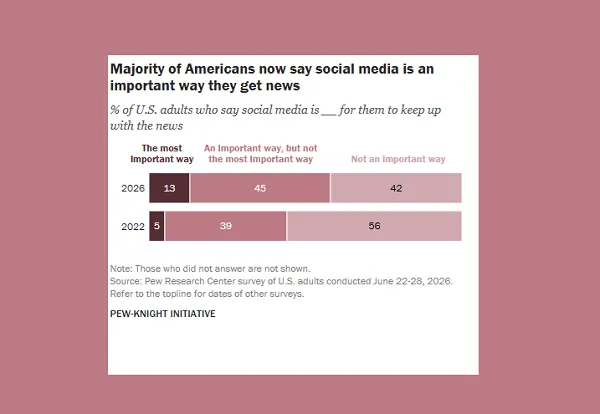
In an era defined by rapid information exchange, the traditional gatekeepers of journalism—newspapers, television broadcasts, and radio—are increasingly being bypassed by the algorithmic streams of social media. A landmark report published by the Pew Research Center on October 23, 2026, confirms a tectonic shift in the American media landscape: more than half of the adult population now identifies social media as a primary, essential vehicle for consuming news and navigating current events.
This shift is not merely a change in habit; it is a fundamental reconfiguration of how the democratic public stays informed, debates policy, and perceives reality. As platforms evolve from mere networking sites into the modern "public square," the tension between free expression and the spread of misinformation has reached a fever pitch, prompting intervention from the highest levels of government.
The Data: A Rapid Ascent in Digital Reliance
The Pew Research study, which surveyed over 3,500 U.S. adults in June 2026, paints a clear picture of an accelerated trend. Currently, 58% of Americans report that social media is an important connector to current events. Even more striking is the intensity of this reliance: 13% of all U.S. adults now consider these platforms their most important source of information.
When extrapolated against the total U.S. adult population—estimated by the Annie E. Casey Foundation to be approximately 270 million—this data suggests that roughly 35 million Americans are fundamentally dependent on social platforms to understand the world around them.
This represents a significant departure from the data Pew recorded just four years prior. In 2022, only 43% of U.S. adults identified social media as an important news source, and a mere 5% considered it their primary resource. The 8-percentage-point jump in "primary reliance" over four years signals that social media has moved from a secondary or supplemental news feed to the dominant hub of public discourse.
Chronology of the Shift: From Networking to Newsroom
The transformation of social media into a primary news source did not occur in a vacuum. It is the result of a multi-year evolution in platform architecture and user behavior:
- 2021: Meta founder Mark Zuckerberg openly acknowledges the hazards of engagement-driven algorithms, noting that users gravitate toward sensationalist, provocative content. He advocates for stricter content moderation to prevent polarization.
- 2022: Elon Musk acquires Twitter (now X), driven by the belief that previous management teams were manipulating public discourse through shadow-banning and algorithmic interference. This marks a pivotal moment where "platform neutrality" becomes a mainstream political demand.
- 2023–2024: The emergence of the "censorship-industrial complex" narrative gains traction among conservative lawmakers and free-speech advocates, who argue that government agencies have been colluding with platforms to suppress dissenting viewpoints.
- December 2025: U.S. Secretary of State Marco Rubio announces formal government actions aimed at dismantling organized efforts to coerce platforms into suppressing specific American viewpoints, characterizing these efforts as a threat to democratic integrity.
- January 2026: In a stunning reversal of his 2021 stance, Zuckerberg announces a policy shift at Meta, significantly rolling back fact-checking measures to allow for "more speech." This signals a move away from the moderation models that dominated the early 2020s.
Official Responses and the "Censorship-Industrial Complex"
The rising influence of social media has not gone unnoticed by the legislative and executive branches. The debate has largely centered on the concept of the "censorship-industrial complex," a term used to describe a network of activists, non-profits, and government officials allegedly working in concert to police online discourse.
Critics of this "complex" argue that it has been used to marginalize controversial but valid political opinions under the guise of "misinformation mitigation." Conversely, proponents of regulation argue that without active moderation, social media platforms become breeding grounds for dangerous falsehoods that threaten public safety and the stability of electoral processes.
Secretary of State Marco Rubio’s late-2025 announcement served as a watershed moment in this conflict. By framing the actions of activists and certain corporate policies as a "coercive" threat to the American perspective, the administration signaled a pivot toward a more laissez-faire approach to platform management, prioritizing the prevention of "suppression" over the containment of "misinformation."
The Algorithmic Dilemma: Engagement vs. Truth
At the heart of the current crisis is the fundamental design of social media algorithms. These systems are not built to curate the most accurate news; they are built to maximize engagement. Because human psychology is naturally drawn to high-arousal content—anger, fear, and shock—the most effective way to keep a user on a platform is to feed them controversial, divisive, and often borderline content.
As Zuckerberg noted in 2021, this phenomenon is not unique to the digital age; it has been the lifeblood of tabloid journalism and cable news for decades. However, the scale at which it operates today is unprecedented. In the past, sensationalism was confined to specific newspapers or channels. Today, it is optimized by artificial intelligence, capable of reaching millions of people in a matter of minutes.
The Zuckerberg Reversal: A Dangerous Precedent?
The most jarring development in this ongoing saga is the ideological flip-flop displayed by Meta leadership. In 2021, Zuckerberg argued that unchecked content leads to mass polarization and social harm. Yet, by early 2025, he justified a move toward less moderation by stating that the company has a moral obligation to facilitate more, rather than less, discussion.
This shift has resulted in the relaxation of rules governing highly charged topics, including immigration, public health, and gender identity. Critics suggest this reversal is a calculated attempt to avoid the political heat of the "censorship" accusations, even if it comes at the cost of increased social friction. By abandoning fact-checking mechanisms, Meta is essentially washing its hands of the responsibility to maintain a factual baseline in public discourse, choosing instead to become a neutral conduit for whatever content generates the most interaction.
Implications for the Future of Democracy
As social media cements its status as the primary news source for the American public, the implications for the future of democracy are profound.
1. The Erosion of Shared Reality
When citizens no longer share a common set of facts—or even a common platform where those facts are vetted—the ability to reach a national consensus becomes nearly impossible. If algorithms are designed to push users toward extreme content, they are effectively reinforcing echo chambers that make cross-partisan understanding increasingly difficult.
2. The Power of Private Governance
We are witnessing a shift where private corporations—accountable to shareholders and their own internal policies—have more power over the "public square" than any government entity. The decision by a few CEOs to tweak an algorithm or change a moderation policy can shift the national conversation overnight. This raises a critical question: should we allow private entities to set the parameters of free speech, or is it time for a new legal framework that treats these platforms as essential public utilities?
3. The Weaponization of Information
The move away from fact-checking and the potential for bad actors to manipulate algorithms remain a significant national security concern. If foreign adversaries or domestic extremists can easily exploit these platforms to spread false narratives, the reliance of 35 million Americans on these sources for news represents a significant vulnerability.
Conclusion
The data from Pew Research is clear: the era of traditional news dominance is over. We have entered an age where social media is the primary window through which the public views the world.
While this transition has undoubtedly democratized the ability to report and share news, it has also introduced systemic instabilities. The government’s move to curb the influence of "censorship" advocates, combined with the platforms’ retreat from active fact-checking, leaves the American public in a precarious position. We are left with a system that prioritizes engagement above all else, where the loudest, most controversial voices are amplified, and the truth is left to fight for air in an environment designed for noise.
Moving forward, the debate will not be about whether social media should be a news source, but rather how we can ensure that this digital public square serves the interests of a functioning democracy rather than undermining the very foundation of our society. The challenge for the next decade will be to find a balance between protecting the open flow of ideas and safeguarding the integrity of the information that powers our democratic life.


 Nila Kartika Wati

 Lina Irawan

 Laily UPN
 Rifan Muazin