
 Raul Delapena Setiawan
In a development that has sent shockwaves through the console gaming and cybersecurity industries, the Nintendo Switch 2—a console barely settled into its lifecycle—has been subjected to a significant security compromise. Security researcher Sammy Hajhamid, known in the modding community as "Pepsipu," has publicly demonstrated a software-only "userland" jailbreak that grants users unprecedented control over the hardware.
This exploit, dubbed "ns2jb," does not require physical hardware modifications, soldering, or complex voltage injections. Instead, it leverages a sophisticated chain of software vulnerabilities, beginning with an unexpected gateway: a legacy programming environment. The implications of this breach are profound, potentially opening the door to widespread game modding, homebrew development, and unauthorized system access, while simultaneously challenging Nintendo’s hardware security model.
The Anatomy of the Exploit: Main Facts
The "ns2jb" jailbreak functions as a tethered exploit, requiring the console to be connected to a macOS or Linux-based PC on the same network to facilitate the initial breach. Once executed, the jailbreak provides what is known as "userland" access—a level of privilege that allows the execution of non-signed code, the modification of game files, and the extraction of save data.
Key capabilities unlocked by the exploit include:
- Homebrew Execution: Users can run unauthorized software, including emulators and custom utilities.
- Game Modification: Access to the console’s file system allows for the alteration of game assets, such as character models and textures.
- Data Preservation: Users can bypass system restrictions to back up save files locally.
- Peripheral Interaction: The exploit grants access to most of the console’s internal peripherals through Memory Mapped I/O (MMIO), providing a playground for hardware hackers to interface with the system’s components.
A Two-Week Odyssey: Chronology of the Hack
The discovery of this exploit was not a stroke of immediate luck, but rather the result of a rigorous, two-week-long "poking" process. Hajhamid’s methodology provides a fascinating case study in modern vulnerability research, utilizing artificial intelligence as a force multiplier.
The AI-Assisted Discovery
Hajhamid utilized OpenAI’s Codex, an AI model designed for code generation, to analyze the inner workings of SmileBasic 4. Originally developed as a programming language for Nintendo hardware, SmileBasic 4 acted as the unwitting entry point for the entire exploit chain.
To conduct his research, Hajhamid constructed a custom hardware harness. This setup included a physical link to send USB commands to the console and a visual feedback loop via HDMI, allowing him to monitor the console’s responses in real-time. He even integrated a Bluetooth-enabled light switch to automate the power-cycling of the console, a necessary step for testing the system’s boot behavior repeatedly.
The Chain of Vulnerabilities
- The Array Overflow: After two weeks of intensive testing, Hajhamid discovered a 32-bit integer overflow within SmileBasic 4. This occurred specifically when removing elements from an array. This error exposed an array pointer, effectively granting the researcher read/write access to segments of the system memory.
- Sysmodule Escalation: With a foothold in memory, Hajhamid began targeting the Switch 2’s internal system modules (sysmodules). He sought modules that possessed higher-level privileges than the base SmileBasic environment.
- The FileSystem Breach: His persistence paid off when he identified a buffer overflow within the console’s FileSystem services module. This vulnerability exposed a cached data pointer, which he leveraged to gain arbitrary read/write privileges over the filesystem.
- Native Execution: Finally, by faking a filesystem process, Hajhamid achieved native code execution. This effectively bypassed the console’s primary security gatekeepers, allowing the system to run arbitrary software as if it were legitimate Nintendo-signed code.
Supporting Data and Proof of Concept
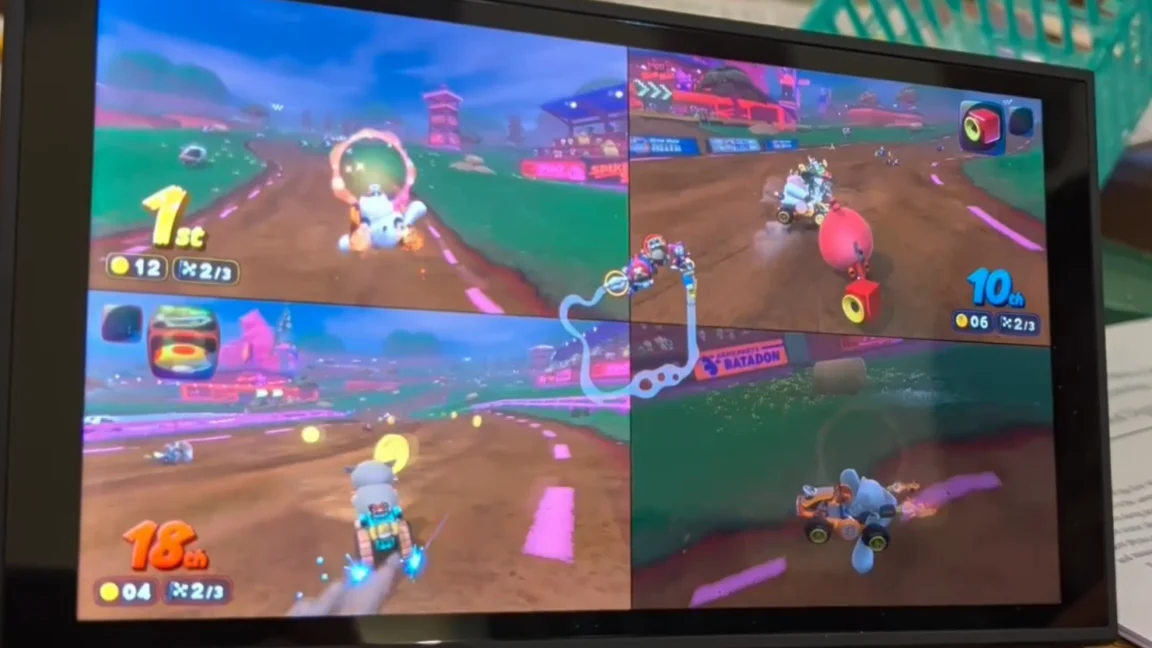
The legitimacy of the "ns2jb" exploit has been verified by the wider developer community. Hajhamid provided immediate proof of concept by modifying Mario Kart World, showcasing entirely custom character models that were not present in the base game.
The online community has since mobilized. Platforms like X (formerly Twitter) and dedicated Reddit communities for Switch 2 hacking have been flooded with demonstrations of the exploit. These include:
- Vulkan GPU Access: Developers have successfully initialized the console’s Vulkan-based GPU drivers within userland, a significant step toward running high-performance homebrew and porting PC titles.
- Developer Tooling: Early-stage tools are already being compiled to simplify the jailbreak process for end-users, moving it from a researcher’s laboratory setup to something potentially accessible to hobbyists.
Official Responses and Security Posture
As of this writing, Nintendo has remained silent regarding the "ns2jb" exploit. Historically, the company has been aggressive in responding to security breaches, often utilizing firmware updates to patch vulnerabilities, revoking digital certificates, or pursuing legal action against those who facilitate piracy.
Industry analysts suggest that because this exploit relies on a software vulnerability within a specific third-party application (SmileBasic 4), Nintendo’s response will likely be two-fold:
- Application Patching: Nintendo may force an immediate update to SmileBasic 4 to remediate the integer overflow, effectively closing the "front door" of the exploit.
- System Firmware Lockdown: Nintendo will likely release a system-level firmware update that changes how system modules handle memory, specifically targeting the buffer overflow discovered in the FileSystem service.
However, the "cat and mouse" game is already in motion. Because the exploit provides such deep access to memory, researchers are already looking for ways to persist the hack even if the initial entry point is patched, though a "tethered" exploit typically requires the user to stay on an older, vulnerable firmware version.
The Broader Implications
The jailbreaking of a console within its early life cycle presents significant challenges for both the manufacturer and the gaming ecosystem at large.
Implications for Nintendo
The primary concern for Nintendo is the integrity of its digital ecosystem. If the Switch 2’s security can be bypassed at the filesystem level, the risk of piracy becomes a critical threat. Unauthorized distribution of software could undermine the company’s revenue streams, which are heavily reliant on the "walled garden" approach. Furthermore, if users can modify game files, the integrity of online leaderboards and multiplayer environments becomes impossible to verify, potentially forcing Nintendo to implement stricter, more intrusive anti-cheat measures.
Implications for the Modding Community
For the homebrew community, this is a "golden age" moment. The ability to access MMIO and the GPU directly allows for hardware-level optimizations that were previously impossible. We are likely to see a surge in "fan patches" that improve framerates, enhance graphics, or add quality-of-life features to games that Nintendo might otherwise leave untouched.
The Cybersecurity Perspective
From a broader cybersecurity standpoint, the use of AI tools like Codex to identify complex memory vulnerabilities marks a shift in how exploits are discovered. The "two-week" turnaround from research to functional native code execution is alarmingly fast, suggesting that the barrier to entry for discovering zero-day vulnerabilities is lowering. Security researchers and developers will now have to contend with a world where AI can automate the tedious process of fuzzing and code analysis, potentially leading to more frequent breaches of consumer electronics.
Conclusion
The "ns2jb" jailbreak is a testament to the persistence of the security research community. By combining legacy software, modern AI, and traditional reverse engineering, Sammy Hajhamid has cracked open a console that Nintendo spent years trying to secure.
While the exploit is currently a technical curiosity used by enthusiasts and developers, it serves as a wake-up call for the console industry. As the line between gaming consoles and high-powered personal computers continues to blur, the security models governing these devices will need to evolve. For now, the Switch 2 remains in a state of vulnerability, with both the modding community and Nintendo preparing for the next phase of this ongoing digital conflict. The question remains: will this breach lead to a more open, user-accessible ecosystem, or will it trigger a period of intense, restrictive security measures that define the future of the platform? Only time—and the next firmware update—will tell.


 Reynand Wu

 Sagoh



 Azzam Bilal Chamdy

 Ali Ikhwan
