
 Nana Muazin
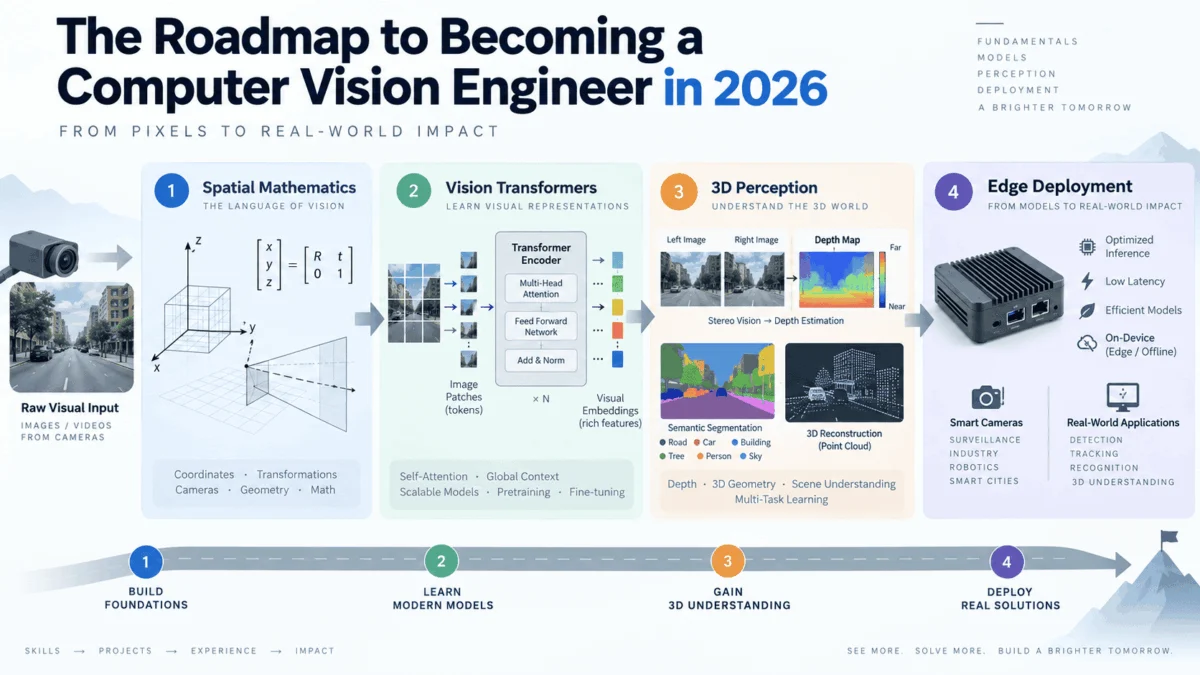
Computer vision (CV) has undergone a tectonic shift. What was once a domain defined by the rigid constraints of object detection and static image classification has evolved into a sophisticated, multi-disciplinary field. In 2026, the modern computer vision engineer operates at the high-stakes intersection of foundation models, spatial computing, and hardware-accelerated inference. They are no longer just training models; they are architecting systems that perceive, reason over, and act upon the physical world in real-time.
As industries ranging from autonomous transport and robotic logistics to advanced medical diagnostics and augmented reality (AR) accelerate their adoption of AI, the demand for "full-stack" vision engineers—those who can bridge the gap from sensor data to production-grade deployment—has never been higher. This guide outlines the rigorous, four-stage evolution required to master this discipline.
The Core Pillars of Modern Computer Vision
The modern CV stack is built upon a hierarchy of skills. To build robust, production-ready systems, an engineer must move fluidly from the fundamental mathematics of light and geometry to the high-level reasoning capabilities of vision-language models (VLMs), eventually grounding their work in the physical realities of edge-based inference.
Stage 1: Spatial Mathematics and Foundational Primitives
Before touching a transformer architecture, an engineer must possess a visceral understanding of how the 3D world is projected onto a 2D sensor. This is the "geometry of vision."
- Matrix Transformations and Coordinate Frames: At the heart of every CV system lies the need to relate coordinate systems. Whether aligning a LiDAR point cloud with an RGB camera or calibrating a multi-camera rig for a warehouse robot, understanding projective geometry is non-negotiable.
- The Power of PyTorch: As the industry standard, PyTorch remains the bedrock for both research and industrial implementation. Proficiency here includes custom data loading and efficient tensor manipulation.
- Synthetic Augmentation: Real-world data is expensive and often biased. Using libraries like Albumentations, engineers must learn to generate high-fidelity synthetic transformations—simulating lighting shifts, occlusions, and geometric distortions—to build resilient models without needing to collect terabytes of raw data.
- Feature Representation: The divide between convolutional backbones (like ResNet or EfficientNet) and modern attention-based architectures is critical. Understanding contrastive learning—where models learn by comparing similar versus dissimilar examples—is the foundational technique for creating meaningful visual embeddings.
Essential Resource: Multiple View Geometry in Computer Vision by Hartley and Zisserman remains the definitive canonical text for understanding the underlying math of vision.
The Rise of Foundation Models: A Paradigm Shift
Stage 2: Vision Transformers and Multimodal Foundation Models
The shift from Convolutional Neural Networks (CNNs) to Vision Transformers (ViTs) has changed the rules of the game. By treating images as sequences of patches and applying self-attention, these models have unlocked a scale of understanding previously thought impossible.
The Era of Open-Vocabulary Understanding
The most significant leap in recent years is the emergence of Vision-Language Models (VLMs) such as CLIP and SigLIP. By training on massive, internet-scale datasets, these models learn joint embeddings across image and text modalities.
- Open-Vocabulary Detection: Techniques like Grounding DINO allow engineers to detect objects based on natural language prompts rather than predefined class labels. This eliminates the need for expensive, task-specific training on every new object class.
- Promptable Segmentation: Meta’s SAM 2 (Segment Anything Model 2) has fundamentally altered segmentation pipelines. By allowing users to provide points, boxes, or text prompts, engineers can generate high-quality segmentation masks in zero-shot scenarios, both for images and live video streams.
The modern CV engineer’s value is increasingly defined by their ability to "compose" these models. The task is no longer just training; it is identifying where these models fail—such as in cases of domain shift or fine-grained classification—and wrapping them in robust system architectures.
From Pixels to Spatial Reality
Stage 3: 3D Vision, Neural Rendering, and Spatial Perception
As vision systems move toward robotics and spatial computing, the requirement to reconstruct the 3D world has become paramount.
- Geometric Representations: Engineers must be fluent in the trade-offs between point clouds (ideal for LiDAR), voxel grids (better for structured, dense space), and Signed Distance Fields (SDFs), which enable differentiable rendering.
- Monocular Depth Estimation: With the advent of models like Depth Anything v2, the ability to extract precise metric or relative depth from a single RGB image has become a standard tool, reducing reliance on expensive depth sensors.
- Neural Rendering and Gaussian Splatting: NeRFs introduced the ability to synthesize novel views, but 3D Gaussian Splatting has superseded them in many real-time applications. By representing a scene as a collection of 3D Gaussians, systems can achieve photorealistic, interactive view synthesis on consumer-grade hardware.
- SLAM and Visual Odometry: For autonomous agents, the ability to map an environment while simultaneously estimating one’s own location—Simultaneous Localization and Mapping (SLAM)—is the holy grail of spatial perception.
The Final Mile: Performance and Deployment
Stage 4: Inference Optimization and Edge Deployment
The final, and often most difficult, stage of the roadmap is the transition from a GPU-heavy research environment to a constrained, real-world deployment. A model that runs at 5 FPS on an A100 is useless in an industrial robotics application that requires 30+ FPS at the edge.
Techniques for Model Compression:
- Quantization: Reducing the precision of model weights (e.g., from FP32 to INT8) to minimize memory footprint and boost inference speed with minimal accuracy degradation.
- Pruning: Removing redundant connections in a neural network to streamline execution.
- Distillation: Training a smaller "student" model to mimic the performance of a larger, more complex "teacher" model.
Hardware Execution Frameworks:
Engineers must master the hardware-specific toolkits: NVIDIA TensorRT for GPU acceleration, ONNX Runtime for cross-platform portability, and Intel OpenVINO for CPU-based vision tasks. For embedded deployment, familiarity with hardware like the NVIDIA Jetson series or dedicated NPUs (Neural Processing Units) is now a core requirement.
Pipeline Engineering:
Deploying a single model is rarely enough. Real-world systems often involve multiple streams, frame synchronization, and complex ingestion pipelines. Tools like NVIDIA DeepStream allow engineers to build high-throughput, GPU-accelerated video analytics pipelines that handle everything from RTSP streaming to metadata output.
Implications for the Future of the Workforce
The trajectory of computer vision is clear: the field is moving away from bespoke, isolated models toward integrated, multimodal, and spatial-aware ecosystems.
Why This Roadmap Matters
The "full-stack" vision engineer is currently the most sought-after profile in the AI job market. Companies are no longer looking for researchers who can simply push the state-of-the-art on a leaderboard; they are looking for engineers who can deploy those breakthroughs into a physical environment that is messy, variable, and resource-constrained.
The Path Forward
For those looking to enter or advance in the field, the strategy is simple but demanding:
- Iterate on Projects: Do not just read papers. Implement a stereo depth pipeline. Build a zero-shot detection demo using Grounding DINO. Quantize a YOLOv8 model and benchmark it on an edge device.
- Understand the Hardware: A CV engineer who does not understand the constraints of the hardware they are deploying on will always hit a ceiling.
- Embrace Versatility: The most successful engineers are those who can zoom out to the high-level system architecture and zoom in to the individual tensor operations.
As Vinod Chugani, an expert in AI education and technical mentorship, notes: "The engineers who stand out are those who can move fluidly between levels of abstraction—from the geometry of a camera model to the instruction set of an edge accelerator."
In 2026, computer vision is no longer a peripheral skill; it is the fundamental bridge between digital intelligence and the physical world. By following this systematic, four-stage progression, aspiring engineers can build the versatile skill set required to master the visual world of tomorrow.

 Nila Kartika Wati

 Sagoh

 Raul Delapena Setiawan

 Jia Lissa
 Nana
