Nila Kartika Wati
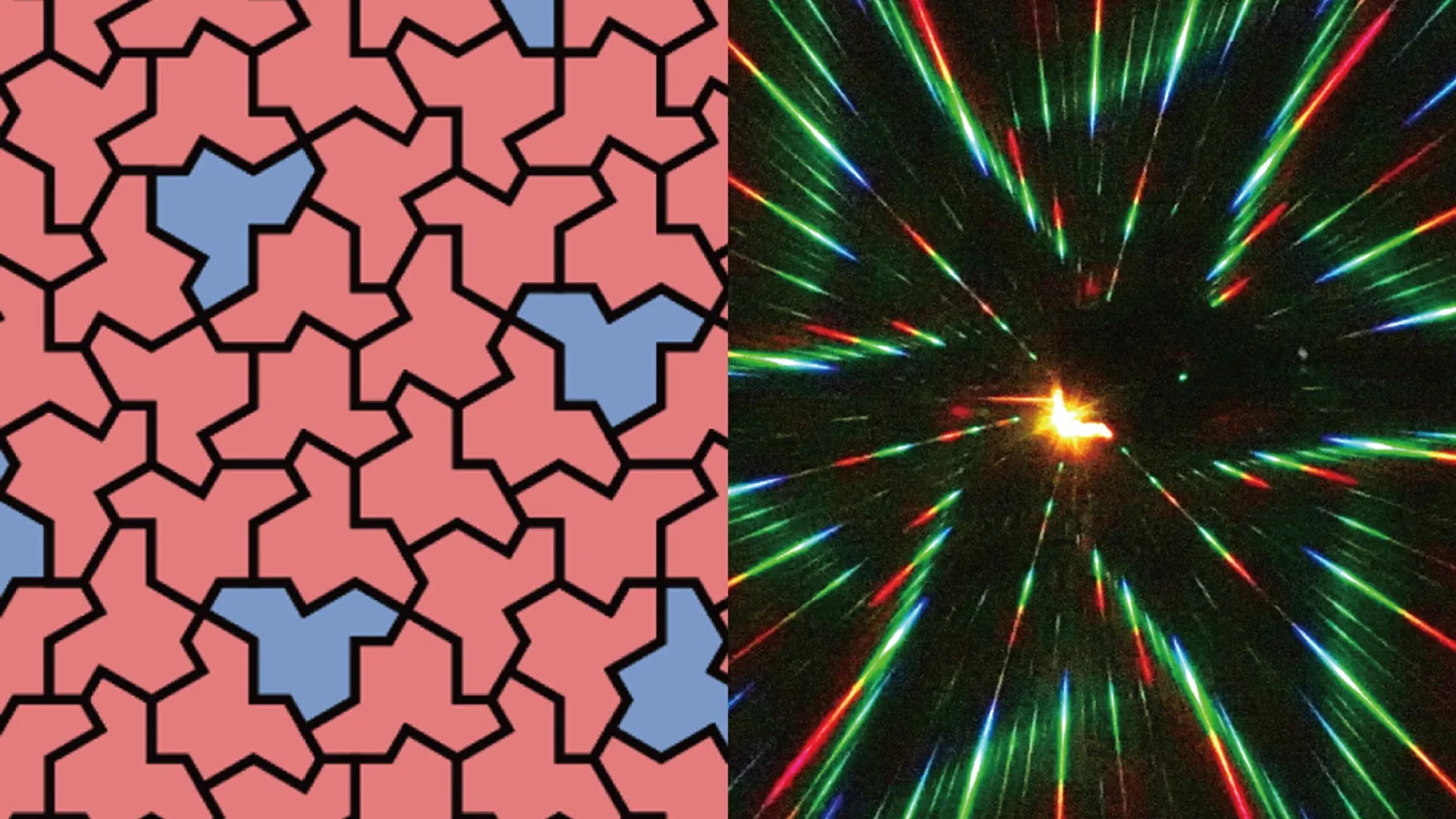
In the annals of geometry, few puzzles have proven as elusive as the "Einstein problem." For decades, mathematicians sought a single, solitary shape—a monotile—capable of tiling a two-dimensional plane without ever repeating its pattern. In 2023, the world watched as a team of researchers unveiled the "hat" tile, an aperiodic shape that finally laid the decades-old quest to rest. But as it turns out, this mathematical triumph was merely the opening act.
In a landmark study recently published in Nature Communications, researchers from the Institute of Industrial Science at The University of Tokyo, in collaboration with international partners, have demonstrated that the "hat" is more than just a geometric anomaly. By translating this abstract mathematical form into the physical realm of nanophotonics, the team has discovered that the shape possesses the unique ability to manipulate light in chiral, pinwheel-like patterns. This breakthrough bridges the gap between pure mathematics and applied physics, suggesting that the very geometry of our universe may hold the key to the next generation of optical technology.
The Chronology of a Geometric Revolution
The Decades-Long Hunt for the "Einstein"
The quest for an "aperiodic monotile"—a shape that can tile a plane without creating a repeating periodic structure—was formally dubbed the "Einstein problem." The term is a clever linguistic play on the German ein stein, meaning "one stone." For years, scientists believed such a shape might not exist. While "aperiodic tilings" (like the famous Penrose tilings) were known, they required at least two distinct tile shapes to function. The challenge was to find a single, solitary shape that could do the job alone.
The 2023 Breakthrough
In 2023, the mathematical community was electrified when a team of researchers led by David Smith unveiled the "hat" tile. This 13-sided polygon, when arranged in a specific, non-repeating configuration, fills an infinite plane without ever settling into a grid or repeating pattern. The discovery provided a definitive "yes" to the Einstein problem, cementing the hat’s place in mathematical history.
The Transition to Nanophotonics
Following the mathematical validation of the hat, Yuto Moritake and his colleagues at the University of Tokyo began to wonder: if this shape is so unique in its geometric arrangement, what happens when it is imposed upon the physical world? In late 2023 and early 2024, the team utilized electron beam lithography to etch nanoscale versions of the hat tiling onto silicon nitride films. By transitioning from the abstract whiteboard to the laboratory cleanroom, the team sought to observe how light—the most sensitive probe in physics—would interact with the hat’s aperiodic symmetry.
Decoding the Physics: Why Chirality Matters
The core of the researchers’ discovery lies in the concept of chirality. In the physical sciences, an object is chiral if it cannot be superimposed onto its mirror image; like a human hand, it has a distinct "left" or "right" orientation.
When the researchers shone laser light through their fabricated hat-tiled nanostructures, they observed diffraction patterns that were fundamentally different from those produced by conventional quasicrystals. Typically, a quasicrystal produces a diffraction pattern that reflects its internal order. However, because the hat tiling lacks mirror symmetry, the light itself underwent a transformation.
"We found that the diffraction patterns themselves become chiral because the structure lacks mirror symmetry," explains senior author Masaya Notomi. "This kind of optical response is fundamentally different from that observed in conventional quasicrystalline materials."
The resulting diffraction pattern formed a distinct, pinwheel-like arrangement. This is not merely an aesthetic curiosity; it indicates that the structural "handedness" of the monotile is being imprinted directly onto the light waves passing through it.
Supporting Data and Experimental Mechanics
To understand the magnitude of this effect, the team scrutinized how the structures responded to variations in incident light. The experiments yielded three primary insights:
- Symmetry-Controlled Optical Response: The diffraction patterns were inextricably linked to the underlying tiling. When the physical structure was flipped, the chiral response of the light reversed, providing definitive proof that the light was "reading" the geometric information of the hat tile.
- Polarization Sensitivity: The researchers observed that the light’s response shifted based on the polarization of the incoming laser. This suggests that the hat-tiled nanostructures act as sophisticated filters or modulators, capable of selectively interacting with specific states of light.
- Aperiodic Diffraction: Unlike traditional crystals—where diffraction spots appear in a predictable, periodic grid—the hat tile produced a complex, quasiperiodic diffraction field. This field is dense with information, offering a high-dimensional playground for light manipulation that is impossible to achieve with standard, periodic optical materials.
Perspectives from the Research Team
The team, led by Yuto Moritake and Masaya Notomi, views this discovery as a foundational step toward a new field of "geometric optics."
"What is especially fascinating about the hat tile is that, although the resulting pattern appears irregular at first glance, it is actually constructed from the honeycomb lattice," Moritake notes. "We wanted to see whether this unique shape could also produce any unexpected physical phenomena."
By grounding their research in the honeycomb lattice while simultaneously breaking its periodic constraints, the team has created a material that sits at the "sweet spot" between total chaos and rigid structure. This middle ground is where the most interesting optical physics occurs.
"These results open a new direction of research on the fusion of quasiperiodic order and chirality," Moritake adds. "Monotile patterns provide a platform for exploring optical phenomena that emerge from the interplay of symmetry, chirality, and aperiodicity."
The Broader Implications: Toward Future Technologies
While the current findings are primarily fundamental, the implications for applied technology are profound. The ability to control light through geometry—rather than through bulk material properties—is the holy grail of modern nanophotonics.
1. Advanced Polarization Control
Current polarization optics, such as wave plates and polarizers, often rely on bulky crystals or complex thin-film stacks. Aperiodic monotile surfaces, being inherently thin and lithographically definable, could allow for the creation of ultra-compact "metasurfaces." These surfaces could manipulate the polarization of light at the chip level, enabling faster, more efficient telecommunications and sensing equipment.
2. Next-Generation Imaging and Lithography
The chiral diffraction patterns observed by the team could be harnessed to create new types of optical lenses or sensors that are sensitive to the chirality of light. This has massive potential for biology and chemistry, where detecting the "handedness" of molecules (which are often themselves chiral) is vital for pharmaceutical development and diagnostics.
3. A New Paradigm for Material Science
Perhaps the most significant implication is the shift in how we think about "order." For centuries, science has categorized materials as either crystalline (ordered) or amorphous (disordered). The Einstein monotile represents a third way: the quasiperiodic state. By proving that this state can host unique physical behaviors like chiral light interaction, the researchers have effectively opened a new periodic table of geometric possibilities.
Conclusion: Geometry as the Ultimate Tool
The transformation of the "hat" from a mathematical solution to a physical tool is a testament to the unpredictable nature of scientific discovery. What began as a question about how to tile a floor has evolved into a study of how to control the fundamental nature of light.
As we look toward the future, the work of the University of Tokyo team serves as a reminder that the boundary between "pure" and "applied" science is often permeable. The Einstein monotile, having conquered the world of geometry, is now poised to conquer the world of physics. By mastering the interplay between the symmetry of the tile and the behavior of the photon, researchers are laying the groundwork for a future where our devices are not just powered by electricity, but shaped by the very geometry of the universe itself.
The "hat" may have been the final answer to an old mathematical puzzle, but in the laboratory, it is clearly the first word of a much larger, brighter conversation.


 Sagoh

 Raul Delapena Setiawan

 Jia Lissa

 Nana