
 Ammar Sabilarrohman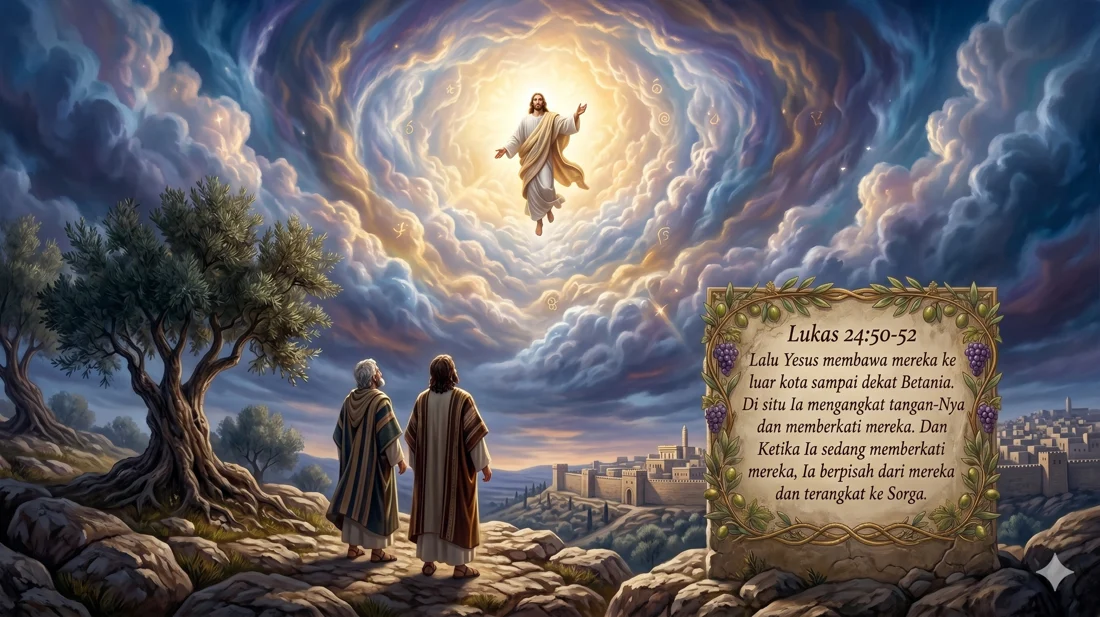
Despite its critical place in the liturgical calendar, the meaning and distinctiveness of Ascension Day are often a source of confusion for many, frequently conflated with the Resurrection of Easter. This article aims to clarify the profound theological underpinnings of the Ascension, differentiate it from Easter, explore its enduring implications for believers, and highlight its observance, particularly within Indonesia.
Understanding the Ascension of Jesus Christ: A Pivotal Moment
The Ascension of Jesus Christ is not merely a historical event but a profound theological truth that underpins much of Christian doctrine. It signifies Christ’s glorious return to heaven, completing His redemptive work on Earth. This moment symbolises His perfect glorification and serves as an unwavering assurance for Christians regarding the ultimate purpose of their spiritual journey: union with God.
While often perceived as a physical separation, the Ascension is celebrated with deep reverence as a powerful symbol of hope and the promise of heavenly dwelling. For believers, it is a sacred occasion that commemorates the opening of the gates to eternal life in heaven.
The Theological Significance Beyond a Physical Departure
According to Vatican News and consistent Christian theology, the Ascension offers believers a guarantee of the ultimate destination of their life’s journey. The theological narrative posits that Jesus’ mission extended beyond merely introducing a new way of living; it was to demonstrate that the zenith of human existence is reunification with the Creator.
This event became a transformative turning point, imbuing all earthly experiences, including suffering and moments of contradiction, with new meaning. Over time, this interpretation has been embraced as a constant reminder that life’s challenges are not an end in themselves, but rather a path towards the glory pioneered by Jesus Christ.
Crucially, the Ascension, while marking the end of Jesus’ visible physical presence, is not interpreted by Christians as a sorrowful farewell. Instead, it is understood as a transformation in Jesus’ mode of being. He is now present spiritually and universally, transcending the limitations of space and time to perpetually accompany His followers.
The biblical account in the Book of Acts describes Jesus being "taken up" into heaven. This specific phrasing underscores that the Ascension was an act of God. A cloud then obscured Him from the disciples’ view, a detail that historically evokes the symbolism of God’s presence at Mount Sinai (Exodus 24:15) and during the Transfiguration (Mark 9:7).
It is imperative to grasp that the Ascension is not a physical "separation" that instils sadness, but rather a source of immense joy. This is because the gateway to heaven and eternal life has been irrevocably opened.
A New Orientation for Human Life
In Christian theology, the Ascension of Jesus imparts a fresh orientation and purpose to human existence. Jesus did not merely arrive to teach a virtuous way of life; He also revealed the ultimate destination of that life. Through this event, every aspect of the world, including difficult and seemingly contradictory moments, acquires new meaning. The Ascension assures believers that this world is a journey towards heaven, and every human action can become a pleasing offering to God.
The Ascension of Jesus, both in body and soul, further affirms that human life, including the physical body, is not an impediment to reaching heaven. Rather, the body and all facets of earthly life are instruments for achieving glory in communion with the Father. Because Jesus died, rose (Easter), and now ascended into heaven (Ascension), the gates of eternal life have been opened for humanity. Christians hold the certainty that if Jesus has risen and ascended to heaven, so too can they aspire to this ultimate destiny.
The Distinct Yet Interconnected Narratives: Ascension Day vs. Easter
While both are integral components of the Paschal Mystery and monumental events in Christian faith, Easter and Ascension Day possess distinct yet complementary meanings. Understanding their individual significance is key to appreciating the fullness of Christ’s redemptive work.
Easter: The Triumph Over Death and the Promise of New Life
Hari Paskah, or Easter Sunday, is celebrated as the pinnacle of Christian belief: the resurrection of Jesus Christ from death on the third day after His crucifixion. The primary focus of Easter is the triumphant victory over sin and death, offering humanity the promise of new, eternal life. It signifies God’s vindication of Jesus and His power over the grave, forming the bedrock of Christian hope. The celebration is marked by joy, renewal, and the affirmation that death is not the final word. Easter initiates the fifty-day period known as Eastertide, which culminates in Pentecost.
Ascension Day: The Completion of Mission and the Glorification of Humanity
In contrast, Kenaikan Yesus Kristus, commemorated precisely 40 days after Easter, marks the physical completion of Jesus’ earthly ministry. If Easter is about "resurrection," then Ascension is about Jesus’ "homecoming" to the Father in heaven, where He glorifies humanity and prepares the way for His followers. It is the moment when Christ, having conquered death and spent time teaching His disciples, physically ascends to God’s right hand.
Theological distinctions are crucial here:
- Purpose: Easter demonstrates Christ’s power over death; Ascension demonstrates His full authority and glorification in heaven, taking His resurrected humanity into the divine presence.
- Presence: Easter reveals Christ’s resurrected body, still present on Earth; Ascension inaugurates a new mode of Christ’s presence—spiritual, universal, and unbound by physical constraints.
- Sequence: The Ascension is the logical next step after the Resurrection, signifying the culmination of the Paschal Mystery before the sending of the Holy Spirit at Pentecost (10 days later).
Through the Ascension, Jesus does not abandon humanity; rather, He inaugurates a "new way of being." He is no longer confined by the spatial and temporal limitations He experienced during His earthly life, enabling Him to accompany His followers always, until the end of time. This universal presence is foundational to the Christian understanding of Christ’s ongoing relationship with the Church.
Historical and Liturgical Observance of the Ascension
The celebration of the Ascension has deep roots within Christian tradition, dating back to the early centuries of the Church. Evidence of its observance can be found in the writings of Church Fathers such as Eusebius of Caesarea and Augustine of Hippo, who spoke of it as a feast of ancient custom. Originally, the Ascension was often commemorated as part of Pentecost, but by the late 4th century, it had begun to be observed as a distinct feast day, 40 days after Easter.
Worldwide Recognition and Public Holiday Status
Today, Ascension Day is recognized and celebrated by most Christian denominations, including Roman Catholics, Eastern Orthodox, Anglicans, and various Protestant traditions. Its significance is underscored by its status as a public holiday in numerous countries around the world, particularly in Europe (e.g., Germany, France, Belgium, Netherlands, Switzerland, Austria, Scandinavia) and parts of Africa. This public holiday status allows believers to fully participate in liturgical celebrations and reflect on the profound meaning of the day.
In Indonesia, a nation with a significant Christian population, Ascension Day (known as "Kenaikan Isa Almasih") is a national public holiday. This recognition reflects the country’s commitment to religious pluralism and allows Christian communities across the archipelago to observe this sacred day with appropriate reverence and communal worship.
Diverse Liturgical Practices
While the core theological meaning remains consistent, the specific liturgical practices for Ascension Day can vary slightly among denominations:
- Roman Catholic Church: Ascension Day is a Holy Day of Obligation, meaning Catholics are expected to attend Mass. The liturgy often includes specific readings from Acts 1 and Luke 24, emphasizing Christ’s final instructions to His disciples and His ascent. Homilies frequently focus on the themes of glorification, intercession, and the sending of the Holy Spirit. In some traditions, a statue of Christ may be "raised" during the service to visually represent the Ascension.
- Protestant Denominations: Many mainline Protestant churches (e.g., Methodist, Presbyterian, Lutheran, Reformed) observe Ascension Day with special services that focus on Christ’s completed work, His heavenly reign, and the promise of His return. Sermons often draw from the same biblical texts, highlighting the Great Commission and the expectation of Pentecost.
- Eastern Orthodox Churches: In the Eastern Orthodox calendar, the feast of the Ascension of Our Lord and Savior Jesus Christ (Analepsis) is also celebrated 40 days after Pascha (Easter), though their Paschal cycle follows a different calculation, often resulting in a different date than the Western churches. The liturgy is rich with hymns and prayers that emphasize Christ’s exaltation and His divine nature.
Enduring Implications for Contemporary Christian Life
The Ascension of Jesus Christ is not a relic of ancient history but a living truth with profound implications for how Christians live, believe, and hope today. Its significance resonates through various aspects of contemporary Christian life.
Hope and Assurance in a Disordered World
Perhaps the most immediate implication of the Ascension is the powerful message of hope and assurance it offers. By ascending to the Father’s right hand, Jesus guarantees that humanity’s ultimate destiny is not confined to earthly existence but extends to eternal communion with God. This provides immense comfort and strength, enabling believers to face life’s uncertainties and sufferings with an eternal perspective. It reminds them that despite the chaos and brokenness of the world, a glorious future awaits those who are united with Christ.
The Foundation for Mission and Evangelism
Before His Ascension, Jesus gave His disciples the "Great Commission" (Matthew 28:18-20, Acts 1:8), instructing them to go and make disciples of all nations, baptizing and teaching them. The Ascension, therefore, empowers and mandates the Church’s mission. Christ’s departure was not an end but a new beginning for His followers, who were now entrusted with continuing His work on Earth, supported by His universal spiritual presence and the forthcoming Holy Spirit. This call to mission remains central to Christian identity and action today.
Christian Living: Living with an Eternal Perspective
The Ascension profoundly shapes Christian ethics and lifestyle. Knowing that Christ has ascended and prepares a place for them encourages believers to live lives that reflect heavenly values. It fosters a detachment from transient earthly pursuits and an attachment to eternal realities. Christians are called to "seek the things that are above, where Christ is, seated at the right hand of God" (Colossians 3:1), influencing their priorities, decisions, and commitment to justice and compassion in the world.
Intercession and Prayer: Confidence in Christ’s Advocacy
At the right hand of God, Jesus continues His work as the ultimate High Priest, interceding for humanity (Romans 8:34, Hebrews 7:25). This truth provides immense confidence and boldness in prayer. Christians believe that their prayers are heard and mediated through Christ, who fully understands human struggles, having experienced them Himself. The Ascension reinforces the accessibility of God through Christ and the efficacy of prayer.
Anticipation of the Second Coming
The angels’ message to the disciples immediately after Jesus’ Ascension in Acts 1:11 – "This same Jesus, who has been taken from you into heaven, will come back in the same way you have seen him go into heaven" – links the Ascension directly to the promise of Christ’s Second Coming. This eschatological hope is a vital aspect of Christian faith, shaping their expectation of a future consummation of God’s kingdom. The Ascension, therefore, is not just a look backward at what Christ accomplished, but also a forward-looking promise of His glorious return.
Ascension Day 2026 in Indonesia: Celebrations and Preparations
As a national public holiday, Ascension Day in Indonesia provides a unique opportunity for Christians to observe this sacred event with communal worship and spiritual reflection. Churches across the archipelago will hold special services, drawing communities together to commemorate Jesus’ return to heaven.
For 2026, Ascension Day falls on Thursday, May 14. This mid-week holiday allows for a focused day of spiritual observance, distinct from the weekend rhythm, and often leads to extended long weekends, facilitating travel for family gatherings and church events.
While specific schedules are typically announced closer to the date, the following examples illustrate the general pattern of services expected at some of Jakarta’s iconic churches for Ascension Day. These times are provided as a guide, reflecting typical patterns, and congregants are always advised to confirm directly with their respective churches for the most up-to-date information for 2026.
Gereja Katedral Jakarta (Jakarta Cathedral)
As the seat of the Roman Catholic Archbishop of Jakarta, the Cathedral typically hosts multiple Masses to accommodate the large number of faithful.
- Morning Mass: 08:30 WIB (often with live streaming options)
- Midday Mass: 11:00 WIB
- Afternoon Mass: 16:30 WIB (often with live streaming options)
- Evening Mass: 19:00 WIB
- Note: For major feast days like Ascension, the Jakarta Cathedral often allows umat (congregants) to attend Mass without prior registration, though this policy can vary and should be confirmed closer to the date.
GPIB Immanuel Jakarta (Immanuel Indonesian Protestant Church in Western Indonesia)
A historic Protestant church known for its distinctive architecture, GPIB Immanuel also plans several services.
- Service I: 06:00 WIB
- Service II: 09:00 WIB
- Service III: 16:00 WIB (often an English language service)
- Service IV: 18:00 WIB
Gereja Santa Maria de Fatima (Church of Saint Mary of Fatima)
This Catholic church, renowned for its Chinese architectural influences, will also host multiple Masses.
- Morning Mass I: 07:30 WIB
- Morning Mass II: 09:00 WIB
GPIB Pniel Jakarta (Pniel Indonesian Protestant Church in Western Indonesia)
Another prominent Protestant church, GPIB Pniel, will offer services, often with options for online participation.
- GPIB Pniel, Pasar Baru Service: 09:00 WIB (typically with live streaming)
- El-Betel Post Service, Sunter: 07:00 WIB
These schedules underscore the commitment of Christian communities across Indonesia to observe Ascension Day with solemnity and joy, reflecting on the profound theological meaning of Christ’s return to heaven and its enduring promise for humanity.
In conclusion, Ascension Day is far more than a mere historical footnote; it is a vital chapter in the story of salvation, offering profound insights into Christ’s glorification, His ongoing presence, and humanity’s ultimate destiny. As May 14, 2026, approaches, Christians worldwide, including those in Indonesia, will once again pause to reflect on this powerful promise, reaffirming their faith in a Risen and Ascended Lord who continues to accompany them on their journey towards eternal life.


 Asep Darmawan
 Basiran
 Raul Delapena Setiawan
 Reynand Wu
 Sagoh
Sagoh

 Azzam Bilal Chamdy
 Ali Ikhwan