
 Suro Senen
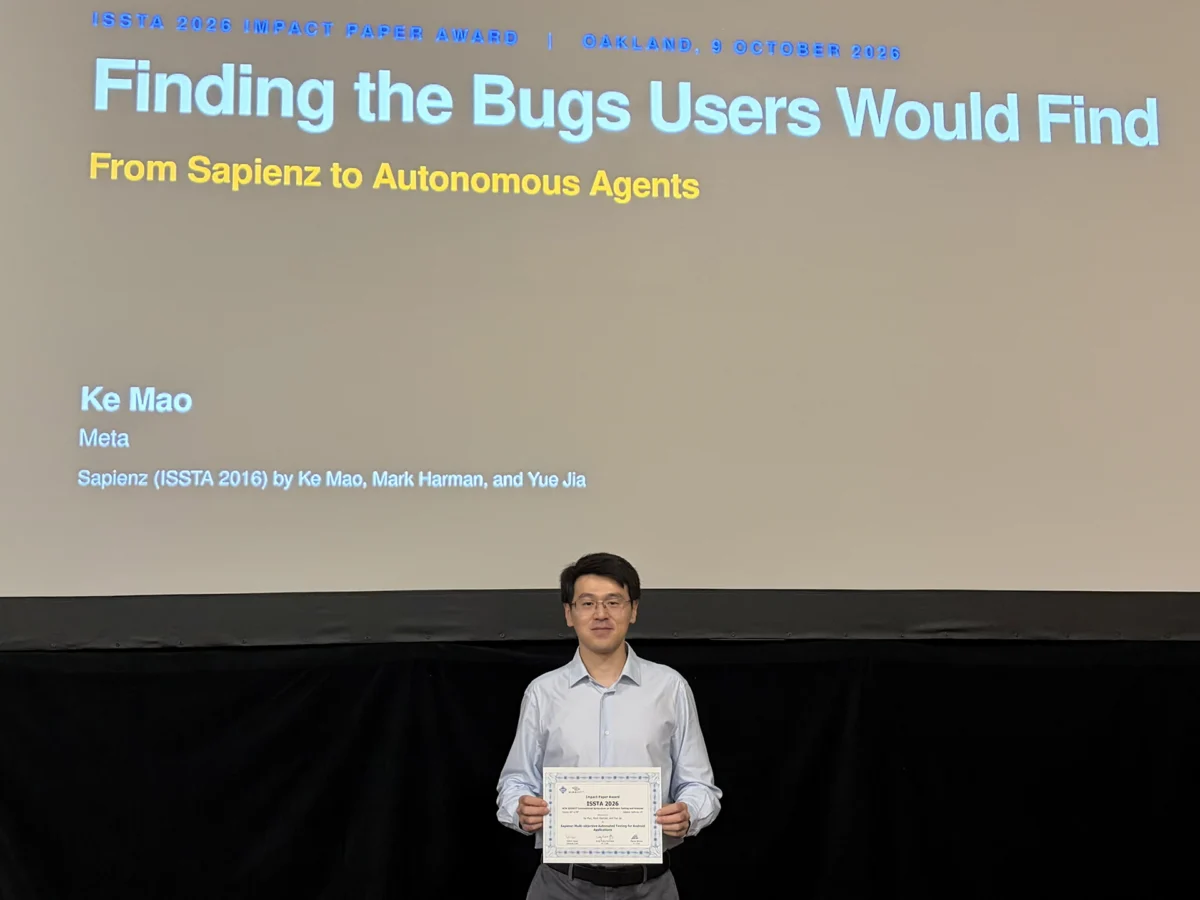
In the fast-paced world of mobile application development, where a single crash can result in millions of uninstalled apps and tarnished reputations, the quest for automated, intelligent testing is the "holy grail" of software engineering. This month, that pursuit reached a significant milestone as the ACM SIGSOFT International Symposium on Software Testing and Analysis (ISSTA) awarded its prestigious 2026 Most Influential Paper Award to the architects of "Sapienz."
The paper, titled “Sapienz: multi-objective automated testing for Android applications,” was originally published in 2016 by researchers Ke Mao, Mark Harman, and Yue Jia. A decade after its debut, the technology has transcended its academic origins at University College London (UCL) to become the backbone of testing infrastructure at Meta, managing the stability of some of the world’s most-used digital platforms.
The Genesis: Solving the Android Testing Dilemma
In the mid-2010s, the Android ecosystem was characterized by massive fragmentation. Developers struggled to ensure their applications functioned seamlessly across thousands of different device configurations, screen sizes, and OS versions. Traditional manual testing was slow, human-intensive, and prone to oversight.
The Sapienz project sought to flip the script. The researchers introduced a multi-objective approach to automated testing, focusing on three core goals: maximizing the exploration of an application’s interface, uncovering crashes that would otherwise remain hidden, and minimizing the number of steps required to reproduce those crashes. By automating these tasks, the researchers aimed to make the "debugging loop"—the time between finding a bug and fixing it—as efficient as possible.
When the team evaluated their prototype against 1,000 popular applications on the Google Play Store, the results were staggering. Sapienz identified 558 previously unknown crashes, proving that automated, search-based testing could outperform human QA testers in breadth and speed.
Chronology: A Decade of Evolution
The journey of Sapienz is a study in the successful translation of academic theory into industrial practice.
2016: The Academic Breakthrough
The publication of the Sapienz paper at ISSTA 2016 provided a roadmap for "multi-objective" software testing. By treating testing as a search problem—using genetic algorithms to "evolve" test sequences—the researchers demonstrated that software could essentially "teach" itself how to find its own weaknesses.
2017–2018: Rapid Industrial Adoption
Within just 17 months of its publication, the researchers—who had transitioned to roles at Meta—integrated the tool into the company’s internal engineering workflow. The move was unprecedented for a research-to-production pipeline of this complexity. By 2018, Meta had officially documented how Sapienz was being used to scale testing, effectively moving the needle from "experimental" to "mission-critical."
2019–2024: Expansion into Security and Privacy
Once the tool was established as a reliable crash-finder, its mandate expanded. Meta engineers realized that if the tool could simulate user navigation, it could also be used to verify data flow. This led to its integration with dynamic taint analysis at WhatsApp, allowing the company to track how data moves through the app during simulated user sessions, thereby enhancing privacy and security auditing.
2026: The AI Era and Recognition
The receipt of the Most Influential Paper Award at ISSTA 2026 marks the decade-long anniversary of the project. During the keynote address, Ke Mao outlined how the foundational principles of Sapienz are now being merged with Large Language Models (LLMs) to transition from simple crash detection to autonomous, intent-based software testing and automated repair.
Supporting Data: The Scale of Sapienz
The numbers behind Sapienz are illustrative of the massive scale at which modern software platforms operate. Today, the infrastructure is not merely a helper tool; it is a vital safeguard for Meta’s product suite.
- Millions of Daily Tests: Sapienz runs millions of test sequences every 24 hours across Meta’s various platforms, including Facebook, Instagram, and Messenger.
- Thousands of Weekly Discoveries: The system surfaces thousands of unique, high-fidelity crash reports every week, allowing developers to triage and resolve issues long before they reach the end user.
- Release Integrity: Hundreds of app releases are safeguarded each month, ensuring that the continuous deployment cycles maintained by Meta’s engineering teams do not compromise product quality.
These metrics highlight a fundamental shift in software engineering: the move from reactive debugging to proactive, automated resilience. By reducing the number of steps to reproduce a crash, Sapienz significantly lowers the cognitive load on engineers, allowing them to focus on feature development rather than forensic bug-hunting.
Official Perspectives: The Keynote Vision
At the ISSTA 2026 conference, Ke Mao’s keynote, "Finding the Bugs Users Would Find: From Sapienz to Autonomous Agents," served as both a retrospective and a forward-looking statement.
"The core ideas of multi-objective exploration and actionable fault revelation remain the heartbeat of the system," Mao noted during the presentation. She explained that the evolution of the software has reached a stage where LLM-driven agents are no longer just "pressing buttons" to find crashes. Instead, these agents are now capable of "reasoning" about user expectations. If an app behaves in a way that is logically inconsistent with its purpose, these new agents can flag the issue as a functional defect—not just a technical crash.
This transition marks the next frontier: Automated Repair. The industry is moving toward a future where, upon finding a bug, the system not only reports it but also suggests a patch. Sapienz’s architecture, which prioritizes the "actionability" of results, provides the perfect substrate for this evolution.
Strategic Implications: Privacy, Risk, and the Future of DevOps
Beyond the technical achievements, the longevity of the Sapienz project underscores a strategic pivot within large-scale tech companies toward "Privacy by Design."
As part of Meta’s comprehensive privacy and risk management framework, Sapienz is now a tool for regulatory and ethical compliance. By identifying potential risks early in the development lifecycle, the tool allows teams to apply safeguards consistently. This means that privacy protections are not an "afterthought" or a patch applied at the end of the development cycle, but rather a built-in feature of every new innovation.
The Broader Industry Impact
The influence of the 2016 paper has extended far beyond Meta’s internal walls. The techniques pioneered by Mao, Harman, and Jia have informed the development of countless other testing frameworks across the software industry. By demonstrating that "search-based software engineering" is not just a theoretical exercise but a robust industrial solution, the team fundamentally changed how the software industry approaches the "testing debt."
Looking Ahead
As we look toward the next decade, the legacy of Sapienz serves as a blueprint for the integration of Artificial Intelligence in software quality assurance. The transition from simple automated testing to autonomous, reasoning agents represents one of the most significant shifts in software engineering history.
For engineers and researchers alike, the story of Sapienz proves that the most impactful solutions are often those that address a simple, universal problem—in this case, "how do we find bugs before the users do?"—with a sophisticated, scalable, and ever-evolving methodology. As software becomes increasingly complex, the principles laid out by the Sapienz team in 2016 are likely to remain relevant, serving as the foundation for the next generation of autonomous digital quality assurance.
In conclusion, the recognition at ISSTA 2026 is more than an award for a past achievement; it is an endorsement of a methodology that has successfully navigated the transition from a university research project to a pillar of global software infrastructure. The "Sapienz era" of testing has only just begun, as the industry begins to leverage these same principles to build software that is not only reliable but also inherently more secure and adaptive.


 Jia Lissa

 Nila Kartika Wati

 Raul Delapena Setiawan

 Reynand Wu

 Sagoh


 Azzam Bilal Chamdy

 Ali Ikhwan
