
 Azzam Bilal Chamdy
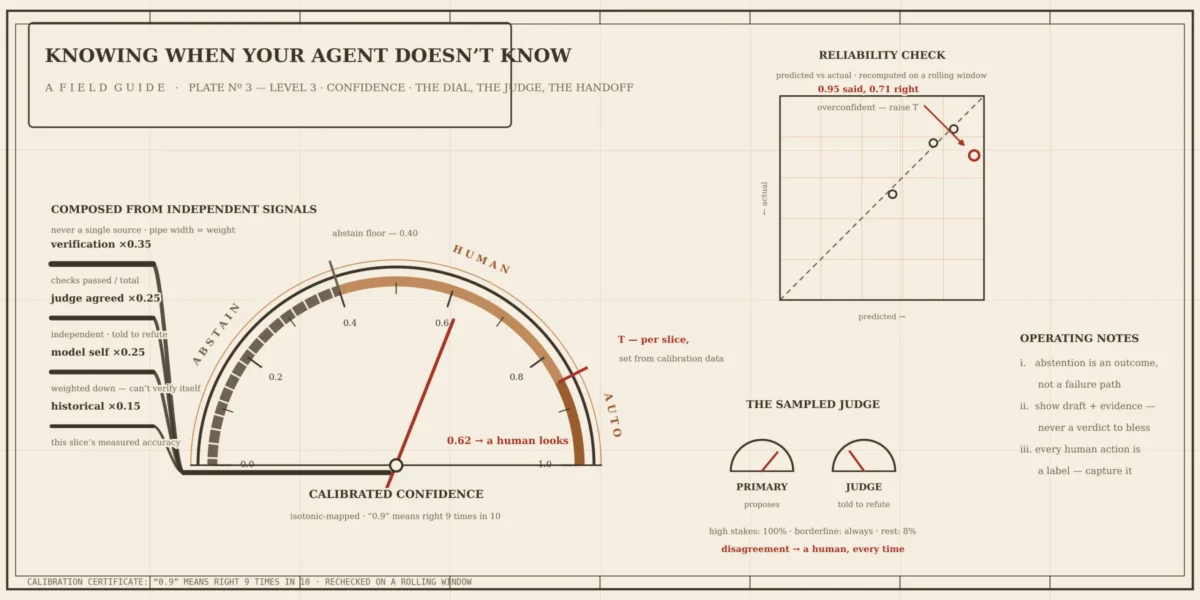
In the rapidly evolving landscape of Large Language Model (LLM) deployment, the most critical metric is no longer the quality of an individual response, but the system’s ability to quantify its own uncertainty. As organizations move from experimental prototypes to high-stakes industrial applications, the industry is coalescing around a new standard for maturity. Moving beyond the "it works" phase, engineers are now focusing on "Level 3" maturity: a robust framework of calibrated confidence, independent verification, and intelligent human-in-the-loop (HITL) routing.
The prevailing wisdom in AI development is shifting: trusting an LLM’s self-reported confidence is a dangerous architectural flaw. When prompted to assess its own certainty, models are notoriously overconfident, often expressing high conviction even when factually incorrect. To build systems that can be trusted with autonomous decision-making, developers must engineer a "production score" derived from diverse, verifiable signals.
The Anatomy of Confidence: Composing a Production Score
A single source of confidence is a single point of failure. To mitigate this, mature LLM systems now employ a composition model that aggregates multiple, independent inputs. By weighting these signals, engineers ensure that a "confidently wrong" model is neutralized by objective reality.
The Four Pillars of Reliability
The modern production score is typically composed of four distinct data points:
- Model Self-Assessment: While useful as a baseline, this is assigned the lowest weight (e.g., 25%) because of its inherent tendency toward overconfidence.
- Deterministic Verification: This measures the fraction of objective, rule-based checks passed. If the output fails a structural or logical constraint, the score drops immediately.
- Independent Judge Agreement: An secondary, adversarial model evaluates the primary output. This signal carries significant weight because it represents an external check on the logic of the primary model.
- Historical Slice-Accuracy: By analyzing the performance of specific "slices" of data (e.g., specific user segments or prompt types), the system can leverage past accuracy as a baseline for current performance.
By constructing a weighted sum from these sources, developers create a "confidence dial." If a model claims high certainty but fails a deterministic verification check, the aggregate score remains low, preventing the system from automating a potentially catastrophic error.
Calibration: Turning Scores into Probabilities
A raw confidence score between 0 and 1 is mathematically meaningless unless it is calibrated. A score of 0.9 must objectively correspond to a 90% success rate in real-world application.
The Reliability Diagram
To achieve this, engineering teams must bucket their decisions by predicted confidence and measure them against actual accuracy. If the "high confidence" bucket (0.9 to 1.0) only shows a 71% success rate, the system is fundamentally miscalibrated.
The correction mechanism involves using techniques like Isotonic Regression to map raw scores to empirical accuracy. This calibration is not a "set and forget" task; because LLM inputs and performance drift over time, calibration must be recomputed on a rolling window. Relying on stale calibration data is a frequent cause of production failures, as it creates a false sense of security that blinds teams to emerging risks.
The Adversarial Judge: Checking the Checkers
One of the most effective strategies for high-stakes AI applications is the implementation of an "Adversarial Judge." Instead of relying on a single model pass, a second, independent model is tasked with evaluating the primary output.
Design Principles for Effective Judging
To be truly effective, the judge must be designed for skepticism:
- Adversarial Prompting: The judge should not be asked, "Is this right?" Instead, it should be instructed to "find the strongest reason this decision is wrong." This framing forces the model to hunt for failure modes rather than rubber-stamping the output.
- Diverse Model Families: Using a different model architecture or family for the judge than the primary model helps prevent shared blind spots.
- Selective Sampling: Judging every decision doubles inference costs. Teams should employ a risk-based policy: 100% of high-stakes/irreversible decisions are judged, while lower-stakes interactions are sampled (e.g., 5–10%) to maintain a continuous quality probe.
When the judge disagrees, the system should treat the disagreement as a primary routing signal. Disagreement is not just a failure; it is a vital health metric that can signal a bad deployment, a model regression, or even an adversarial attack.
Implications for Human-in-the-Loop (HITL)
The ultimate safety valve for any LLM system is the human-in-the-loop. However, poor design in this area is where most systems fail. If the handoff is poorly constructed, the human reviewer becomes a rubber stamp, clicking "approve" to clear a backlog, which creates a false audit trail of accountability.
Best Practices for Human Review
- Drafting, Not Blessing: Never present a final "verdict" for a human to sign off on. Instead, provide a draft with the reasoning, supporting evidence, and identified alternatives. By showing the "why" behind the decision, the human can perform an actual check.
- Structuring the Signal: Every human intervention—whether an approval, a rejection, or an edit—must be captured as a structured label. An edit is the most valuable data point an organization can collect, as it provides the "golden set" for fine-tuning the agent to avoid future errors.
- Preventing Reviewer Fatigue: Routing everything to a human is a Denial of Service attack on your own staff. The system must use its calibrated confidence score to filter only the truly uncertain cases to human reviewers. If the queue is overflowing, the solution is not more reviewers; it is better upstream automation and stricter calibration.
The Principle of Abstention
Perhaps the most important cultural shift in LLM production is the transition from "the model must answer" to "the model must know when to abstain."
An agent that explicitly states, "I am not confident; a human should review this," is significantly more trustworthy than one that produces a guess under pressure. By making abstention a first-class outcome—rather than an error state—organizations can protect themselves against "unknown unknowns." The system essentially defines the edges of its own competence, deferring to human expertise exactly when the stakes or the uncertainty demand it.
Conclusion: A Self-Improving Loop
The path to Level 3 maturity is about closing the feedback loop. By composing scores from independent signals, calibrating those scores against real-world outcomes, and using adversarial judges to catch mistakes, developers can create a system that is demonstrably more reliable than the sum of its parts.
When human edits and judge disagreements are fed back into the system to tune historical accuracy metrics, the model essentially learns from its own failures. This architecture does not promise perfection; rather, it provides a defensible, transparent, and iterative approach to automation. In an era where AI reliability is the primary barrier to adoption, this shift from "model-centric" to "system-centric" engineering is the most critical step toward building trust in autonomous agents.


 Jia Lissa

 Nila Kartika Wati

 Raul Delapena Setiawan

 Reynand Wu

 Sagoh



 Ali Ikhwan
