
 Raul Delapena Setiawan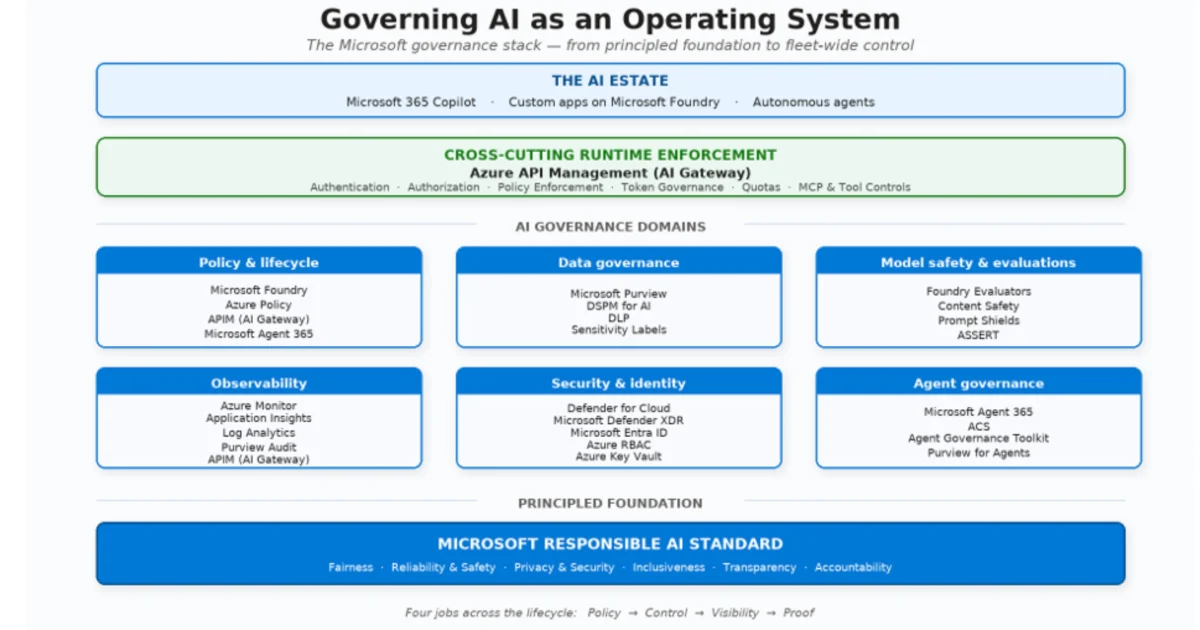
As organizations transition from experimental AI prototypes to mission-critical production environments, the industry is grappling with a fundamental paradox: the more autonomous an AI agent becomes, the harder it is to govern through traditional, static policy documents. Microsoft has responded to this challenge by unveiling a comprehensive AI governance architecture that shifts the paradigm from theoretical "policy-on-paper" to "runtime-enforced proof."
This new framework, detailed by Microsoft architects and engineers, outlines a continuous operational loop designed to ensure that AI applications remain safe, compliant, and auditable at scale. By integrating runtime controls, continuous evaluation, and real-time observability, Microsoft is attempting to provide a standard for how enterprises can reliably govern the rapid proliferation of autonomous agents.
The Shift: Moving Beyond Static Documentation
For years, corporate governance in IT has relied on static compliance checklists—documents that outline what should happen without necessarily enforcing those rules within the software itself. In the era of Generative AI, where systems interact with enterprise data and external APIs in non-deterministic ways, this approach is increasingly viewed as obsolete.
Manasa T. Ramalinga, a Cloud Solution Architect at Microsoft, succinctly captured the industry sentiment in a recent LinkedIn discussion: “Organizations cannot scale what you cannot control.” Her perspective highlights a growing trend among enterprise leaders: moving away from treating governance as an afterthought or a "check-the-box" activity. Instead, companies are now forced to re-architect their foundational structures to embed safety directly into the AI deployment pipeline.
Microsoft’s new architecture treats governance as a dynamic, continuous operational loop consisting of four essential functions:
- Policy: Establishing the high-level requirements and risk classifications.
- Control: Translating those policies into actionable access and runtime rules.
- Visibility: Capturing granular system behavior through observability tools.
- Proof: Using telemetry and evaluation data to provide audit-ready evidence of compliance.
The Nine Pillars of Governance
To operationalize this loop, Microsoft has categorized AI governance into nine distinct domains. This multi-layered approach ensures that no aspect of an AI system—from its initial training data to its final output—is left unmonitored.
- Policy & Compliance: The foundational layer that sets the risk appetite and regulatory requirements.
- Data Governance: Managing the provenance, quality, and access rights of the data powering the AI.
- Model Governance: Overseeing the selection, versioning, and lifecycle of the underlying LLMs.
- Observability: Providing the "eyes" on the system to track performance and anomalies.
- Evaluations: A rigorous testing layer that spans both pre-deployment (benchmarking) and production (drift detection).
- Security: Protecting the AI infrastructure from prompt injection, data exfiltration, and other adversarial threats.
- Identity & Access: Ensuring that only authorized users and agents can trigger specific actions or access sensitive tools.
- Audit: The mechanism that turns operational telemetry into forensic evidence.
- Agent Governance: The most specialized domain, focusing on the autonomous workflows, decision-making logic, and tool-use capabilities of agents.
Technical Implementation: The Role of the AI Gateway
The architecture relies on a robust stack of Microsoft services, notably Microsoft Foundry, Microsoft Purview, Microsoft Entra ID, and Microsoft Defender. A central component of this strategy is the Microsoft Foundry AI Gateway, which acts as a hardened runtime boundary between the AI model and the enterprise ecosystem.
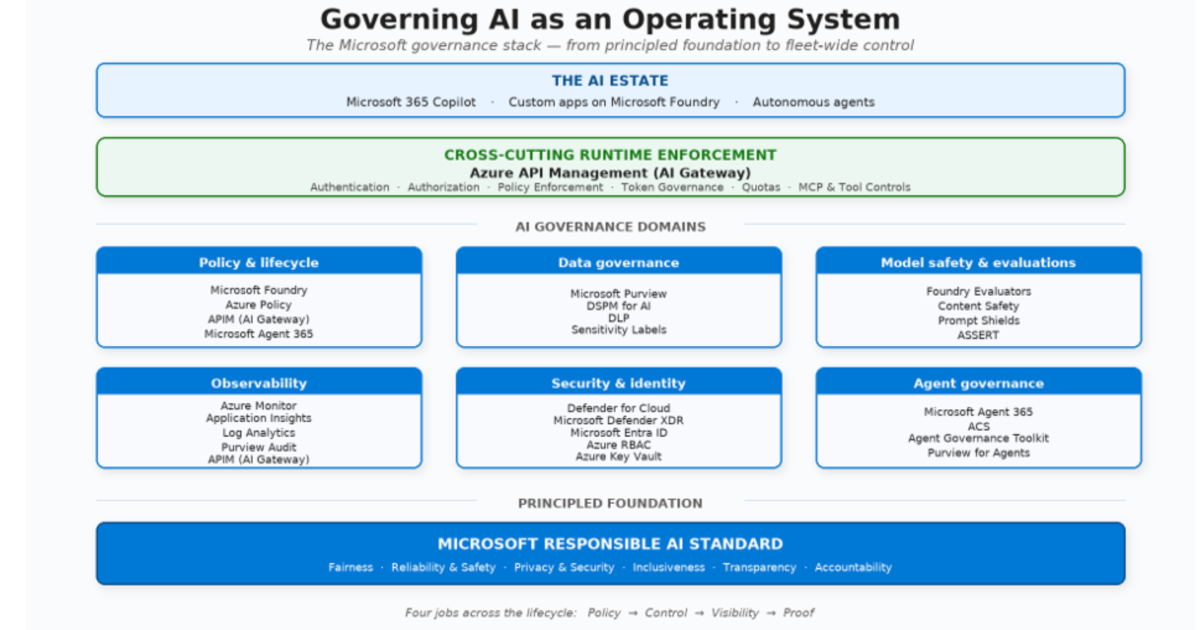
The Gateway provides a critical choke point for governance. It allows administrators to enforce authentication, set token limits, manage quotas, and apply policy-based filters without requiring modifications to the agent’s underlying code. This is particularly vital for the governance of Model Context Protocol (MCP) tools. By routing requests through the AI Gateway, organizations can implement centralized rate-limiting, IP restrictions, and comprehensive audit logging for autonomous agents, effectively "wrapping" legacy systems in a modern security perimeter.
Continuous Evaluation: Testing Quality and Safety
A major innovation in this framework is the integration of "Evaluations" as a core component of the production lifecycle. In traditional software development, CI/CD pipelines usually handle testing. In the AI context, Microsoft argues that evaluation must continue long after the "Go Live" date.
Microsoft Foundry enables teams to run evaluations against custom datasets, assessing for quality, safety, and alignment with enterprise standards. These evaluators can be triggered automatically during deployment or scheduled as part of continuous monitoring. This dual-layered approach—pre-release validation combined with ongoing production monitoring—is designed to catch "model drift" or hallucinations before they impact business operations.
Anthony Bartolo, a Principal Cloud Advocate at Microsoft, emphasized the practical necessity of this approach: “Your AI policy is not governance until production can prove it.” His assertion underscores that the goal is not merely to write rules, but to create a technical environment where the AI’s actions can be systematically verified against those rules in real-time.
Aligning with Global Standards
Microsoft’s framework does not exist in a vacuum. It serves as a practical implementation layer for broader, vendor-neutral initiatives like the NIST AI Risk Management Framework (RMF) and the Generative AI Profile.
While NIST provides the strategic roadmap—governance, measurement, evaluation, and risk mitigation—Microsoft’s architecture acts as the "how-to" guide for enterprises using Azure. By mapping abstract NIST principles into concrete platform controls (like Entra ID permissions or Defender for Cloud alerts), Microsoft is attempting to bridge the gap between regulatory requirements and technical reality.
The Frontier: Governing Autonomous Agents
Perhaps the most significant challenge in the current landscape is the rise of autonomous agents capable of chaining multiple actions together. To address this, Microsoft has released the Agent Governance Toolkit, an open-source framework designed to provide runtime security for agents.
/filters:no_upscale()/news/2026/08/microsoft-ai-governance/en/resources/1microsoftaigoverance-1786848893730.jpeg)
This toolkit introduces the concept of the Agent Control Specification. This mechanism allows developers to define "checkpoints" at critical junctures:
- Inputs: Validating the provenance of user prompts.
- Model Calls: Restricting which models can be accessed for specific tasks.
- Tool Execution: Ensuring agents have explicit permission to invoke specific APIs or perform enterprise actions.
- Outputs: Verifying that the final response meets safety guidelines.
For high-impact tasks—such as executing financial transactions or modifying infrastructure—the framework allows for the insertion of "human-in-the-loop" approval gates, ensuring that autonomous systems remain under human oversight even when operating at high speed.
Implications for the Enterprise
For CTOs and Chief Risk Officers, the message from Microsoft is clear: governance must evolve from a static organizational function into a dynamic engineering discipline. This shift has several profound implications:
- Investment in Tooling: Enterprises must move away from spreadsheet-based governance and toward integrated, platform-level observability and policy enforcement.
- Skillset Evolution: Security and compliance teams will need to work more closely with AI engineering teams, as governance rules are now expressed as code, configurations, and API policies.
- Audit Readiness: The ability to provide an automated, real-time audit trail of why an AI agent took a specific action will become a competitive advantage, particularly in regulated sectors like finance and healthcare.
Conclusion
Microsoft’s "From Policy to Proof" architecture marks a maturing phase in the adoption of generative AI. By emphasizing that governance is a continuous loop of enforcement and evidence-gathering, Microsoft is providing a blueprint that balances the need for innovation with the non-negotiable requirements of enterprise security.
As AI agents begin to handle more complex, autonomous workflows, the ability to observe, control, and audit their behavior will define the winners and losers in the next wave of enterprise transformation. The shift toward runtime-enforced governance ensures that while human ambition may drive AI development, it is machine intelligence—governed by clear, verifiable boundaries—that will ultimately scale it.


 Jia Lissa
 Nila Kartika Wati

 Reynand Wu
 Sagoh
Sagoh

 Azzam Bilal Chamdy
 Ali Ikhwan