
 Azzam Bilal Chamdy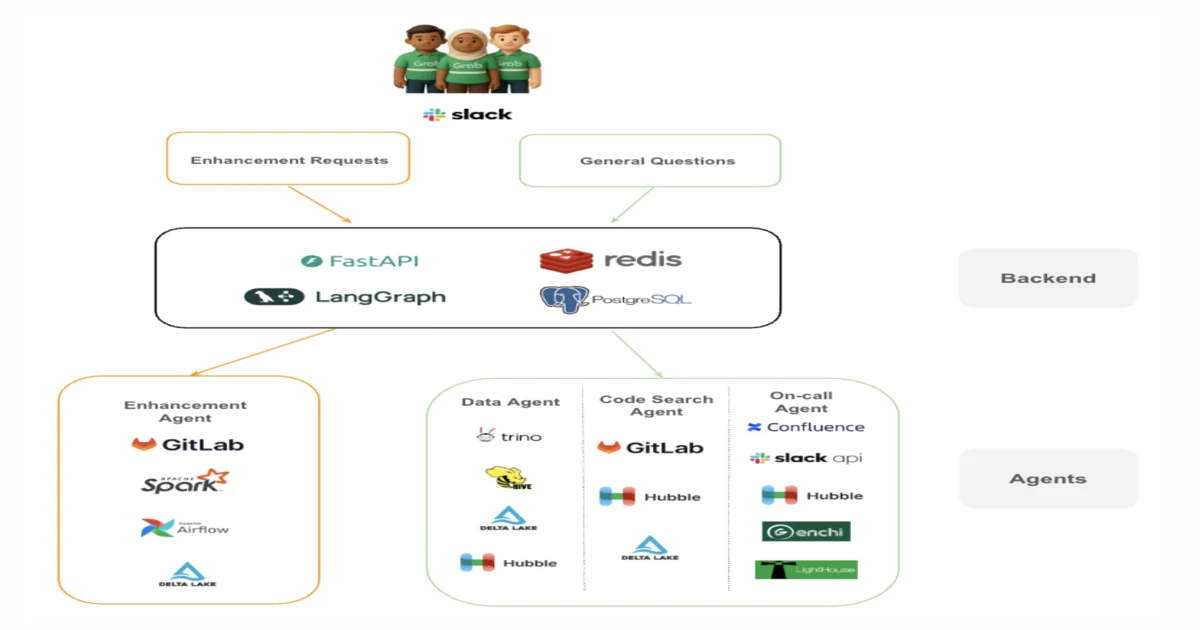
In the high-velocity world of super-apps, data is the lifeblood of operations. For Grab, the Southeast Asian technology giant, the Analytics Data Warehouse (ADW) serves as the central nervous system, supporting over 1,000 internal users and managing a staggering 15,000 tables. However, as the scale of this infrastructure exploded, so did the "support debt." Engineering teams found themselves increasingly trapped in a cycle of reactive firefighting—addressing ad-hoc SQL debugging requests, log retrieval, and platform maintenance—at the expense of long-term platform evolution.
To break this cycle, Grab’s ADW team has unveiled a sophisticated multi-agent AI system designed to automate the lifecycle of engineering support. By shifting from manual intervention to autonomous orchestration, the team is reclaiming hundreds of engineering hours per month, effectively pivoting their focus from maintenance to innovation.
The Genesis of the Problem: Scaling Pains
The challenge Grab faced is a familiar one for large-scale data organizations. When a platform reaches a certain threshold of complexity, the sheer volume of "how-to" requests and minor troubleshooting issues can overwhelm even the most capable engineering teams.
For the ADW team, these operational burdens were not merely a time sink; they were an opportunity cost. Every hour spent debugging a query for a stakeholder or manually investigating a schema error was an hour lost for designing better infrastructure, optimizing system performance, or building next-generation data tools. The team realized that to support a growing business, they needed to fundamentally change how they interacted with their own platform.
Chronology: Building the Autonomous Support Ecosystem
The journey to an automated support architecture did not happen overnight. It was a methodical transition from manual support to a structured, AI-driven framework.
Phase 1: Identifying the Bottlenecks
Early assessments by the ADW team highlighted that the majority of support tickets followed predictable patterns: identifying missing data, troubleshooting SQL syntax, or performing routine log analysis. The team recognized that these tasks, while critical, were repetitive and prime candidates for automation.
Phase 2: Designing the Multi-Agent Framework
Rather than building a single, monolithic AI assistant, the team opted for a multi-agent architecture. This approach allows for specialization. By separating concerns into distinct workflows—specifically "Investigation" and "Enhancement"—the team reduced the complexity of agent reasoning.
Phase 3: Tool Consolidation and Governance
A critical milestone in the development was the rationalization of the internal toolset. Initially, the agents had access to over 30 disparate tools. The engineering team discovered that this breadth led to unpredictable tool selection and high maintenance overhead. By curating a refined, high-performance toolset, they increased the system’s reliability and predictability.
Phase 4: Production Integration
The final phase involved integrating the system with existing Git-based workflows and human-in-the-loop (HITL) safeguards. By ensuring that all automated code changes require human verification, Grab balanced the efficiency of automation with the necessity of rigorous engineering oversight.
Supporting Data and Architectural Logic
The architecture behind Grab’s success is built on a foundation of LangGraph, a framework designed for orchestrating complex, multi-actor AI workflows.
Orchestration and Routing
The system utilizes a FastAPI-based service layer that acts as the traffic controller. When a request arrives, the "Supervisor" agent analyzes the query, determines its intent, and routes it to the appropriate specialized agent. This ensures that a query requiring deep schema analysis doesn’t get muddled with a request for log retrieval.
The Two-Track Workflow
- Investigation Workflows: These agents are the diagnostic engines of the platform. Their primary function is to interpret the user’s problem, search through logs, pull relevant metadata, and summarize findings. They are the eyes and ears of the system, turning opaque system behaviors into actionable insights.
- Enhancement Workflows: Once the investigation is complete, the enhancement agents take over. These agents are tasked with proposing solutions, including generating SQL patches or configuration updates. These outputs are then passed to a Git workflow, where they wait for human approval before being merged into the codebase.
Managing Context Constraints
One of the most significant technical hurdles identified by the team was the "context window." AI models often struggle to maintain coherence over long, multi-step operations. Grab’s engineers addressed this through "structured context compression." Instead of feeding the agent raw, unformatted data, the system utilizes selective retrieval strategies, ensuring the model only receives the information strictly necessary for the task at hand. This keeps the logic tight and prevents the model from hallucinating or losing the thread of the request.
Official Perspectives: Shifting the Paradigm
Sneh Agrawal, Head of Analytics at Grab, has been a vocal proponent of this transition. In a recent LinkedIn post, she noted the profound impact of the system on the team’s culture:
"Grab’s Central Data Team is leveraging a multi-agent system to automate repetitive operational work, reclaiming hundreds of engineering hours each month. This shift is unlocking critical engineering bandwidth and enabling a transition from reactive firefighting to higher-value system building."
The engineers themselves have corroborated this, noting that the separation of investigation and enhancement paths was the single most important decision in reducing complexity. By narrowing the scope of each agent, they improved the system’s "reasoning reliability," making the AI output more consistent and, ultimately, more trustworthy for the human engineers supervising the workflow.
Implications for the Future of Data Engineering
Grab’s success story serves as a blueprint for organizations struggling with the operational overhead of large-scale data platforms. The implications of this implementation are threefold:
/filters:no_upscale()/news/2026/05/grab-multi-agent-support-system/en/resources/1grabtechmultiagentarch-1778993206295.jpeg)
1. The Death of "Firefighting" as a Career Path
For many junior engineers, the "support rotation" is a rite of passage that often becomes a dead end. By automating these tasks, Grab is not just saving time; they are elevating the role of the data engineer. Future engineering hires can focus on architecture and optimization from day one, rather than spending their first six months debugging SQL queries for other teams.
2. Standardization through AI
When humans perform support, they bring individual biases and inconsistent debugging habits. An AI agent, by contrast, operates based on the best practices defined in its configuration. By embedding these practices into the agents, Grab is effectively standardizing the quality of its internal support, ensuring that every user receives the same high-level troubleshooting experience.
3. The Necessity of Human-in-the-Loop (HITL)
Perhaps the most important takeaway is that Grab did not seek to replace the engineer, but to augment them. By requiring a human to review all enhancement workflows, the team has created a "guardrail" system. The AI handles the drudgery—the searching, the reading, and the drafting—while the human retains the ultimate authority to deploy. This hybrid model is likely to become the industry standard for enterprise-grade AI adoption.
4. Technical Maturity and Tooling
The move to consolidate 30 tools into a curated set is a lesson in minimalism. Many organizations assume that "more is better" when it comes to AI tool integration. Grab’s experience suggests the opposite: a smaller, more refined set of tools allows agents to perform with greater precision and fewer errors.
Conclusion
Grab’s Analytics Data Warehouse team has effectively turned the tide in the battle against operational bloat. By architecting a multi-agent ecosystem that treats "support" as a structured, automated product rather than a chore, they have created a model that is both scalable and sustainable.
As AI continues to mature, the ability to decompose complex engineering tasks into discrete, agent-driven workflows will distinguish the most efficient technology companies from the rest. For Grab, the future is no longer about putting out fires—it is about building the infrastructure that will power the next generation of digital services in Southeast Asia. The transition from reactive support to proactive innovation is not just an operational win; it is a competitive advantage in a market that never stops growing.


 Jia Lissa
 Nila Kartika Wati
 Raul Delapena Setiawan
 Reynand Wu
 Sagoh
Sagoh


 Ali Ikhwan