
 Dwi Wanna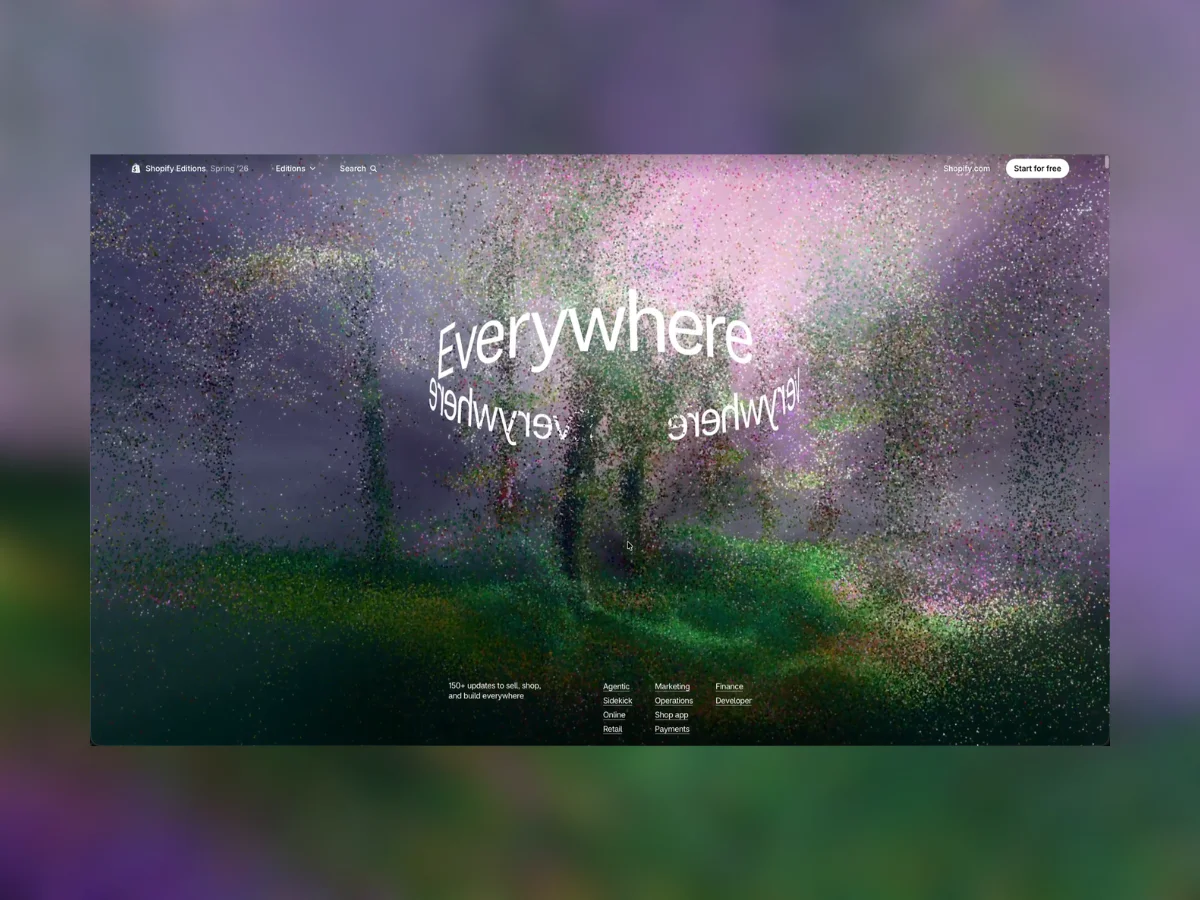
In the fast-evolving landscape of e-commerce, the boundary between a traditional product page and a cinematic experience is becoming increasingly porous. With the launch of its Spring 2026 "Everywhere" Edition, Shopify has set a new benchmark for web development. By blending high-fidelity 3D rendering with the rigorous performance requirements of a global commerce platform, the engineering team has transformed the "product release" into a masterclass of interactive digital storytelling.
The Vision: A Cinematic Web
Every Shopify Edition is designed to push the technical envelope. For the Spring 2026 iteration, the mandate was clear: the site needed to feel like a high-end motion picture—fluid, atmospheric, and reactive—without sacrificing the accessibility, responsiveness, and performance expected of a mission-critical web page.
Creative Director Maggie Fost and Principal Product Designer Andy Thelander led a multidisciplinary team to solve a core paradox: how to deliver heavy, volumetric, and interactive visuals while maintaining a lightning-fast load time across diverse hardware. The result is a hybrid architecture where the DOM (Document Object Model) handles content and user interaction, while a sophisticated WebGL layer provides the atmosphere, volumetric lighting, and particle effects.
Chronology: From Concept to Production
The development cycle of the "Everywhere" Edition was an iterative process that prioritized "pipeline engineering" over one-off effects.
- Phase 1: Pipeline Development: Recognizing that traditional asset management wouldn’t scale for such a high-fidelity project, the team first built a bespoke creative workflow. This ensured that designers and developers could work in a unified "playground" environment, tuning shaders and lighting in the browser rather than relying on static mockups.
- Phase 2: The Asset Factory: The team developed custom pipelines to transform raw video into volumetric light boxes and complex point clouds. By creating tools that could automate the conversion of video clips into spatial data, they effectively built a "factory" capable of generating performance-optimized assets at scale.
- Phase 3: Integration and Tiering: Once the core visual systems were established, the team implemented a tiered rendering strategy. By detecting GPU performance and device capabilities, the site dynamically scales its complexity, ensuring a smooth experience on everything from high-end workstations to entry-level mobile devices.
- Phase 4: Optimization and Deployment: Final performance tuning involved offloading complex calculations from React’s main thread to specialized WebGL buffers, ensuring that scroll-driven animations never stuttered or blocked user input.
Supporting Data: The Mechanics of "Everywhere"
The technical architecture behind the site relies on several novel engineering approaches that allow for "cinematic" visuals within a browser-safe footprint.
Volumetric Light via Raymarching
Rather than relying on flat, static video backgrounds, the team utilized a custom raymarching approach. By slicing video data into KTX2 array textures, they created a stack of frames that the browser’s camera can move through. This creates a "light box" effect, providing a sense of depth and spatial presence that feels significantly more immersive than traditional 2D video. By capping raymarch steps and grid density, the team ensured this effect remains performant on mobile hardware.
Point Clouds and the .mdpc Format
To capture the aesthetic of high-end Gaussian splats without the associated data bloat, Shopify created the .mdpc (Modified Point Cloud) format. These files use quantized positions and luma/chroma streaming to represent complex 3D scenes in a fraction of the size of standard formats. This allowed the team to load multiple "atmospheric scenes" during a scroll, as the data footprint is small enough to keep in memory without stalling the browser.
The Transparency Solution
Transparent video remains a pain point across various browsers, with inconsistent support for native alpha channels. Shopify bypassed this with a stacked-video technique: by placing the RGB frame on top of an alpha-channel frame in a single video file, they used a custom WebGL2 shader to reconstruct the transparency at runtime. This "universal" approach ensures consistent visual quality across Chrome, Firefox, and Safari.
Official Insights: A Philosophy of Constraints
In an exclusive look at the project, Principal Product Designer Andy Thelander emphasized that the stability of the site is a direct result of "practical constraints."
"The biggest lesson we learned is that high-end browser work is mostly pipeline work," Thelander noted. "You aren’t just building a page; you are building the factory that builds the page."
The team’s decision to move away from React state for high-frequency rendering was a pivotal architectural choice. By using refs to handle Three.js geometries and materials, they avoided the overhead of React’s reconciliation process, allowing for 60fps performance even during complex scroll transitions.
"We had to ensure that our design workflow fed directly into our production pipeline," added Maggie Fost. "When designers can tune the actual WebGL scenes in the browser, the gap between the vision and the final product essentially disappears. We aren’t asking engineers to interpret a mockup; we are all working with the same data shapes."
Implications: The Future of E-Commerce Interfaces
The "Everywhere" Edition is more than just a successful web project; it represents a fundamental shift in how large-scale platforms can approach digital marketing.
Performance as a Feature
Shopify has demonstrated that "cinematic" does not have to be synonymous with "slow." By implementing a tiered system that aggressively optimizes for mobile memory pressure, the team has proven that high-end interactive design can be inclusive. This sets a new standard for accessibility in creative web design.
The Rise of the "Unified Playground"
The success of the "Everywhere" site suggests a future where the distinction between "prototyping" and "production" is blurred. By empowering designers to work within the same environment that ships to the end user, companies can significantly reduce the technical debt associated with hand-off processes.
A New Standard for Generative Web Content
Finally, the use of AI-assisted tools to generate point clouds and volumetric light textures from video highlights an emerging trend: the "onion layer" approach to content creation. By combining multiple generative methods—extracting geometry from video, then refining it with custom compression—the team created visuals that feel hand-crafted but are produced at industrial scale.
As the web continues to mature into a space for immersive brand storytelling, the techniques pioneered in the Spring 2026 "Everywhere" Edition offer a blueprint for success. By focusing on pipeline engineering, hardware-agnostic rendering, and a collaborative design-to-code workflow, Shopify has not only delivered a stunning visual experience but has also provided a roadmap for the next generation of web developers. The future of the web, it seems, is not just about what you see, but how intelligently that experience is built from the ground up.

 Sagoh
Sagoh
 Asep Darmawan
 Raul Delapena Setiawan
 Reynand Wu


 Azzam Bilal Chamdy
 Ali Ikhwan