
 Evan Lee Salim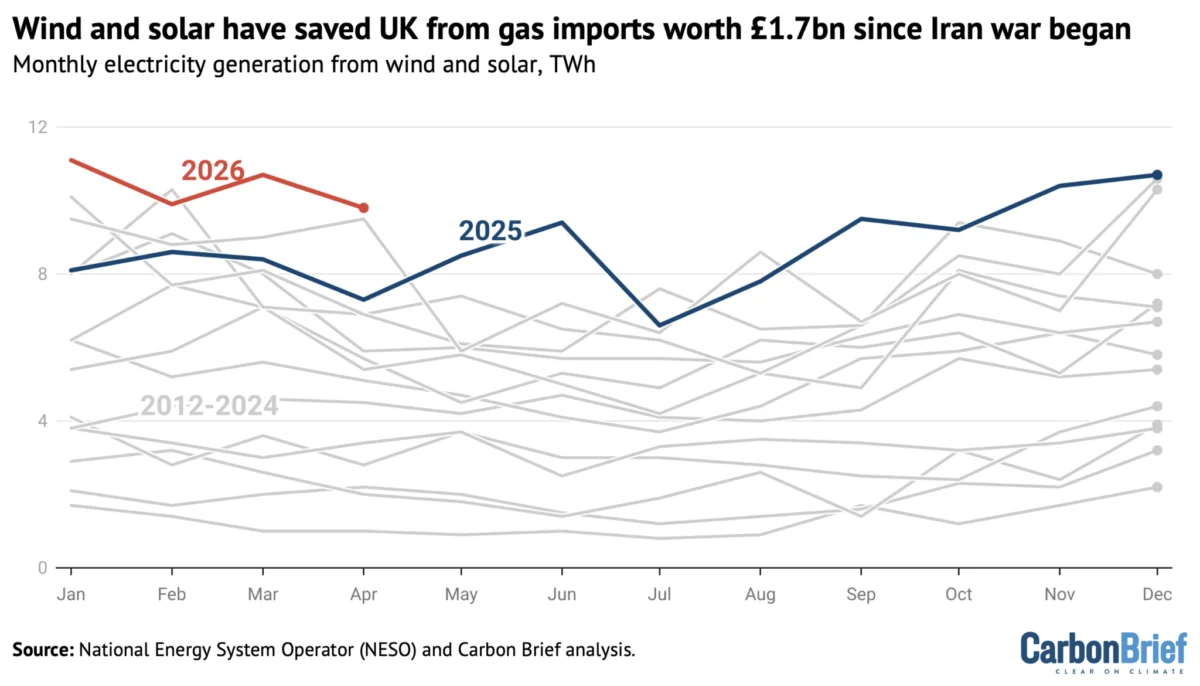
Welcome to this week’s edition of Carbon Brief’s DeBriefed, your essential guide to the week’s most consequential developments in the global climate landscape. As geopolitical tensions reshape energy markets, the tension between immediate supply needs and long-term climate targets has reached a boiling point.
1. Main Facts: The Retreat from Climate Ambition?
The global energy transition is facing a dual crisis this week: a concerted push by the fossil fuel lobby to soften methane regulations and a resurgence of North Sea extraction activities.
Most notably, the European Commission is reportedly contemplating a significant pivot in its flagship methane emissions regulation. According to documents seen by Politico, Brussels is weighing the introduction of "leeway" provisions that would allow national authorities to grant fossil fuel companies exemptions from penalties on the grounds of "energy security." This development marks a potentially major victory for the oil and gas sector, which has been lobbying heavily against stringent compliance measures.
This shift in European policy does not occur in a vacuum. Reports suggest that the Trump administration has intensified diplomatic pressure on the EU to soften these "super-pollutant" rules. For climate advocates, this represents a dangerous precedent, as methane—a greenhouse gas with a warming potential significantly higher than CO2 over a 20-year horizon—is exempted precisely when the world should be tightening the net.
Simultaneously, the Norwegian government has faced a firestorm of criticism for approving the reopening of three North Sea gas fields that had been dormant for nearly three decades. Officials in Oslo have justified the move as a strategic necessity to bridge the energy supply gap exacerbated by the ongoing conflict in the Middle East. Beyond these reopenings, Norway has greenlit exploration at 70 new sites across the North Sea, Barents Sea, and Norwegian Sea, signaling a long-term commitment to hydrocarbon extraction that contradicts the IEA’s roadmap for net-zero.
2. Chronology of the Week’s Developments
- Monday: The week opened with fresh scrutiny on the European Commission’s draft guidelines regarding methane. The prospect of "security-based exemptions" sparked immediate backlash from environmental NGOs, who argue that energy security should be achieved through renewables, not by lowering the bar for methane leaks.
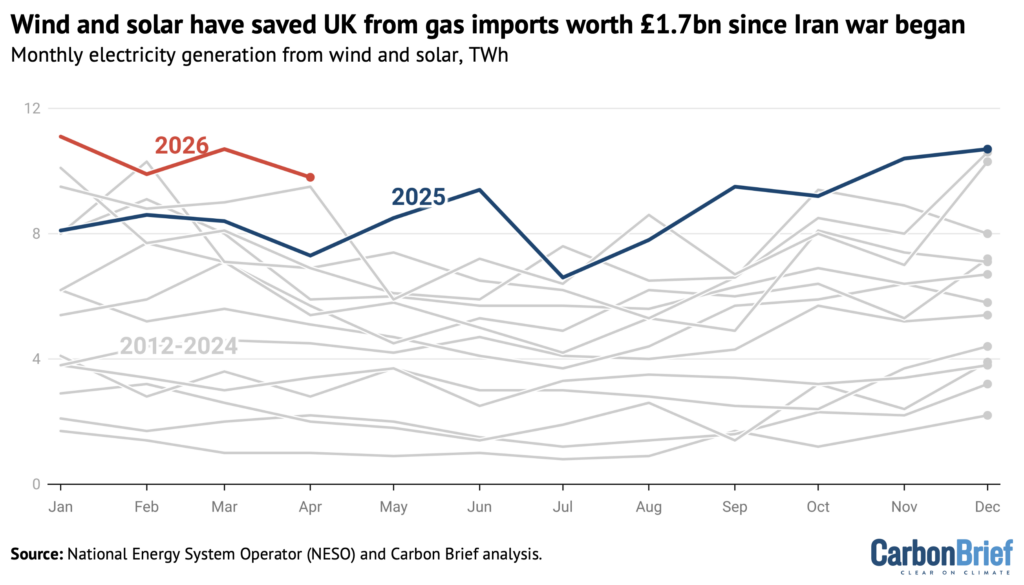
- Tuesday: Carbon Brief published a detailed analysis revealing that the UK has successfully avoided £1.7bn in gas import costs since the onset of the Iran conflict, thanks to record-breaking wind and solar output.
- Wednesday: Norway’s decision to reopen North Sea gas fields reached the headlines, drawing sharp rebuke from European climate watchdogs. Meanwhile, global clean-power investment data showed a significant surge, with £3bn funneled into renewables in April alone.
- Thursday: Discussions at the European Geosciences Union (EGU) in Vienna highlighted the critical state of the Amazon rainforest. Research presented by Prof. Nico Wunderling shifted the focus from mere policy debates to the physical "tipping points" of planetary systems.
- Friday: Coverage focused on the upcoming "Santa Marta" follow-ups, with analysts questioning whether the inaugural conference on transitioning away from fossil fuels will result in substantive policy or remain a platform for rhetoric.
3. Supporting Data: The Renewables Buffer
Despite the news of renewed fossil fuel exploration, the data provides a compelling counter-narrative regarding the efficacy of the transition.
The UK serves as a prime case study for the "security through transition" argument. Since the outbreak of the Iran war at the end of February 2026, the island of Great Britain has generated a record-shattering 21 terawatt hours (TWh) of electricity from wind and solar.

The Economic Impact:
- Imports Avoided: This record output displaced the need for 41TWh of natural gas imports.
- Tanker Equivalence: That is the equivalent of 34 large liquified natural gas (LNG) tankers.
- Financial Savings: By reducing reliance on these volatile global markets, the UK effectively saved £1.7bn in import costs.
Furthermore, capital is moving in tandem with this technical progress. Financial markets are demonstrating a renewed appetite for energy independence. Global funds linked to renewable energy saw a net asset value increase to $43bn in April, marking the fastest inflow of investment into the sector in five years. This suggests that while governments may be hedging their bets with gas, private capital is increasingly convinced that the future of energy security lies in clean-power deployment.
4. Official Responses and Expert Analysis
The discourse surrounding these events has been dominated by a clash of priorities.
The Case for "Energy Security"
Proponents of the European Commission’s proposed methane exemptions and Norway’s new gas fields argue that the "middle-of-the-road" approach is necessary. With global energy markets in disarray due to the Iran-Israel conflict, governments are prioritizing short-term supply stability to prevent blackouts and keep inflation in check.
The Scientific Reality: The Amazon Tipping Point
In contrast to the political maneuvering in Brussels and Oslo, the scientific community is sounding an urgent alarm. Prof. Nico Wunderling of the Potsdam Institute for Climate Impact Research (PIK) provided a sobering look at the Amazon’s stability during the EGU assembly.
"The Amazon is not just a collection of trees; it is a self-sustaining system," Wunderling noted. "Through atmospheric moisture recycling, the forest generates over 50% of its own rainfall."
Wunderling’s research highlights that we are dangerously close to a threshold. While 17% of the Amazon has already been lost, a tipping point—where the rainforest transitions into a dry savannah—could be triggered at 22-28% deforestation.
"If we continue on our current path," Wunderling warned, "the tipping point comes down to within the 1.5-1.9C global warming range." Crucially, he emphasized that this is not inevitable. By halting deforestation below the 22% mark and strictly curbing global emissions, humanity can still prevent this catastrophic ecosystem shift.
5. Implications for the Future
The current week’s events underscore a profound dilemma for global leaders. We are witnessing a "bifurcation of strategy":
- The "Safety Valve" Strategy: Governments in Europe and beyond are attempting to use the current geopolitical instability to justify a temporary slowdown in climate regulation. By granting "leeway" on methane or reopening legacy gas fields, they hope to insulate their economies from price shocks.
- The "Structural Transition" Strategy: Simultaneously, the surge in renewable investment and the performance of wind/solar in the UK demonstrate that the energy transition is actually the most viable long-term solution to the very energy security crisis governments are citing.
The "Climate Monster" Looming
As noted in the New York Times by David Wallace-Wells, the world is also bracing for an El Niño event that may be the most severe in recorded history. When environmental systems are already stressed by human-driven climate change, the impact of natural climate variability becomes exponentially more dangerous.
The implication is clear: every regulatory exemption granted today—whether it is a methane leak that goes unpenalized or a gas field that is reopened—adds to the systemic instability of the planet. While the focus remains on the price of gas tankers and the politics of the European Commission, the real-world costs are being paid in the degradation of the Amazon and the narrowing of the window to meet the Paris Agreement targets.
As we look toward the coming weeks, the question remains: will the "Santa Marta" spirit of transition hold, or will the short-term pressures of war and energy prices lead to a permanent, and perhaps irreversible, drift away from the climate commitments made in recent years?
For more in-depth daily analysis, continue to follow Carbon Brief’s daily briefings as we track the intersection of energy, security, and climate science.


 Raul Delapena Setiawan
 Laily UPN
 Reynand Wu
 Sagoh
Sagoh

 Azzam Bilal Chamdy
 Ali Ikhwan