
 Pevita Pearce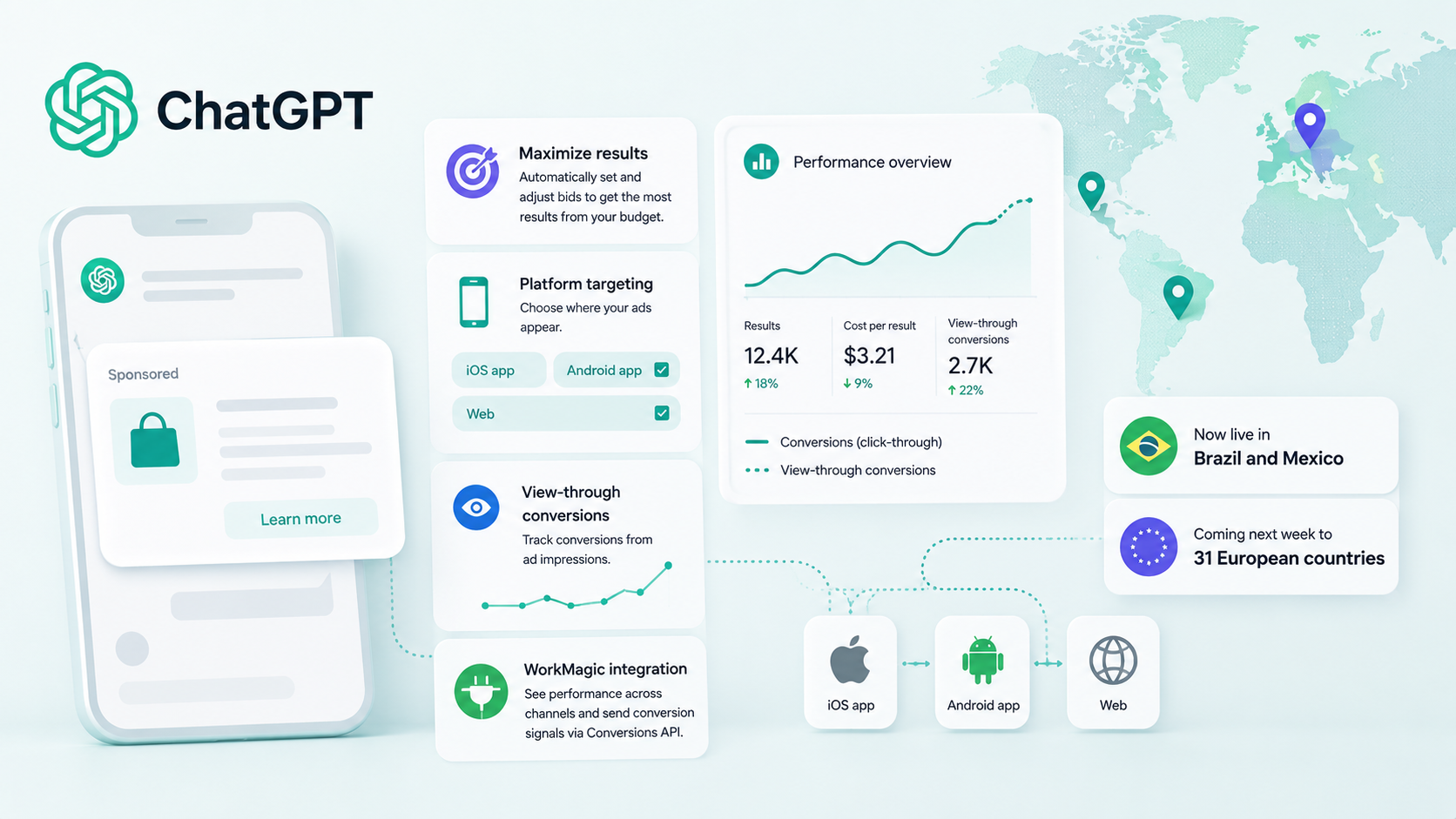
The digital advertising landscape is undergoing a tectonic shift as OpenAI’s ChatGPT Ads platform moves toward full maturity. In a significant update released this week, the platform has introduced a suite of sophisticated features designed to bridge the gap between AI-driven intelligence and traditional performance marketing requirements. By integrating "Maximize Results" bidding, granular platform-level targeting, and robust view-through conversion reporting, ChatGPT Ads is positioning itself as a primary contender for enterprise marketing budgets.
Concurrent with these feature rollouts, the platform is expanding its geographical footprint, officially entering the Brazilian and Mexican markets. This dual approach—scaling infrastructure while deepening the technical utility of its ad stack—signals that OpenAI is no longer merely experimenting with advertising; it is building a comprehensive ecosystem for global brands.
Main Facts: The Core Updates
The latest update to ChatGPT Ads focuses on three pillars: automation, control, and visibility. For performance marketers, these changes represent a move away from manual micro-management toward a more algorithmic, goal-oriented workflow.
1. The "Maximize Results" Bid Strategy
The centerpiece of this update is the "Maximize Results" bidding strategy. Rather than requiring advertisers to manually set Cost-Per-Click (CPC) or Cost-Per-Acquisition (CPA) targets, the system leverages OpenAI’s proprietary machine learning models to adjust bids in real-time. The algorithm evaluates the probability of a conversion based on the campaign’s specific objective and optimizes spend to generate the highest possible volume of conversions within a set budget.
2. Platform-Level Targeting
Recognizing that user behavior differs significantly across touchpoints, ChatGPT Ads has introduced "Eligible Platforms" settings. Advertisers can now isolate their campaigns to specific surfaces: iOS applications, Android applications, or Web interfaces. This granularity is essential for brands that experience varying conversion rates or customer lifetime values (CLV) depending on whether a user is interacting via a desktop browser or a mobile application.
3. View-Through Conversion (VTC) Reporting
Attribution has long been the "holy grail" of advertising, and ChatGPT Ads is addressing this with the introduction of one-day view-through conversion reporting. The system will now track when a user views an ad but does not immediately click, yet completes a conversion within 24 hours. This data is available at the campaign, ad group, and individual ad levels, providing a more holistic view of how ad exposure influences the customer journey.
4. WorkMagic Integration and API Connectivity
The platform has also unveiled a deep integration with WorkMagic. This allows advertisers to synthesize ChatGPT Ads data with other channels, providing a centralized dashboard for performance monitoring. Furthermore, this integration enables the passing of conversion signals back to OpenAI via the Conversions API, creating a closed-loop feedback system that helps the AI "learn" which real-world events are most valuable to the business.

Chronology of Development
The path to these updates reflects a rapid development cycle characteristic of the generative AI space.
- Early Phase: When ChatGPT Ads first entered the market, the platform was characterized by its simplicity, focusing primarily on search-intent-driven text ads.
- The Scaling Phase: Over the past six months, the focus shifted to infrastructure, with the team preparing for the international rollout. This period saw the stabilization of the Conversions API and the initial testing of automated bidding cohorts.
- The Current Milestone: This week’s announcement marks the transition from "beta-style" experimentation to a robust enterprise-ready toolset. By adding Latin American markets (Brazil and Mexico), the platform demonstrates it has the latency and language support necessary to compete with established giants like Meta and Google.
Supporting Data and Technical Nuance
To understand the weight of these changes, one must look at the shift in advertiser control. Historically, ChatGPT Ads relied on manual input, which kept the barrier to entry low but limited the scalability of larger accounts.
By shifting toward the "Maximize Results" strategy, OpenAI is mirroring the successful models used by Meta’s Advantage+ and Google’s Performance Max. Data indicates that when advertisers delegate bid management to AI, the primary hurdle is trust. However, the introduction of the WorkMagic integration and the Conversions API serves as a vital safeguard. By feeding outcome data back into the system, advertisers are essentially "training" the AI to prioritize the leads or sales that matter most to their bottom line, rather than just chasing low-cost traffic.
The inclusion of view-through conversions (VTC) is also a sophisticated move. Industry benchmarks suggest that VTCs can account for a 15–25% increase in total attributed conversions for brands with high-frequency ad creative. For advertisers, this means that while their "click-through" metrics may remain stable, the total perceived value of their ad spend will likely rise as the platform begins to account for the "halo effect" of ad impressions.
Official Responses and Market Positioning
While OpenAI has remained characteristically lean in its public-facing communications, the underlying sentiment from the developer community and product leads suggests a strategy of "controlled autonomy."
The goal, as stated in recent technical briefs, is to "remove the friction of bid management" so that advertisers can focus on the creative elements—the ad copy and visual assets—that ChatGPT is uniquely capable of generating. By automating the "boring" parts of campaign management (bidding and placement), OpenAI aims to position its platform as the most efficient environment for content-led advertising.
The expansion into Brazil and Mexico is equally strategic. These markets are currently seeing a massive surge in AI adoption, and by establishing a footprint there, OpenAI is securing first-mover advantage in regions where digital ad spend is growing at a double-digit compound annual growth rate.

Strategic Implications for Advertisers
The shift toward automation, while beneficial for efficiency, introduces new complexities for digital marketers. Here are the key implications for those managing budgets on the platform:
The "Black Box" Problem
With automated bidding, the "why" behind performance shifts becomes harder to decipher. Advertisers must move away from analyzing individual bid changes and instead focus on "input quality." If the AI is not performing, it is likely because the conversion signals being fed back through the API are either insufficient or improperly categorized.
The Rise of Creative Strategy
As bidding becomes automated, the competitive advantage shifts to creative strategy. Because ChatGPT Ads uses generative AI to tailor ads, advertisers who can provide the platform with high-quality, varied, and relevant creative inputs will see significantly better results. The "Maximize Results" algorithm is only as good as the assets it has to work with.
Attribution Complexity
The introduction of view-through conversions will inevitably lead to inflated performance reporting compared to previous months. Marketing teams will need to be diligent in distinguishing between "Click-Through" (direct engagement) and "View-Through" (passive influence) metrics. It is recommended that companies update their internal reporting dashboards to clearly separate these metrics to avoid over-counting during quarterly reviews.
Global Market Readiness
For multinational brands, the Brazil and Mexico expansion means that localized creative is no longer optional. The ChatGPT Ads platform’s ability to handle regional nuances, when paired with its new platform-level targeting, allows for highly localized campaigns that can bypass the "one size fits all" trap.
Conclusion
The evolution of ChatGPT Ads is a clear indicator that the platform is maturing into a significant pillar of the digital advertising ecosystem. By balancing the "black box" efficiency of automated bidding with the granular control of platform-level targeting, OpenAI is catering to both the casual user and the enterprise marketer.
As we move through the remainder of the year, the success of these new features will be measured not by their novelty, but by their ability to deliver sustained, measurable ROI. Advertisers who embrace these automated tools—while maintaining a rigorous focus on data hygiene and creative quality—will likely find that ChatGPT Ads has transitioned from an experimental channel to an essential component of their diversified media mix. The age of manual bidding is waning; in its place, a more intuitive, AI-driven era of digital advertising has begun.


 Reynand Wu
 Iffa Jayyana
 Raul Delapena Setiawan

 Sagoh
Sagoh

 Azzam Bilal Chamdy
 Ali Ikhwan