
 Evan Lee Salim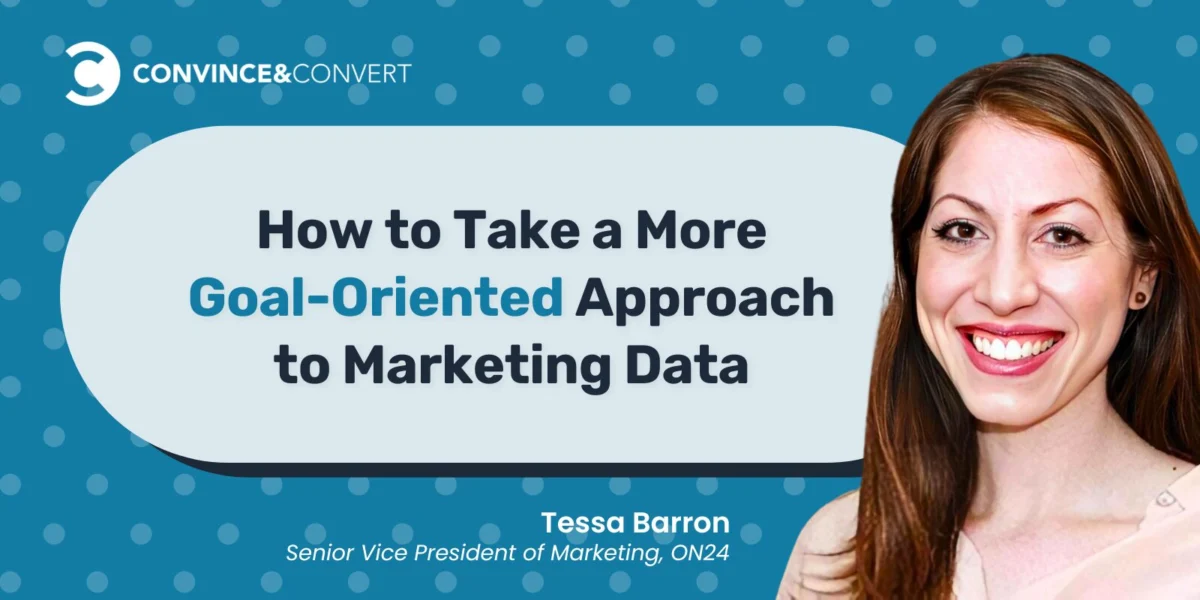
The modern marketing landscape is currently defined by a persistent, often demoralizing mantra: “do more with less.” As budgets tighten and the macroeconomic climate forces organizations to prioritize efficiency, the pressure on marketing teams to deliver aggressive pipeline targets has never been higher. Yet, for many, this creates a fundamental paradox. How can one scale results while resources are being stripped away?
According to Tessa Barron, former Senior Vice President of Marketing at ON24 and a featured guest on the Data-Driven Decisions podcast, the solution does not lie in increased velocity or output. Instead, it requires a radical departure from the "tactic-first" mentality that has dominated the industry for decades. In a shift toward goal-oriented marketing, Barron argues that the key to sustained pipeline growth is not doing more, but doing better through the precise application of data-driven signals.
The Structural Shift: From Tactics to Outcomes
The post-pandemic business environment has fundamentally altered consumer behavior. Yet, a significant number of marketing organizations remain anchored to playbooks written three or four years ago. This inertia is, according to Barron, the primary reason many departments fail to meet their growth objectives despite increased effort.
“We as marketers have to check in with ourselves and ask: Are we still doing what we were doing three years ago?” Barron notes. If the strategy is simply to execute the same volume of webinars, whitepapers, and social campaigns, the expectation that these will yield higher returns is fundamentally flawed.
The Tactic-First Trap
For seasoned marketers, the comfort of "tried-and-true" channels—webinars, blogs, and podcasts—often leads to a trap where the channel itself becomes the objective. A common error is planning a calendar around quantity: “We need to run four webinars in Q1.”
Barron suggests reversing this logic. Instead of focusing on the volume of content, organizations should begin with the desired outcome, such as "a 10% uplift in pipeline" or "reaching X number of new accounts." By anchoring strategy to a specific business goal, the choice of tactic becomes a secondary, calculated decision rather than a default action.
Decoding the Signal: Data as a Strategic Asset
In the modern digital ecosystem, marketers are drowning in data, yet they are often starving for actionable insights. Barron distinguishes between "noise"—the vanity metrics like page views or session attendance—and "signals," which represent verifiable indicators that a buyer is moving closer to a conversion point.
Designing the "Trap"
Once a marketer understands which signals correlate with a sale, they can design digital environments that proactively capture that data. Barron refers to these as "traps"—structured, non-intrusive interactions within a piece of content designed to extract high-value information from the prospect.
The effectiveness of this approach is best illustrated through real-world applications:
- The Cloud Provider Strategy: A technology company struggling to regain market share identified that prospects using a specific cloud provider were ten times more likely to close. Instead of generic lead-generation tactics, they utilized their webinar platform to ask a simple, targeted question: "What cloud provider are you currently using?" This allowed the marketing team to isolate high-intent leads and fast-track them to sales, bypassing the noise of the general audience.
- The Clinical Risk Assessment: A pharmaceutical firm aimed to connect with physicians treating high-risk patients. By embedding a risk-assessment poll in their educational webinars—asking doctors to rate their patient base’s risk—the company could identify which attendees were in immediate need of their therapeutic solutions, thereby creating a prioritized outreach list for the sales team.
These examples underscore a critical evolution: data capture is no longer about gathering demographic information; it is about gathering intent-based intelligence that informs the next step of the customer journey.
The Sales-Marketing Nexus: Bridging the Pipeline Gap
A recurring theme in modern B2B discourse is the misalignment between sales and marketing. Barron argues that this is often because marketing departments view their job as "creating pipeline," when, in reality, they are merely setting the stage for it.
The Role of the Front Line
Salespeople occupy the front lines of the customer experience. They understand the specific language, hesitations, and triggers that influence a buyer’s decision. Marketing teams that fail to interview their sales counterparts are operating in a vacuum.
"Marketers are creating a net to catch people who might turn into pipeline," says Barron. "But it’s the salespeople who actually create the pipeline."
To bridge this divide, marketing leaders should adopt the following practices:
- Direct Discovery: Ask sales leaders, "What are the three most common questions a prospect asks before they commit to a meeting?"
- Vocabulary Alignment: Ensure that the messaging used in marketing assets mirrors the language used by sales during discovery calls to maintain a consistent brand experience.
- Unified Goal Setting: If sales is measured on conversion rates, marketing should be measured on the quality of the data that facilitates those conversions, not just the quantity of leads passed over.
Optimizing the "In-Between" Spaces
When focusing on the pipeline, organizations often fixate on the "top of the funnel" (lead acquisition) and the "bottom of the funnel" (close). However, the most significant improvements in conversion rates often happen in the friction-filled spaces in between.
Barron emphasizes that minor, often overlooked elements—such as bloated lead-capture forms, disjointed cross-departmental messaging, or overly generic follow-up sequences—act as "conversion killers." By scrutinizing the journey a lead takes from a first interaction to a qualified opportunity, marketers can identify and remove these barriers.
This is where the shift from "doing more" to "doing better" becomes tangible. A shorter form, a more targeted email, or an interactive session that asks for the right information can have a greater impact on revenue than an entire quarter of generic, high-volume content production.
Implications for Stakeholder Communication
Finally, the shift toward a data-driven, goal-oriented framework has profound implications for how marketing impact is reported to the C-suite. As companies become more data-conscious, the "noise" of marketing dashboards—charts displaying likes, shares, and raw traffic—often fails to impress stakeholders who are focused on the bottom line.
Visualizing Value
Barron advocates for the simplification of data reporting. Stakeholders, particularly those outside the marketing department, do not need to see the complexity of the funnel; they need to see the relationship between a specific strategic investment and the resulting movement in pipeline growth.
By distilling complex data sets into simple, trend-based visualizations, marketers can demonstrate that their budget is not being spent on "tactic execution," but on "signal acquisition." This clarity fosters trust and allows marketing teams to secure the resources they need for future initiatives, as the correlation between their efforts and company growth becomes undeniable.
Conclusion: A Future of Intentionality
The "do more with less" era is not a mandate for exhaustion; it is a mandate for intelligence. By moving away from the treadmill of constant content creation and toward a framework defined by strategic signal capture, alignment with sales, and an obsession with conversion, marketing teams can reclaim their role as primary drivers of organizational revenue.
The path forward for the modern marketer is clear: stop counting what you do, and start counting what you uncover. In a world of increasing digital noise, the competitive advantage belongs to those who know exactly which signals matter—and know how to act on them before anyone else.


 Reynand Wu
 Iffa Jayyana
 Raul Delapena Setiawan

 Sagoh
Sagoh

 Azzam Bilal Chamdy
 Ali Ikhwan