
 Ali Ikhwan
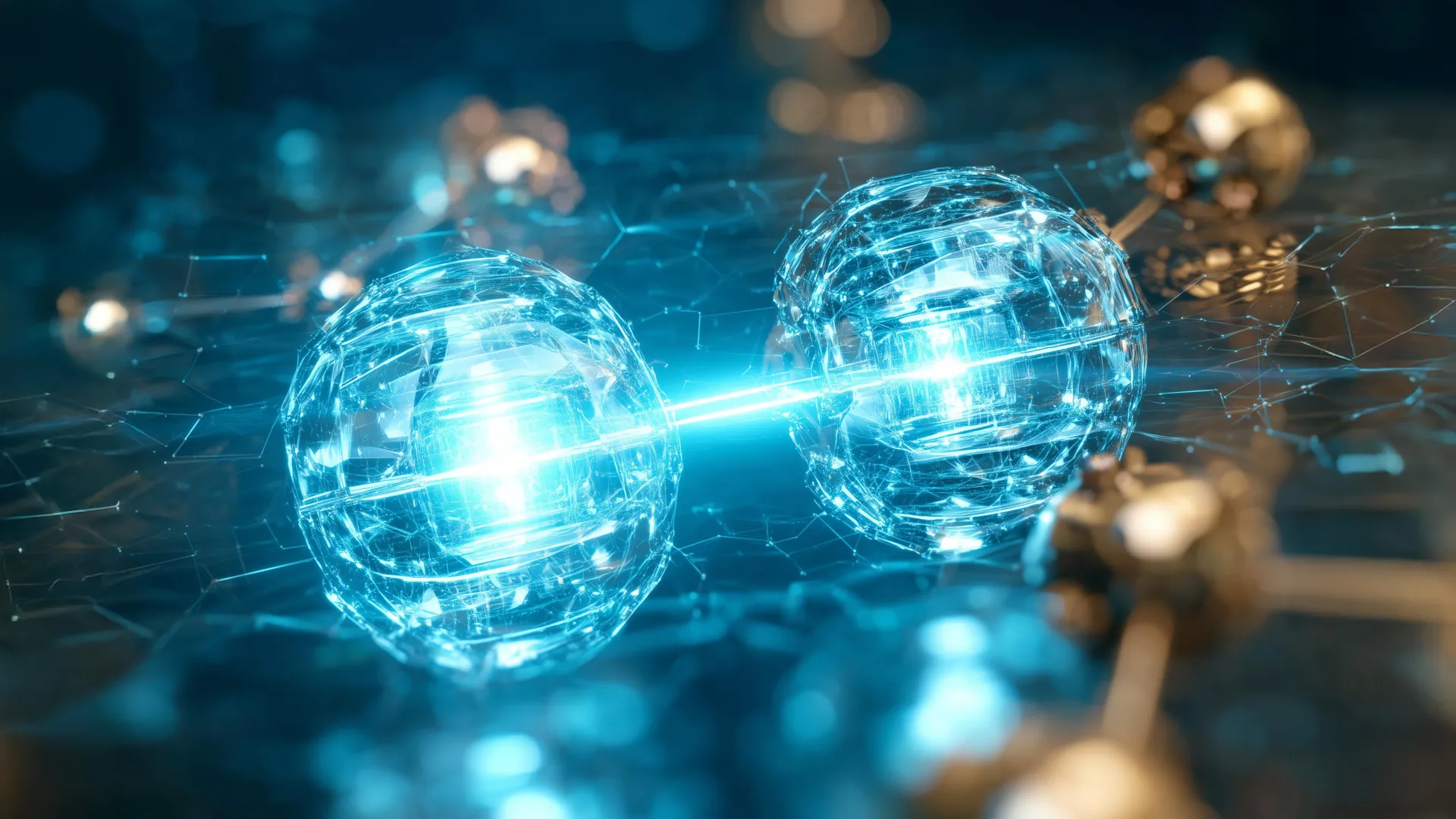
In the race to build a functional, large-scale quantum computer, the industry has hit a formidable "error wall." While quantum bits, or qubits, offer the tantalizing promise of processing power that dwarfs classical supercomputers, they are notoriously fragile. A sneeze, a stray radio wave, or even a microscopic fluctuation in temperature can cause "decoherence"—the collapse of a quantum state—leading to computational errors.
Now, a team of researchers at the University of Surrey has unveiled a pioneering proposal that could bypass these limitations entirely. By harnessing the unique properties of superfluid helium-3, the team has designed the Superfluid Helium Oscillator Quantum (SHOQ) device. This novel architecture, detailed in the journal npj Quantum Information, suggests a path toward quantum hardware that is inherently shielded from the electromagnetic interference that plagues current systems.
The Fragility of Current Quantum Hardware
To understand why the SHOQ device is being heralded as a potential breakthrough, one must first understand the "noise" problem. Today’s leading quantum computers, such as those developed by IBM, Google, and Rigetti, largely rely on superconducting circuits. These circuits are marvels of modern engineering, operating at temperatures colder than deep space to allow electricity to flow without resistance.
However, these superconducting qubits are "electrically active." Because they rely on the movement of electrons, they are hyper-sensitive to electromagnetic noise and stray electric charges. Think of these qubits like a high-precision scale that is constantly being buffeted by gusts of wind; even the smallest vibration or static charge can introduce errors, forcing engineers to dedicate the vast majority of their qubits to "error correction" rather than actual computation. As systems scale from dozens of qubits to thousands, this overhead becomes exponentially harder to manage.
A New Frontier: The Superfluid Advantage
The Surrey team, led by Dr. Priya Sharma and Dr. Eran Ginossar, suggests that the solution is to move away from purely electrical qubits. Their proposed SHOQ device utilizes superfluid helium-3—a rare state of matter where liquid helium flows without any viscosity or friction.
The genius of the SHOQ design lies in its neutrality. Unlike superconducting qubits that rely on the flow of charged electrons, superfluid helium is charge-neutral. Because it lacks an electric charge, it is fundamentally immune to the electromagnetic "static" that disrupts superconducting systems. By decoupling the information-carrying mechanism from the electromagnetic environment, the researchers believe they can achieve error rates approximately 100 times lower than those seen in current superconducting designs.
Chronology of the Research
The path to the SHOQ device was not an overnight discovery, but the result of years of cross-disciplinary collaboration between quantum physicists and microfluidics engineers.
- Initial Conceptualization: The theoretical foundations were laid through an analysis of superfluid helium-3’s quantum properties. The researchers sought a way to trap and manipulate these states within a structured environment.
- Mathematical Modeling: The Surrey Quantum Sciences Group spent significant time modeling the interactions between superfluid oscillations and electromagnetic fields. They determined that a microfluidic architecture could serve as a "vessel" for quantum information.
- The Collaboration: The project expanded to include Professor Jens Koch of Northwestern University. Dr. Koch’s background as a co-inventor of the "transmon"—the gold standard for superconducting qubits today—provided the necessary bridge between theoretical superfluid physics and practical quantum computing architecture.
- Publication and Peer Review: The findings were formally published in npj Quantum Information, marking the first time such a device has been proposed in a peer-reviewed setting with explicit parameters for construction.
- Current Status: The team has secured an IAA Commercialisation Fellowship to move from the drawing board to the laboratory, focusing on the fabrication of a physical prototype.
Supporting Data and Theoretical Framework
The SHOQ device functions as a hybrid system. It maps the quantum state of the superfluid helium onto a physical oscillator. Because the superfluid is incompressible and frictionless, it creates a highly stable, high-Q factor environment. In physics, a "high-Q" oscillator is one that maintains its energy for a long period, meaning it is less prone to losing its state due to external perturbations.
The team’s calculations indicate that by confining the superfluid within a microfluidic circuit, they can create a "quantum memory" cell. This cell would not necessarily be the processor itself, but rather a "vault" where quantum information could be stored with extremely high fidelity.
The mathematical model demonstrates that the interaction between the superfluid and the electromagnetic field can be controlled through precise geometry, allowing for the manipulation of qubits without the usual sensitivity to noise. According to the research, the predicted coherence times—the amount of time a qubit can hold its information—are significantly longer than those of current transmon qubits.
Official Responses and Expert Commentary
Dr. Priya Sharma, the lead author of the study and a Daphne Jackson Fellow, emphasizes that the strength of this design lies in its realism.
"We are not the first to think about the individual components behind this idea," Dr. Sharma noted. "But what we have done for the first time is bring them together in a microfluidic device and work out the specific details that could enable the device to function as a qubit. The maths tells us that it should work. We have taken what we already know about superfluid helium and quantum technologies and turned that into an educated design."
Dr. Eran Ginossar, Associate Professor at the University of Surrey, suggests that the future of quantum computing is not a "winner-take-all" scenario. Instead, he envisions a heterogeneous architecture.
"We don’t necessarily need one type of qubit to do everything," Dr. Ginossar explained. "Combining different quantum technologies could allow us to take advantage of the strengths of each. Superfluid helium gives us a fundamentally different type of quantum hardware to explore. If the predicted performance can be demonstrated experimentally, it could eventually work alongside existing superconducting technologies as part of a larger quantum system."
The Roadmap: Building the Prototype
The leap from mathematical theory to hardware reality is the most significant challenge remaining. Building a prototype requires cooling the device to near absolute zero—a threshold already achieved in other experiments involving superfluid helium-3. The collaboration with Professor Jens Koch is critical here, as his team brings extensive experience in the practical implementation of qubit architectures.
The immediate next step is the creation of a microfluidic chamber that can be integrated with existing microwave readout systems. This would allow the team to observe the "oscillation" of the helium and confirm whether it truly remains shielded from environmental noise. If successful, this would represent the first experimental validation of a superfluid-based qubit.
Implications for the Future of Computing
The potential implications of this research are profound. If the SHOQ device proves effective, it could solve the "scalability bottleneck" that currently limits quantum computers to a few hundred qubits.
1. Quantum Memory
One of the most immediate applications is in quantum memory. By offloading the storage of quantum information to a stable, superfluid-based system, researchers could perform complex calculations on superconducting hardware while the helium-3 system acts as a high-fidelity "buffer."
2. Hybrid Architectures
The era of the "monolithic" quantum computer may be short-lived. A hybrid system, using superconducting qubits for fast gate operations and superfluid qubits for long-term memory, could be the key to achieving the millions of qubits required for fault-tolerant quantum computing.
3. Energy Efficiency and Stability
Because the SHOQ device is inherently more stable, it may reduce the need for the massive, energy-intensive error-correction subroutines currently required. This could make quantum computers not only more powerful but also more sustainable and easier to maintain.
Conclusion
The University of Surrey’s proposal to use superfluid helium-3 as a medium for quantum computing is a bold departure from traditional solid-state physics. While the team faces the daunting task of building a prototype, the theoretical foundation they have established is robust and grounded in established quantum principles.
By looking toward the unique properties of fluids to solve the problems of the solid state, the researchers have opened a new door in the quest for quantum supremacy. Whether or not the SHOQ device becomes the standard for the next generation of quantum hardware, it serves as a powerful reminder that in the search for the future of technology, the most effective answers may lie in the most unconventional materials. As Dr. Sharma and her team prepare to enter the lab, the quantum community waits with bated breath to see if superfluid helium can indeed provide the "quiet" that quantum computers so desperately need.


 Neng Nana

 Evan Lee Salim

 Raul Delapena Setiawan

 Reynand Wu

 Sagoh


 Azzam Bilal Chamdy

