
 Lina Irawan
In the high-stakes world of enterprise AI, the difference between a prototype that gathers digital dust and a production-ready agent that drives real value often comes down to one uncomfortable moment. It is the moment a compliance officer, a CTO, or a risk manager asks a question that the engineering team cannot answer: "How do you know your agent isn’t hallucinating patient symptoms?" or "How can we prove this agent won’t leak proprietary data?"
For many development teams, the initial response is defensive. They point to unit tests, integration suites, and glowing results on a curated demo dataset. But in the real world—where users throw unpredictable, messy, and context-heavy queries at a system—standard software testing fails to capture the unique, non-deterministic nature of Generative AI.
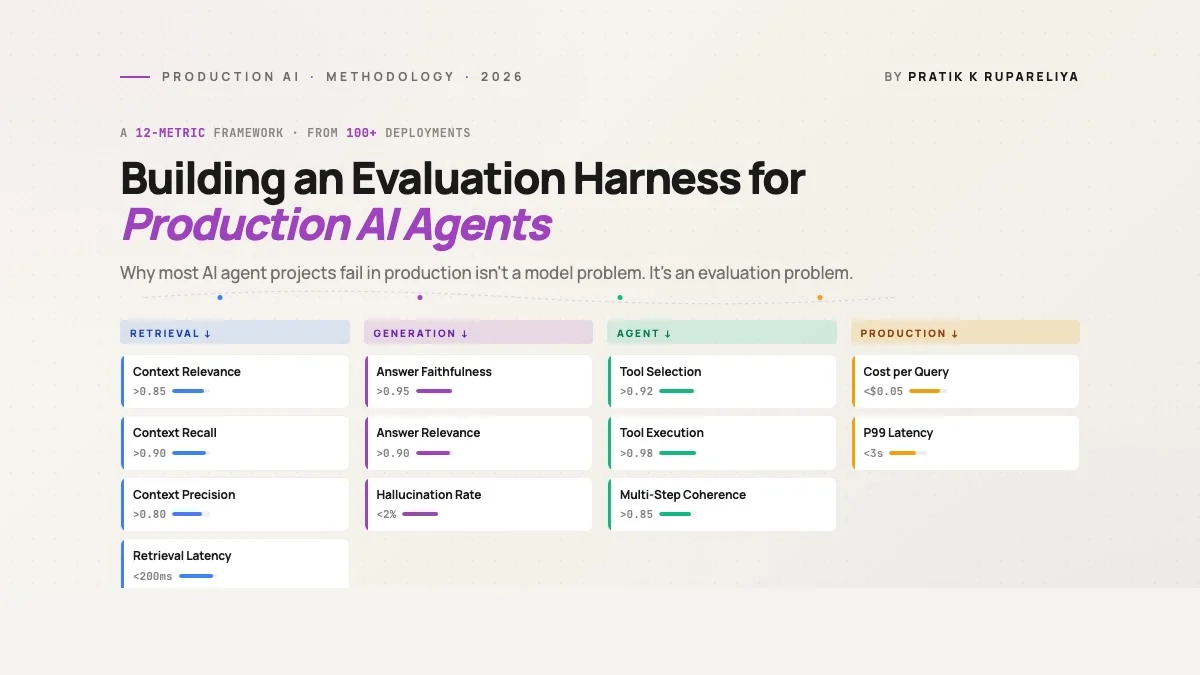
This gap, the "Evaluation Void," has derailed countless promising projects. Over the past few years, through more than 100 enterprise AI deployments, a definitive playbook has emerged. Moving from "it works on my machine" to "it is safe for the enterprise" requires a rigorous, multi-layered evaluation harness.
The Anatomy of an Evaluation Crisis: A Chronology
The trajectory of a failing AI project often follows a predictable, albeit painful, timeline.
Phase 1: The "MVP Mirage" (Weeks 1–4)
Teams often prioritize feature velocity. They build the UI, the API integrations, and the core LLM orchestration. During this time, evaluation is treated as an afterthought—a box to be checked once the "heavy lifting" of building the agent is complete.
Phase 2: The Compliance Wall (Weeks 5–6)
As the project nears deployment, it hits the wall. Compliance teams, rightfully cautious about liability, demand proof of reliability. The team realizes they have no metrics for "faithfulness" or "hallucination rates." The project stalls as engineers scramble to retrofit an evaluation harness into a system already in production.
Phase 3: The Recovery (Weeks 7–12)
By implementing a comprehensive evaluation framework, the team regains control. They begin measuring everything from retrieval precision to token costs. Only then does the agent achieve the reliability required for production sign-off.
The 12-Metric Framework: Measuring the Invisible
To effectively govern AI agents, we must categorize performance into four distinct domains: Retrieval, Generation, Agentic Behavior, and Production Health.
I. Retrieval Metrics: The Foundation
If the agent’s knowledge retrieval is flawed, the LLM is effectively guessing from a corrupted dataset.
- Context Relevance: Measures the percentage of retrieved chunks actually relevant to the user query. A score below 0.85 suggests your retrieval system is bringing "noise" into the context window.
- Context Recall: Did we find all the necessary information? Low recall is a silent killer, leading the model to hallucinate because it doesn’t know what it doesn’t know.
- Context Precision: Are the most relevant chunks ranked at the top? With token limits, if the answer is buried in the 10th result, it might as well not exist.
- Retrieval Latency: At a p95 threshold of <200ms, this ensures that the foundation of the agent doesn’t bottleneck the user experience.
II. Generation Metrics: Trust and Fidelity
Once the data is retrieved, how does the model process it?
- Answer Faithfulness: The gold standard for regulated industries. It measures whether the answer strictly adheres to the retrieved context. If it deviates, it’s a compliance risk.
- Answer Relevance: Does the answer actually address the user’s intent? An answer can be "faithful" to a document but completely miss the point of the user’s question.
- Hallucination Rate: The most scrutinized metric. It tracks instances where the model invents facts entirely outside the provided context. A target of <2% is generally the threshold for enterprise viability.
III. Agentic Behavior: Beyond Simple RAG
Modern agents don’t just chat; they act. These metrics govern the "doing" aspect of AI.
- Tool Selection Accuracy: In a system with multiple tools, did the agent pick the right one? A drop in this metric is often a sign that tool descriptions need clarity or that the agent needs to be decomposed into smaller sub-agents.
- Tool Execution Success: Did the API call succeed? This measures the robustness of the integration, ensuring the agent doesn’t fail at the point of action.
- Multi-Step Coherence: Does the logical chain hold up over four or more steps? This measures the "reasoning" quality of the agent across time.
IV. Production Health: The Business Reality
- Cost per Query: Without tracking, token sprawl can lead to budget shocks. Monitoring the cost of the entire chain (retrieval, reasoning, tool use) is vital for long-term sustainability.
- P99 Latency: The metric that defines user experience. A system that is fast 90% of the time but lags for 10% of users will see high abandonment rates.
Implications for Enterprise Strategy
The adoption of this 12-metric framework shifts the conversation from "AI hype" to "AI engineering."
Why Teams Fail: Three Common Patterns
Many organizations fall into the trap of believing they can "add evaluation later." This is rarely true. Retrofitting evaluation is expensive, time-consuming, and often results in compromised trust because the initial MVP was deployed without guardrails.
Furthermore, many teams rely on "manual spot-checks." While this works for a handful of queries, it fails entirely at scale. You cannot manually review 10,000 queries a day; automated evaluation is not a luxury, but an operational necessity.
The Financial and Legal ROI
The cost of implementing this framework is significant—requiring roughly 2–3 weeks of focused engineering time—but the ROI is realized through the prevention of "catastrophic failures." In a regulated environment, a single hallucinated medical diagnosis or a botched financial transaction could result in lawsuits, regulatory fines, and permanent reputational damage. Evaluation is, in effect, an insurance policy for your AI strategy.
Implementation: A Tiered Approach
You do not need to launch with all 12 metrics. A phased rollout allows teams to manage complexity:
- Phase 1 (The Launchpad): Focus on retrieval metrics and answer faithfulness. These are the "must-haves" for a stable release.
- Phase 2 (The Refinement): Integrate hallucination detection and tool selection accuracy as you gather real-world user data.
- Phase 3 (The Optimization): Once stable, introduce production health metrics like cost and p99 latency to maximize efficiency.
Expert Perspective: The Commodity Model vs. The Evaluation Edge
As models like GPT-4, Claude, and Llama continue to improve, the underlying "intelligence" of the LLM is becoming a commodity. The competitive advantage no longer lies in which model you choose, but in the evaluation infrastructure you build around it.
The most successful enterprise teams today are not those with the most complex prompts or the largest models, but those with the most transparent and rigorous evaluation pipelines. They treat their AI agents like software products, subject to the same standards of quality assurance and reliability as any other mission-critical system.
Summary Checklist for Deployment
For those embarking on the journey of enterprise AI, keep these principles in mind:
- Automation is mandatory: If you cannot measure it automatically, you cannot scale it.
- LLM-as-Judge is your best friend: Use a superior model to evaluate the performance of your agent, but calibrate it regularly with human-in-the-loop reviews.
- Prioritize the "Faithfulness" metric: In any industry where accuracy is paramount, this is your primary defense against liability.
- Define your thresholds early: Do not wait for a compliance audit to decide what constitutes an acceptable hallucination rate.
The era of "black box" AI agents is coming to a close. The future belongs to organizations that can peer inside the box, measure the output, and guarantee the results. By adopting a structured, metric-driven evaluation harness, you aren’t just shipping an agent—you’re shipping a reliable piece of enterprise infrastructure.
Pratik K Rupareliya is the Co-Founder and Head of Strategy at Intuz, where he has overseen the deployment of over 100 enterprise AI agents across the healthcare, fintech, manufacturing, and retail sectors. His work focuses on bridging the gap between theoretical AI capabilities and the practical, high-reliability demands of the enterprise.


 Dwi Wanna
 Azzam Bilal Chamdy
 Pevita Pearce

 Nana
 Ammar Sabilarrohman
