
 Asro
Asro
For the modern founder, the email marketing dashboard is a siren song of data. It is a sprawling, colorful landscape of percentages, heat maps, and granular tracking that promises clarity but often delivers confusion. Open rates, click-through rates, bounce rates, and revenue-per-email—these figures blink back at you from the screen, demanding attention.
For many, the standard practice is to glance at a few metrics, feel a fleeting sense of validation or anxiety, and then return to the messy, high-stakes work of actually running a business. This reaction is not only common; it is arguably rational. Most of the data provided by standard email service providers (ESPs) is noise. However, buried within this "wall of percentages" are a few key performance indicators (KPIs) that act as the true North Star for your business growth.
To scale, you must stop being a spectator of your metrics and start being a strategist. It is time to decode which numbers truly matter, which have been rendered obsolete by modern privacy standards, and how to execute a fifteen-minute monthly ritual that transforms your email program from a chore into a primary revenue engine.
The Evolution of Email Analytics: Why Your Data May Be Lying to You
To understand the current state of email marketing, one must look at the historical pivot point of 2021. Before this, "Open Rate" was the undisputed king of metrics. It served as the primary barometer for subject line effectiveness and list health.
The Apple Mail Privacy Protection (MPP) Shift
In 2021, Apple introduced Mail Privacy Protection, a move that fundamentally altered the digital marketing landscape. By pre-loading emails on user devices—regardless of whether the recipient actually viewed the message—Apple caused "open" counts to spike across the industry.
Suddenly, a 45% open rate no longer signified that nearly half your list was engaged; it signified that a significant, unquantifiable portion of your "opens" were generated by automated server pings. This "broken speedometer" effect means that relying on open rates for precise decision-making is a trap. However, it does not mean the metric is entirely useless. If you track open rates over a long period, you are tracking a trend. If that trend is consistently downward, you have a signal—not a measurement—that suggests your subject lines are tiring or your sender reputation is eroding.
The Hierarchy of Truth: Metrics That Matter
If the open rate is a faulty compass, what should you actually be looking at? The answer lies in a hierarchy of reliability, where user action—rather than passive receipt—takes precedence.
1. Click Rate: The Honest Metric
Nobody clicks a link by accident. Unlike an open, which can be triggered by a machine, a click represents an intentional, human interaction. This makes the Click Rate the most honest number on your dashboard.
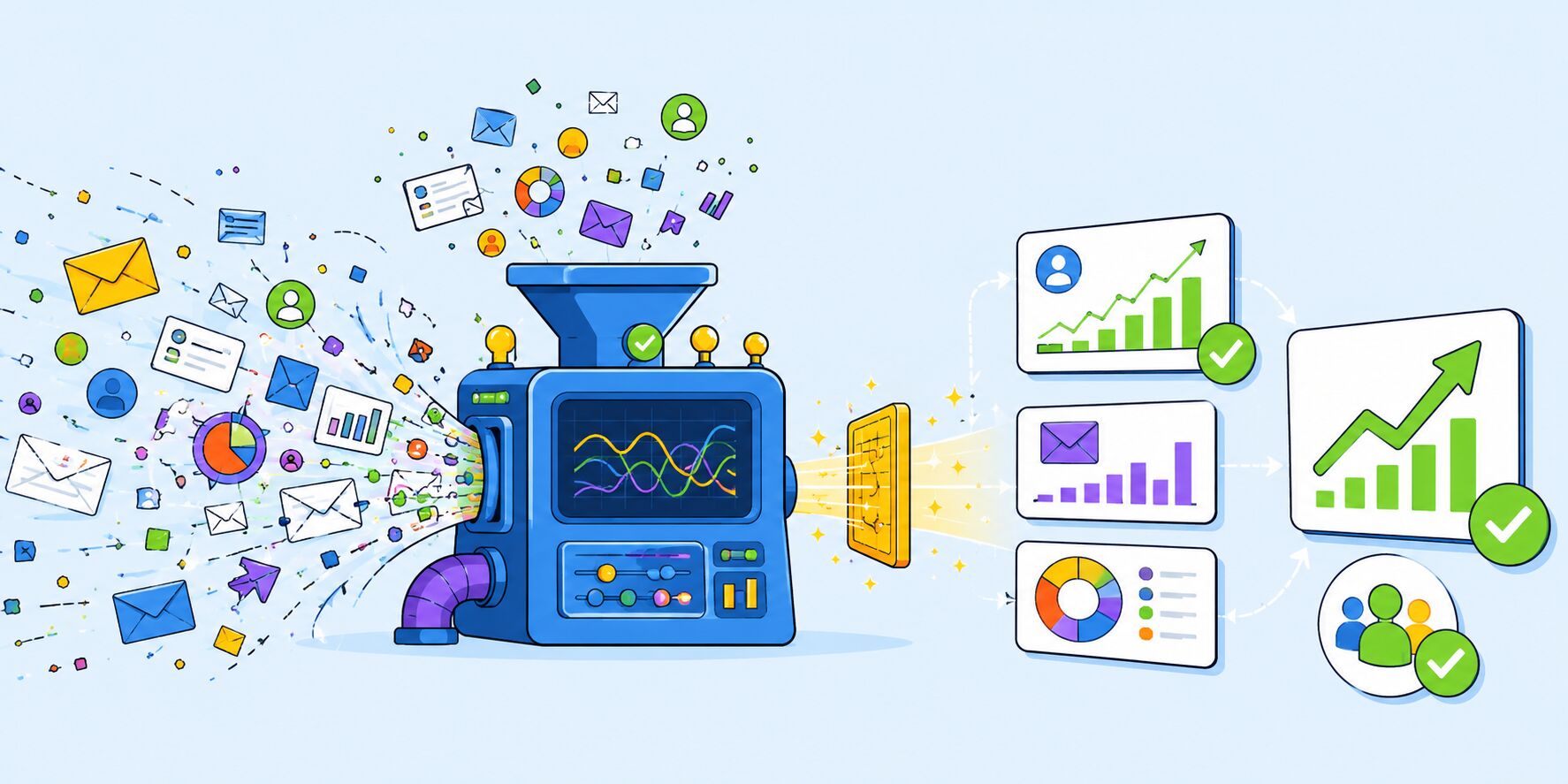
To diagnose your email performance, you must compare two distinct figures:
- Click Rate (Clicks/Delivered): This provides an overview of how your campaign performed relative to the entire audience.
- Click-to-Open Rate (Clicks/Opens): This reveals how effective your content was among those who actually saw the message.
By viewing these side-by-side, you unlock a diagnostic tool. If you see a low click rate but a healthy click-to-open rate, your content is likely excellent, but your subject lines are failing to drive interest. Conversely, if you see high opens but weak click-to-open performance, your subject line is promising a value that the body of the email fails to deliver. This is the difference between a marketing problem and a creative problem.
2. Revenue Per Email (RPE): The Bottom Line
Engagement is a vanity metric if it doesn’t translate to business health. Revenue Per Email (RPE) is the ultimate arbiter of success. By dividing total revenue attributed to a campaign by the number of emails delivered, you create a standardized metric that allows you to compare a high-volume sale blast against a quiet, automated welcome flow.
RPE has a humbling effect on founders. It often reveals that the "clever" campaign you spent days crafting is vastly outperformed by a simple, automated product replenishment email. When you begin to optimize for RPE, you shift your focus from "cleverness" to "utility," which is where sustainable growth resides.
The Smoke Detectors: Protecting Your Deliverability
While RPE and Click Rates drive growth, three "smoke detector" metrics warn you of impending disaster. These are the numbers you should ignore 95% of the time, provided they remain within healthy thresholds.
Bounce Rate
A hard bounce occurs when an email address is invalid. A rising hard bounce rate is a direct signal to inbox providers (like Gmail or Outlook) that your list hygiene is failing. If this climbs above 1%, it can trigger spam filters that penalize your entire domain. Always ensure your ESP is configured to automatically suppress hard bounces.
The Unsubscribe Rate Paradox
Many founders view a 0% unsubscribe rate as a badge of honor. In reality, it is often a red flag. A healthy unsubscribe rate—typically between 0.2% and 0.5%—is a natural part of list curation. It means you are filtering out people who are not interested, which protects your overall engagement and, by extension, your deliverability. If your rate is 0%, your unsubscribe link may be too difficult to find, which leads frustrated users to hit the "Mark as Spam" button instead.
Spam Complaints: The Metric With Teeth
Spam complaints are the most dangerous metric. Even a tiny percentage of complaints can permanently damage your sender reputation, causing your emails to be relegated to the "Promotions" or "Junk" folders indefinitely. If complaints spike, you have a frequency problem (sending too often), a relevance problem (not sending what they signed up for), or an accessibility problem (hiding the opt-out link).

The Fifteen-Minute Monthly Ritual
The greatest failure in data management is the assumption that monitoring equals improving. Data is useless without the subsequent decision-making process. To master your email program, implement a fifteen-minute monthly audit:
- Revenue Review: Identify which campaigns had the highest RPE and determine the common thread. Was it a specific offer? A certain tone?
- Engagement Audit: Analyze the best click-to-open performers. What content style resonated most?
- Trend Tracking: Are opens, clicks, and unsubscribes trending up or down over the last quarter?
- Automation Check: Which automated flows are driving the bulk of your revenue, and which are stagnating?
The Golden Rule: Change only one variable at a time. If you update your subject line style, change your call-to-action button, and rewrite your footer simultaneously, you will never know which change drove the improvement. Precision in testing is the hallmark of a growth-oriented business.
Implications for Modern Ecommerce
As the digital landscape becomes more crowded, the ability to leverage first-party data through email is no longer a luxury—it is a competitive necessity. Platforms like Omnisend have responded to this by integrating revenue attribution directly into the dashboard, allowing founders to see exactly how individual segments are responding in real-time.
For the entrepreneur, the implication is clear: you must stop viewing your email dashboard as a static report. View it as a laboratory. When you link revenue directly to campaigns and automations, you stop guessing. You move from a cycle of "send and hope" to a disciplined cycle of "test, learn, and optimize."
The Strategic Shift
The ultimate goal of this data-driven approach is to transition your email program from a series of one-off, manual tasks into a sophisticated, automated revenue engine. By focusing on the "honest" metrics—clicks and revenue—while using the "smoke detectors" to maintain a healthy domain reputation, you ensure that your business growth is both predictable and scalable.
If you find yourself overwhelmed by the complexity of your data, remember: your dashboard is not there to be watched. It is there to be argued with. Question every trend, test every assumption, and refine your approach one small change at a time. Your email program is not just a marketing channel; it is the most effective tool you have for building a direct, profitable relationship with your customers. Use it with intent.


 Iffa Jayyana
 Raul Delapena Setiawan
 Laily UPN
 Rifan Muazin
 Suro Senen
 Lina Hope
 Lina Irawan