
 Iffa Jayyana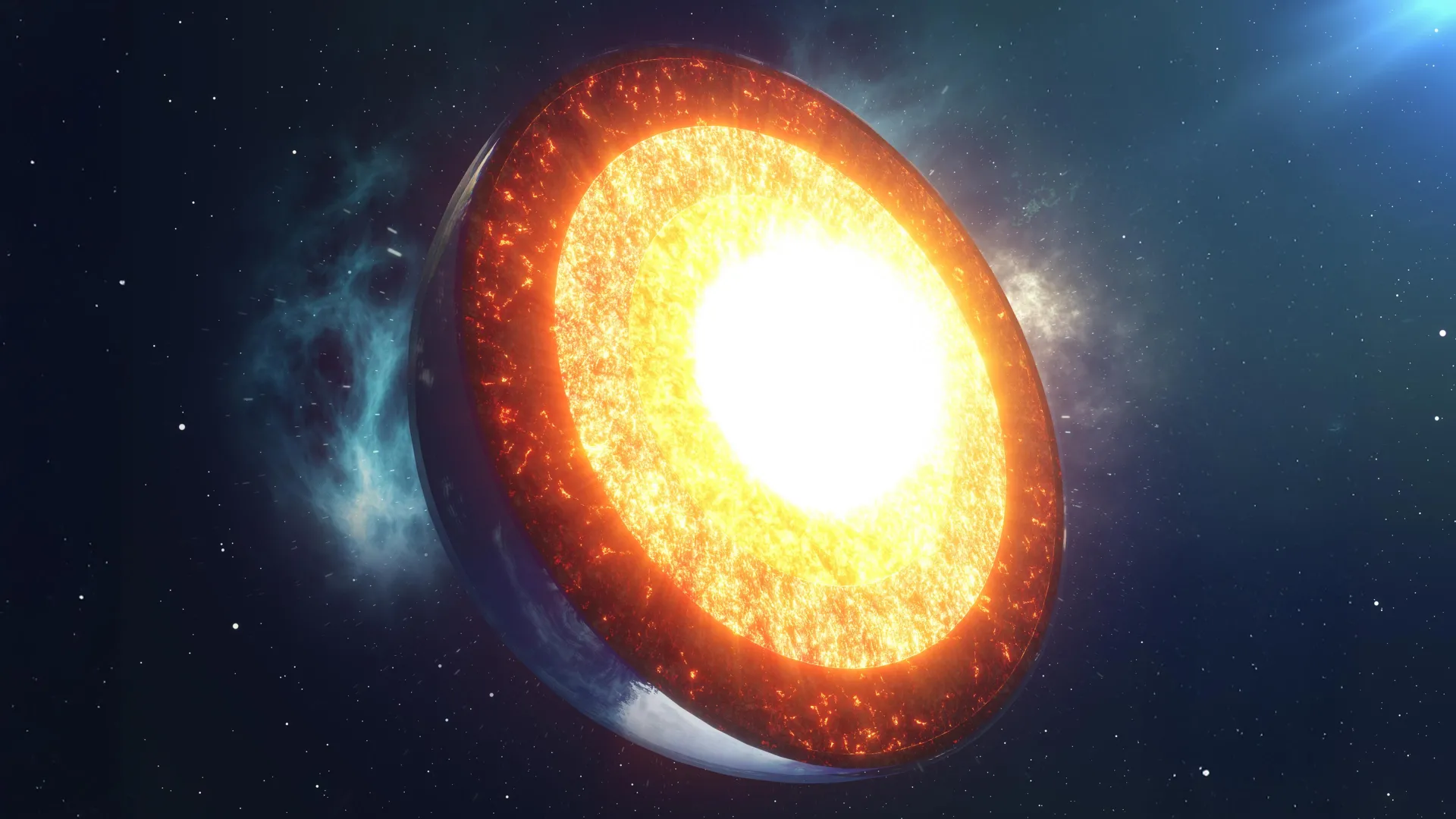
For most of humanity, the 24-hour day is the ultimate constant—a rigid, immutable framework upon which we build our lives, our economies, and our civilizations. We perceive time as a steady, mechanical tick-tock, dictated by the sunrise and the sunset. However, beneath our feet, a vastly different reality unfolds. Earth’s rotation is not a fixed gear, but a fluid, dynamic process governed by the turbulent behavior of the planet’s deepest, most inaccessible regions.
New research has illuminated a long-standing mystery regarding why the length of our days fluctuates by mere milliseconds. Far from being a trivial curiosity, these tiny deviations are the fingerprints of a complex, invisible dance between the Earth’s core and its mantle.
The Core Facts: A Planet in Flux
The Earth is not a solid, static rock. It is a layered, spinning body with a complex interior that behaves more like a fluid machine than a marble. For decades, geophysicists have been aware that the length of a day (LOD) is subject to slight variations. These shifts, though measured in milliseconds, are detectable by high-precision atomic clocks and satellite tracking.
The fundamental driver of these changes lies in the conservation of angular momentum. In a closed system, momentum must be conserved; if one part of the Earth speeds up, another must slow down to compensate. This cosmic "tug-of-war" occurs between the planet’s liquid outer core and the solid mantle—the 3,000-kilometer-thick layer of rock that extends from the crust down to the core-mantle boundary. When the liquid core accelerates, the mantle experiences a corresponding deceleration, and vice versa. This mechanical trade-off is the primary engine behind the flickering length of our days.
A Chronology of Discovery: Tracking the Core’s Pulse
The scientific journey toward understanding this phenomenon has been a decades-long pursuit of "deep-Earth forensics."
The Early Recognition (1990s – 2010s)
By the 1990s, scientists had established that the Earth’s magnetic field—which is generated by the swirling liquid iron in the outer core—was not constant. Observations of magnetic field fluctuations provided the first concrete evidence that the outer core undergoes periodic shifts in rotational speed. Researchers noted that these cycles often spanned several decades, suggesting a slow, rhythmic "sloshing" of molten iron within the planet’s depths.
The Missing Link (2010s – 2023)
While the core-mantle momentum exchange was a widely accepted theory, the mechanism of that exchange remained elusive. How does the liquid, churning core "grab" the solid mantle and influence its rotation? For years, this was the central question. Models existed, but they lacked the necessary physics to explain the observed precision of the day-length variations.
The Recent Breakthrough (September 2024)
On September 23, 2024, a pivotal study published in the journal Nature by University of Alberta researchers Huifeng Zhang and Professor Mathieu Dumberry bridged this gap. By modeling the gravitational interactions between the inner core and the mantle, the team provided a rigorous mechanical explanation for the momentum exchange, moving the field from theoretical postulation to concrete, observable physics.
Supporting Data: The Gravitational Torque Mechanism
The core of the matter, quite literally, lies with the inner core—a solid sphere of iron-nickel alloy at the very center of the planet. While the outer core is liquid, the inner core is solid, yet it is not a perfect sphere. It possesses an irregular shape, characterized by subtle mass anomalies—some areas are denser or more protruding than others.
The "Gravitational Torque" Theory
Zhang and Dumberry’s research posits that because the inner core is non-spherical, its rotation creates a "gravitational torque" against the mantle. As the inner core rotates, its uneven mass distribution exerts a gravitational pull on the mass concentrations within the mantle. This interaction is akin to a cosmic gear system; as the inner core shifts, it exerts a "torque" (a twisting force) on the mantle, physically dragging it into a faster or slower rotation.
Competing Forces: The Boundary Tug-of-War
The gravitational torque is not the only force at play. Scientists identify a second, opposing force known as "core-mantle boundary torque." This consists of two primary components:
- Frictional Drag: The physical friction between the turbulent liquid outer core and the base of the mantle.
- Electromagnetic Drag: The interaction between the mantle’s electrical conductivity and the magnetic field lines generated by the core.
These two forces—gravitational torque and core-mantle boundary torque—act as a regulatory system. The final rotation speed of the mantle, and thus the length of our day, is the result of the constant, subtle equilibrium between these competing forces.
Official Perspectives: Implications for Geophysics
The findings from the University of Alberta have sent ripples through the geological community, as they suggest that the Earth’s interior is far more dynamic than previously assumed.
"We are seeing that the deep interior is not merely a passive weight at the center of the planet," says Professor Mathieu Dumberry. "It is an active participant in the rotation of the entire Earth. The fact that the inner core can influence the mantle on a decade-long time scale changes how we model the evolution of the Earth’s interior."
Deforming the Deep
Perhaps the most startling implication of the study is the behavior of the inner core itself. Zhang and Dumberry’s models suggest that the inner core "deforms viscously" over roughly 10-year cycles. This indicates that despite being under immense pressure, the solid core is capable of subtle, slow-motion shape changes. This "viscous deformation" allows the inner core to absorb and release energy in a way that solid rock on the surface never could.
The Broader Implications: Why It Matters
While a few milliseconds might seem insignificant to the average person, the implications of this research are profound for several fields:
1. Global Timekeeping
Our modern world relies on ultra-precise time. Global Positioning Systems (GPS), telecommunications, and financial trading platforms all depend on the exact rotation of the Earth. While these systems account for "leap seconds" to keep our clocks synchronized with the planet’s rotation, understanding the cause of these variations allows for more accurate long-term predictive models.
2. Understanding the Dynamo
The Earth’s magnetic field protects us from solar radiation, and it is generated by the very core processes discussed here. By understanding how the core and mantle exchange momentum, we gain insight into the health and longevity of the geodynamo—the mechanism that sustains our magnetic shield. If we can better model the rotation of the core, we can better predict long-term changes in the Earth’s magnetic field.
3. Planetary Evolution
This study opens a window into the deep history of our planet. By understanding the viscosity and dynamics of the inner core, geophysicists can create better simulations of how the Earth’s interior has cooled and shifted over billions of years. It challenges the "static" view of the planet’s center and paints a picture of a planet that is constantly adjusting, shifting, and breathing.
Conclusion: A Living, Rotating Entity
The research conducted by Zhang and Dumberry serves as a humbling reminder of our place on this planet. We stand upon a surface that feels solid and dependable, yet we are riding a complex, multi-layered machine that is in a state of constant, rhythmic flux.
The discovery that the inner core’s gravitational torque dictates the length of our days is more than just a footnote in a physics journal. It is a testament to the interconnectedness of the Earth’s systems. From the liquid iron swirling 3,000 kilometers beneath us to the satellites orbiting above, the planet acts as a single, cohesive unit. As we continue to refine our understanding of these deep-Earth dynamics, we move closer to fully grasping the intricate, ticking heart of the world we call home. We now know that the day is not merely a measurement; it is a manifestation of a grand, subterranean ballet that has been playing out since the dawn of time.


 Dwi Wanna
 Muslim
 Raul Delapena Setiawan

 Nana Wu

 Rifan Muazin