
 Ammar Sabilarrohman
As artificial intelligence continues to reshape the software development lifecycle, its role in security research has evolved from a theoretical curiosity into a potent, practical tool. The GitHub Security Lab recently unveiled the "GitHub Security Lab Taskflow Agent," an open-source framework designed to help security researchers automate, package, and share the AI-driven prompts and workflows that streamline vulnerability discovery.
By leveraging these AI agents, security researchers have already identified over 20 vulnerabilities in Android applications, ranging from minor logic flaws to high-impact security gaps. This shift toward AI-assisted auditing is not merely about speed; it is about precision, allowing researchers to decompose complex codebases into manageable segments that even the most sophisticated Large Language Models (LLMs) can parse with clinical efficiency.
The Mechanics of AI-Driven Security Auditing
The power of the GitHub Security Lab Taskflow Agent lies in its ability to guide LLMs through structured, incremental research steps. While modern models are increasingly adept at understanding source code, they often falter when tasked with broad, open-ended audits. By using custom taskflow prompts, researchers can enforce a rigorous methodology that forces the model to examine specific entry points, trace data flows, and evaluate threat vectors that might otherwise be overlooked.
Strategic Workflow Customization
To tailor these agents for the unique architecture of Android, researchers have introduced specialized taskflows. One such addition, gather_mobile_entry_point_info.yaml, acts as a filter, distinguishing mobile-specific entry points from general web or desktop components. This segmentation is critical, as it allows the AI to narrow its "attack surface" awareness to the components most relevant to the mobile platform.
Furthermore, the classify_application_local.yaml taskflow integrates a comprehensive list of known Android vulnerability classes. By prompting the model to explicitly consider risks like "confused deputy" attacks or insecure broadcast receivers when an intent-based entry point is identified, researchers can bridge the gap between abstract code analysis and concrete threat modeling. This hybrid approach—combining structured, repeatable scans with the creative, non-deterministic reasoning of the LLM—ensures that obvious vulnerabilities are captured while complex, logic-based exploits are not ignored.
Case Studies: Real-World Vulnerability Discovery
The effectiveness of this framework is best illustrated by the 24 vulnerabilities identified to date. Two particularly noteworthy discoveries highlight how AI can uncover critical logic flaws in widely used applications.
1. Tracking Users via OsmAnd
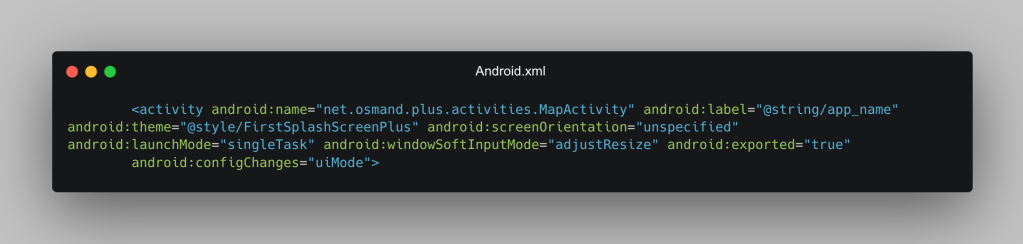
OsmAnd, a popular navigation application with over 10 million downloads, was found to contain a severe vulnerability that allowed unauthorized tracking of device location. The issue stemmed from the way the application’s MapActivity handled intent extras.

In Android development, "exported activities" are components that can be launched by external applications. The research revealed that OsmAnd’s MapActivity accepted various intent extras—such as silent_import and replace—that were intended only for internal use. Because Android does not restrict which extras an external caller can attach to an intent, a malicious application could transmit crafted extras to the MapActivity, effectively hijacking the app’s settings import function.
By forcing the application to import attacker-controlled settings, the exploit could overwrite map tile URLs. When the user navigated the map, the application would unknowingly send requests to an attacker-controlled server, leaking precise x and y coordinates. This allowed for the tracking of the user’s location and even the extraction of origin and destination points for routes, all without the user’s knowledge or explicit permissions.
2. Wikipedia Account Takeover via Deeplink
A second, equally critical vulnerability was discovered in the Wikipedia Android application. The app utilized a custom wikipedia:// deeplink protocol to navigate users to specific pages. However, a flaw in the application’s hostname parser allowed an attacker to bypass domain validation.
By crafting a malicious link, an attacker could force the application to load a non-Wikipedia URL while tricking the user into believing they were browsing the legitimate site. When combined with a secondary vulnerability—an improper domain check in the app’s cookie manager—this enabled an account takeover. An attacker could execute arbitrary JavaScript within the application’s WebView, providing a direct path to sensitive user cookies and long-lived authentication tokens.
Supporting Data and Technical Limitations
While the results are compelling, the integration of AI into security research is not without its hurdles. The GitHub Security Lab team notes that while LLMs excel at identifying potential vulnerabilities, they often struggle with severity assessment and context.
The Problem of False Positives
One of the most persistent issues is the "low-severity trap." AI models frequently flag issues that, while technically valid, are practically impossible to exploit in real-world scenarios due to environmental constraints. Furthermore, the models often fail to account for mitigating factors, such as data storage priority, where internal system data might overwrite attacker-injected data, rendering a vulnerability moot.
To address these limitations, researchers are increasingly relying on "proof-of-concept" (PoC) generation as an iterative step. By requiring the AI to write and simulate an exploit, researchers can force the model to validate its own findings. However, this is computationally expensive and requires significant time and token usage.
API Mastery
Despite these challenges, the team was surprised by the models’ deep understanding of API behavior. Without direct access to language source code, the LLMs demonstrated an impressive ability to identify unsafe function calls—such as the difference between path.Clean and filepath.Clean in Go—which are common precursors to security exploits. This suggests that the model’s "knowledge base," derived from vast repositories of existing security research and code, is already more robust than many human-managed audit checklists.
Implications for the Open Source Ecosystem
The broader implication of these findings is that AI-powered security research is becoming an essential component of the modern open-source landscape. As the complexity of mobile and web applications grows, manual auditing is no longer sufficient to keep pace with the volume of code being produced.
The GitHub Security Lab’s move to open-source the seclab-taskflow-agent serves as a call to action for the developer community. By democratizing access to these specialized taskflows, GitHub is encouraging maintainers to take a proactive stance on security. The goal is to move beyond passive dependency scanning and toward a proactive, AI-driven hunt for logic vulnerabilities that standard security tools often miss.
Future Outlook
The path forward involves improving the context-awareness of LLMs. As model window sizes grow and reasoning capabilities improve, the rate of false positives is expected to decline. In the interim, the combination of human oversight—essential for verifying PoCs and assessing real-world impact—and AI-powered auditing represents the most effective defensive posture available to maintainers.
Conclusion: Securing the Future
The findings reported by the GitHub Security Lab represent a significant milestone in the intersection of AI and cybersecurity. By automating the discovery of vulnerabilities in apps like OsmAnd and Wikipedia, researchers have proven that AI can act as a force multiplier for security teams, regardless of the size of the project.
For developers and maintainers looking to adopt these practices, the barrier to entry is lower than ever. With the seclab-taskflow-agent available on GitHub, the ability to conduct high-level security audits is now at the fingertips of anyone willing to learn the framework. As the industry looks toward a future of increasingly complex cyber threats, the integration of AI into the security workflow will not just be a competitive advantage—it will be a fundamental requirement for building safe and resilient software.
Security, as the team emphasizes, should be a primary concern for every maintainer. By running these taskflows against their own projects, developers can take the first, vital step toward a more secure digital future, effectively turning the power of AI against the very threats it is so adept at identifying.

 Muslim
 Ali Ikhwan
 Laily UPN
 Nana
Nana
 Jia Lissa