
 Raul Delapena Setiawan
In the modern corporate boardroom, "supply chain" has moved from a back-office logistical concern to a central pillar of competitive strategy. Yet, despite the proliferation of digital transformation initiatives, global multi-nationals are finding themselves caught in a paradox: they are spending more on technology than ever before, but they are failing to scale performance or achieve true economies of scale.
According to the latest Supply Chains to Admire research, this performance plateau is not a failure of technology, but a failure of focus. As the industry becomes intoxicated by the allure of "shiny objects"—autonomous supply chains, generative AI, and agentic workflows—many leaders are neglecting the bedrock principles of operational efficiency. The industry is effectively attempting to build high-performance skyscrapers on a foundation of sand.
The Dance with Shiny Objects: A Distraction from Reality
The current discourse in supply chain management is dominated by a fixation on "agentics"—the use of autonomous software agents to execute tasks. While the potential for AI to optimize complex networks is undeniable, the application of these tools onto flawed, legacy architectures is a recipe for disaster. This phenomenon, which industry observers call "AI Stupid," involves automating broken processes to make them move faster, rather than fixing the processes themselves.
The core issue lies in a misalignment between innovation and the user experience. Innovation is not found by asking users what they want, as they often struggle to articulate a solution to a problem they are living through. Instead, true innovation requires an intimate understanding of the operational reality of the workforce. As the adage goes, "Users may not always articulate the solution, but they are living with the problem." For supply chain leaders, this means leaving behind the sterile, PowerPoint-driven projections of tech vendors and descending into the granular, often messy, reality of the shop floor and the warehouse.
Chronology of Neglect: How We Lost Our Way
To understand why modern supply chains are struggling, one must look at the evolution of planning technology. Fifty years ago, the first generation of supply chain planning and execution systems was born. These systems were built under constraints—limited computing power, siloed data, and a reliance on linear, static averages.

Over the decades, as technology advanced, companies simply layered new, complex software on top of these archaic, rigid architectures. The result is a fragmented digital landscape where data latency is the norm and "the truth" about inventory, lead time, and demand is hidden in a labyrinth of incompatible systems.
Today, the drive for "resilience" and "risk management" has led companies to bolt on AI-driven analytics. However, without addressing the underlying data latency and the fundamental lack of a unified data model, these companies are merely creating a more efficient way to repeat the same errors.
The Pillars of Value: Rethinking Fundamentals
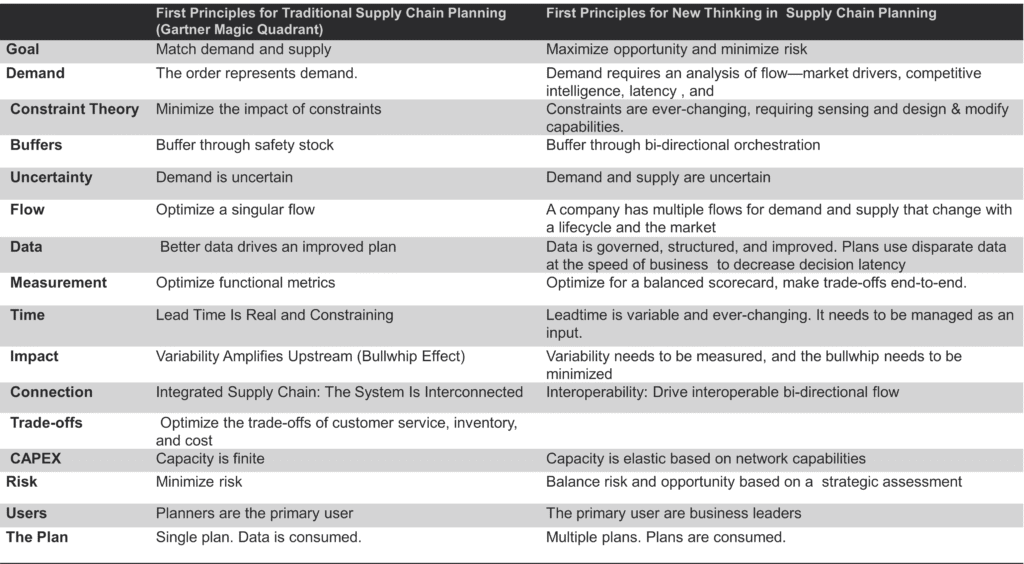
If the goal is to drive real value, leaders must initiate a shift in strategy. This requires a three-step movement back to first principles.
1. Aligning on First-Principle Thinking
First-principle thinking requires stripping away the jargon and asking: What are we actually trying to do? Often, companies find that their internal processes are built around outdated definitions of value. For instance, is the goal to minimize cost, or to maximize service? Is the planning cycle aligned with the actual replenishment cycle?
By documenting these processes in plain language and comparing them against the "ideal" state of a market-driven supply chain, leaders can identify the "delta"—the gap between where they are and where they need to be. Only once this clarity is achieved should a company engage with technologists to implement new tools.
2. Redefining the Relationship with Data
Data is the lifeblood of the supply chain, yet it is currently treated as an exhaust byproduct of transactional systems. To move forward, organizations must prioritize the creation of a "planning master data layer." This is not merely a database; it is a unified, real-time model that breaks down the silos between procurement, manufacturing, and distribution. If a company continues to accept the inherent latency of traditional, batch-processed data, it will never be able to leverage the predictive power of AI, regardless of how advanced the algorithms are.
3. Embracing the Reality of Lead Time
In the supply chain, lead time is a "gossamer thread"—a fine, almost invisible connection that links planning, inventory, and delivery. In most organizations, this thread is broken. When lead times are not updated to reflect actual performance, they become a source of "supply chain entropy."
Supporting Data: Understanding Entropy and Variability
Entropy, in the context of the supply chain, is the measure of uncertainty and disorder. It is distinct from the famous "Bullwhip Effect." While the Bullwhip Effect describes how small changes in customer demand are amplified as they move upstream, entropy is the broader, systemic accumulation of unpredictability across every touchpoint of the supply chain.
The primary driver of this disorder is the lack of discipline in lead time management. A "set-it-and-forget-it" approach to lead times is a critical failure. Aggregate lead time—the total time to complete the order, replenishment, manufacturing, procurement, and logistics cycles—is highly volatile. In a modern environment, it must be calculated using probabilistic models that account for both the average and the variance.
The Math of Reliability
When calculating safety stock, many organizations fail to integrate demand variability and supplier performance variability. The formula:
Safety Stock = Z × √[(LT × σd²) + (D² × σLT²)]
(Where Z is the service factor, LT is lead time, σd is demand standard deviation, D is average demand, and σLT is lead time standard deviation)

If a firm is not feeding real-time, actualized data into this formula, their safety stock is essentially a guess. This creates a ripple effect of "ghost inventory," where the system believes it is protected, but the reality on the ground is a stockout or a surplus.
Official Perspectives and Industry Implications
Industry experts argue that the obsession with "predictive" AI is premature if the "descriptive" data is flawed. The implication is clear: the current generation of supply chain leaders faces a "productivity gap."
Corporate financial officers (CFOs) and Chief Operating Officers (COOs) are beginning to realize that the investments in "Digital Transformation" are not yielding the expected ROI. The conversation is shifting. Instead of asking, "How do we implement AI?", the new, smarter question is, "How do we measure our supply chain entropy and reduce it?"
By utilizing metrics like the Supply Chain Entropy (SE) score—calculated as the product of entropy (H) and the coefficient of variation (CV)—companies can finally quantify the cost of their disorder. High entropy indicates a supply chain that is inherently unpredictable. When this data is fed into network design simulations, it provides a powerful, bottom-line justification for cleaning up the data and tightening operational discipline.
Conclusion: The Path Forward
The path to a high-performing supply chain is not found in the latest software brochure. It is found in the rigorous application of first principles:
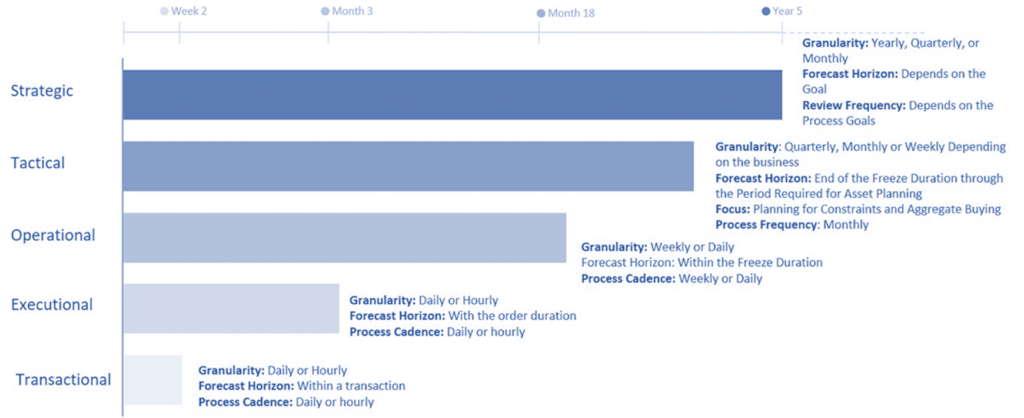
- Simplify the process to its core components.
- Standardize the data to eliminate latency.
- Stabilize the lead times by anchoring them to reality rather than assumptions.
The promise of AI and agentic workflows is real, but it is a reward for the disciplined, not a shortcut for the disorganized. By addressing the "gossamer threads" of lead time and reducing the entropy that plagues global networks, companies can build a foundation that is truly ready for the next generation of technological innovation.
Stop dancing with shiny objects. Stop trying to "AI" your way out of a broken process. Instead, focus on the fundamentals, measure your disorder, and align your systems with the reality of the market. Only then will you be able to transform your supply chain from a source of friction into a true competitive advantage.


 Basiran
 Neng Nana
 Iffa Jayyana
 Rifan Muazin
 Asro
Asro