
 Nila Kartika Wati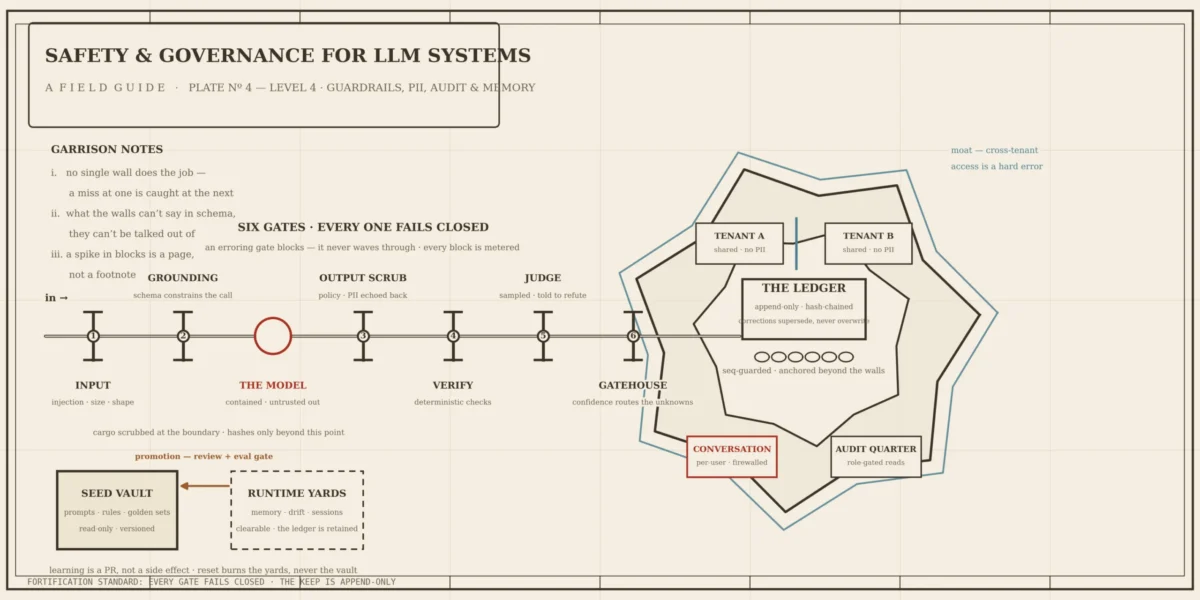
In the rapidly evolving landscape of artificial intelligence, a dangerous gap has emerged between "it works" and "it is production-ready." As Large Language Model (LLM) applications move from experimental prototypes to mission-critical decision-making systems, the standard for success has fundamentally shifted. Mere capability is no longer the metric of interest; the new bar is Level 4 Maturity: Safety and Governance.
Achieving this level requires moving beyond "bolted-on" security features. It demands an architectural paradigm shift where four core disciplines—layered guardrails, boundary-based data handling, immutable audit trails, and scoped memory—are integrated into the system’s foundational code. For engineers and organizations, this transition is the difference between a system that serves as a reliable business asset and one that represents an unmanageable liability.
The Four Pillars of AI Governance
To transition from a demonstration to a production system, developers must abandon the hope that a single point of failure can be avoided by luck or simple filtering. Instead, the focus must be on defense in depth.
1. Layered Guardrails: The Fail-Closed Mandate
Many teams mistakenly treat guardrails as a singular firewall rule, often relying on a solitary moderation filter on the model output. This is insufficient. True safety involves arranging independent, testable guardrails in a sequence where a failure at one stage is caught by the next.
The most critical principle here is to fail closed. If a guardrail fails to execute or returns an error, the system must not assume the request is safe. It must block or escalate the request immediately. By defining guardrails as a standardized code contract, teams can independently add, remove, and test filters, ensuring that no single component becomes a bottleneck or a blind spot.
2. PII at the Boundary: Eliminating Liability
AI systems are inherently "hungry" for data; they require rich context to perform effectively. However, this collides with the ethical and legal necessity to protect sensitive information. The solution is to handle Personally Identifiable Information (PII) strictly at the boundary.
Data should be scrubbed, masked, or hashed before it reaches the model or the persistent storage. By classifying data by sensitivity—ranging from PUBLIC to SECRET—developers can ensure that raw, sensitive payloads never accumulate in logs or model traffic. The objective is to achieve verifiability without the liability of storing raw sensitive data.
3. The Immutable Audit Ledger: Truth as a Record
When an LLM makes a controversial decision, the "why" must be discoverable months later. Logs are insufficient for this, as they are often unstructured and ephemeral. An audit ledger must be the canonical, append-only, and tamper-evident record of every decision.
This ledger should utilize cryptographic chaining, where each entry contains a hash of its contents and a reference to the previous entry’s hash. By revoking UPDATE and DELETE permissions at the database level, organizations can ensure that the audit trail remains a reliable, untampered history of the system’s logic.
4. Typed Memory: Preventing Sideways Leaks
When an agent serves multiple users or tenants, memory ceases to be a convenience and becomes a security risk. A "sideways leak"—where one user’s data informs the decision-making process for another—is a catastrophic failure. The fix is a typed memory model that categorizes data into strict buckets (e.g., TENANT_SHARED, CONVERSATION, AUDIT). Each category carries explicit rules for scope, access, and residency, enforced at the store boundary rather than through application-level logic.
Chronology of an AI Request: A Structural Walkthrough
Understanding how these disciplines interlock is best achieved by tracing the lifecycle of a single request. When a prompt enters the system, it passes through a series of checkpoints:
- Input/Pre-prompt: Validation against injection attacks and malformed data.
- Grounding Constraints: Ensuring the model adheres to schemas and disallowed actions.
- Model Inference: The generation phase.
- Output Scrub: Immediate sanitization of PII that the model may have echoed back.
- Verification: Deterministic checks against business rules.
- Judge: A secondary, sampled model check to detect "plausible but wrong" hallucinations.
- Confidence/Routing: A final determination of whether the output is safe for the user or requires human intervention.
This chain is not just a sequence of tasks; it is a defensive structure. Each layer addresses a unique class of failure, ensuring that the system is resilient against both malicious attacks and internal logic regressions.
Supporting Data: Why "Fail-Closed" is Non-Negotiable
The industry has seen a troubling trend of "fail-open" systems, where a system error results in the model defaulting to an unrestricted state. This provides a false sense of security.
Quantitative analysis of production health signals, such as guardrail_blocks_totallayer, rule, serves as a vital diagnostic tool. When an organization monitors these metrics, a sudden spike in blocks often signals a targeted attack or a flawed deployment. By treating these blocks as first-class signals, teams can proactively manage system health, turning governance from a reactive chore into a proactive operational advantage.
Furthermore, the implementation of an HMAC (Hash-based Message Authentication Code) for PII ensures that audit trails remain useful without becoming honeypots. By storing a keyed hash of sensitive fields alongside a redacted summary, systems can verify that a decision was made on specific, consistent inputs without actually storing the sensitive data itself.
Official Perspectives: The Separation of Seed and Runtime
A recurring architectural failure in AI systems is the "amnesia bug," where a system reset wipes out not only accumulated runtime experience but also the foundational prompts and rules needed to function.
Industry experts advocate for a strict separation between Seed and Runtime:
- Seed Data: Represents the system’s genome—prompts, versioned policies, and grounding data. This is shipped with the release and must be read-only at runtime.
- Runtime Data: The system’s experience—audit trails, learned patterns, and session context. This is mutable and clearable.
By maintaining this seam, developers can reset the system to its baseline behavior without destroying its core identity. Learning should be treated as a versioned, peer-reviewed process (a pull request) rather than a dynamic, unversioned mutation of the system’s behavior.
Implications for Future AI Development
The implications of adopting Level 4 maturity are profound. As organizations face increasing scrutiny from regulators regarding data privacy, model transparency, and decision-making fairness, the architecture described above provides a defensible framework.
The Cost of Neglect
Retrofitting these governance structures after a data leak or a series of model-driven errors is a "nightmare scenario." When data has already spread across logs, vector databases, and cache layers, achieving compliance becomes exponentially more expensive and technically difficult.
Building for the Future
Adopting these four disciplines—layered guardrails, boundary-based PII handling, immutable auditing, and typed memory—transforms the LLM from a "black box" into a governed, reproducible, and reliable business component.
The path forward for enterprise AI is not found in more powerful models alone, but in more robust architectural structures. By embedding these safeguards into the code, engineers ensure that their systems are not only capable of achieving great results but are also worthy of the trust placed in them. The goal of Level 4 is not to stifle innovation, but to create a foundation upon which high-stakes, real-world AI applications can finally stand.
This report concludes the fourth installment of the six-part series: "Running LLM Systems in Production."


 Neng Nana
 Lina Hope
 Basiran

 Iffa Jayyana
 Raul Delapena Setiawan
 Rifan Muazin
 Asro
Asro