Nana Wu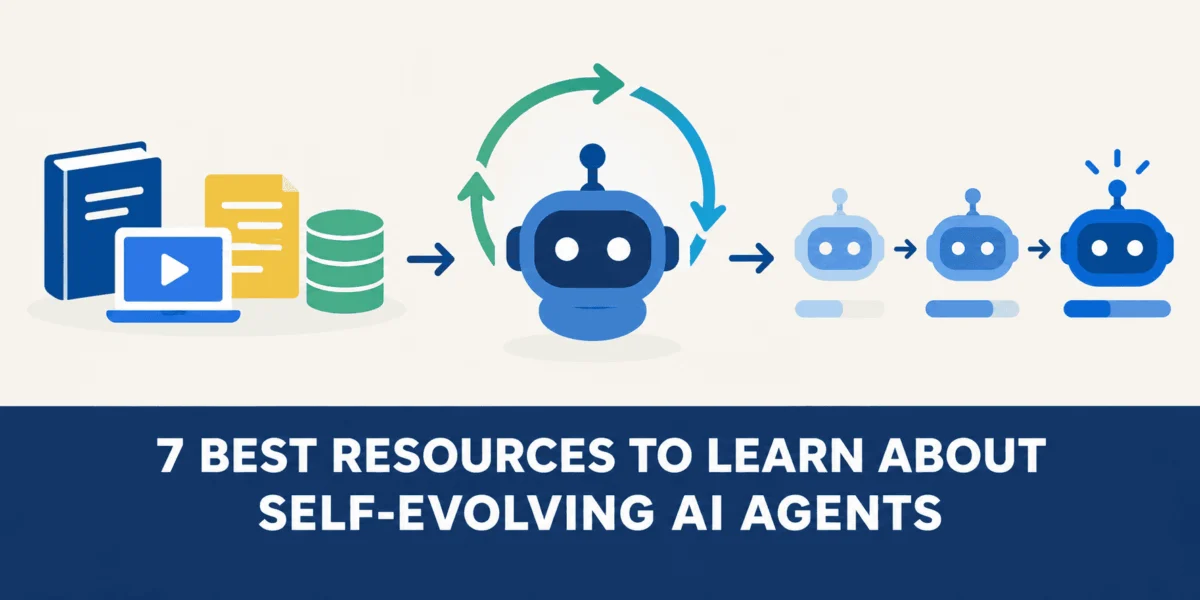
The landscape of artificial intelligence is currently undergoing a profound paradigm shift. For the past several years, the industry has been defined by static models—systems that receive a prompt, execute a predefined logic, and return a response. However, we are now entering the era of the Self-Evolving AI Agent.
These systems represent a departure from traditional "input-output" workflows. Instead, they are designed to possess a recursive capacity for growth. Through a combination of experience, failure analysis, and internal optimization, these agents can refine their own prompts, expand their skill libraries, and even modify their underlying reasoning pipelines. As we look toward the future of automation, the ability for an agent to "learn how to learn" is no longer science fiction—it is the next frontier of computer science.
1. The Core Concept: Moving Beyond Static Logic
To understand self-evolving agents, one must first distinguish between "standard" agency and "recursive" agency. A standard agent operates within a fixed container: it has a set of tools (like a search engine or calculator) and a rigid reasoning framework. A self-evolving agent, conversely, treats its own operation as a variable to be optimized.
By analyzing its own previous failures, a self-evolving agent might realize that its retrieval process for RAG (Retrieval-Augmented Generation) is inefficient. It then adjusts its own search queries, updates its memory storage parameters, or builds a new "skill" to handle similar requests more effectively in the future. This creates a feedback loop where the agent’s performance ceiling rises with every interaction.
2. Chronology of Evolution: From Fixed Tools to Adaptive Systems
The trajectory of agentic research has been rapid and non-linear.
- Phase 1 (The "Tool-Use" Era): The early 2020s were dominated by LangChain and simple ReAct (Reasoning + Acting) patterns. Agents were limited to executing predefined functions.
- Phase 2 (The "Memory" Era): Developers began introducing vector databases and long-term memory, allowing agents to retain context across sessions.
- Phase 3 (The "Self-Improvement" Era – 2025-2026): We are currently witnessing the transition into agents that perform "scaffold engineering." They no longer just use tools; they optimize the tools themselves. Research papers from 2026 suggest that agents can now perform "meta-cognition"—evaluating whether their own reasoning path was logical or flawed before finalizing an output.
3. The Essential Curriculum: A Roadmap for Researchers
For those looking to master this rapidly evolving field, a structured approach is essential. The following resources serve as the current gold standard for transitioning from a basic developer to an architect of self-evolving systems.
The Foundation: Hugging Face Agents Course
Before attempting to build an agent that modifies itself, you must master the mechanics of the "Think/Act/Observe" loop. The Hugging Face Agents Course provides the definitive introduction to agentic frameworks like smolagents and LangGraph. It covers the critical infrastructure of function-calling and observability—the "must-haves" before you can implement self-correction.
The Academic Benchmark: Stanford CS329A
Stanford University’s CS329A: Self-Improving AI Agents is widely considered the most rigorous starting point. Unlike courses that focus purely on implementation, CS329A dives into the "why." By dissecting research papers on Constitutional AI, verifiers, and test-time compute, students learn the theoretical underpinnings of how an LLM can be prompted to critique and improve its own performance.
Surveying the Literature
Two pivotal surveys act as the "map" for this field:
- A Comprehensive Survey of Self-Evolving AI Agents: This paper defines the feedback loop architecture—the environment, the optimizer, and the system inputs. It is the best resource for understanding the system-level architecture of an evolving agent.
- Self-Improvements in Modern Agentic Systems (2026): This survey provides a vital taxonomy. It distinguishes between improving the "foundation model" (fine-tuning) versus improving the "scaffolding" (the surrounding code, prompts, and tool-use strategies).
The "Awesome" Repositories
Because the field changes weekly, traditional textbooks are obsolete before they are printed. Researchers rely on GitHub-based, community-maintained bibliographies:
- Awesome Self-Improving Modern Agentic Systems: A categorized repository that maps research papers to specific areas of improvement (e.g., memory, skills, or model parameters).
- Awesome RSI (Recursive Self-Improvement): This map situates agentic research within the broader, long-term goal of recursive self-improvement. It covers embodied systems and AI-led R&D.
- Awesome Harness Engineering: This is the most practical of the bunch. It focuses on the "harness"—the engineering layer that allows an agent to run experiments on its own processes.
4. Supporting Data and Technical Implications
The shift toward self-evolving agents is supported by a growing body of empirical data. Recent benchmarks indicate that agents capable of self-reflection show a 30–40% increase in performance on complex coding tasks compared to static counterparts.
The technical implication is that we are moving toward "Harness Engineering." As the industry matures, the value is shifting away from the model weights themselves and toward the surrounding infrastructure—the "scaffold" that enables the agent to evaluate its own logs, identify failure patterns, and iterate on its strategy.
5. Official Perspectives and Industry Response
Leading AI research labs are heavily invested in this transition. The move toward "Test-Time Compute"—the idea that an agent can spend more "thinking" or "self-correcting" before producing an answer—is the primary focus for companies like OpenAI, Anthropic, and Google DeepMind.
The consensus among industry leaders is that we are moving toward a future where AI systems act as "autonomous scientists." Instead of humans needing to manually patch a prompt or update a database, the system will identify its own shortcomings and deploy a "self-patch" within its operational logic.
6. Implications: The Future of Autonomous Systems
The rise of self-evolving agents carries profound implications for the global economy and software development:
- Software Development: We are moving toward a "no-code" or "low-code" future where the agent writes, tests, and deploys its own updates. This will drastically reduce the maintenance burden for enterprise software.
- Scientific Discovery: In fields like biomedicine and materials science, agents that can iterate on experimental design without human intervention could accelerate discovery by orders of magnitude.
- Safety and Alignment: As agents become more autonomous, the "Recursive Self-Improvement" (RSI) safety challenge becomes critical. How do we ensure that an agent’s self-evolution remains within the bounds of human intent? This is why current research, such as that covered in the Awesome RSI repository, is so vital; it balances power with robust control loops.
7. Conclusion: The Path Forward
For the aspiring AI engineer, the path is clear: start with the basics of agentic loops (Hugging Face), move into the academic theory (Stanford), and stay updated via community repositories.
The era of the "static bot" is ending. We are now building systems that evolve in real-time, learning from the world around them. As you begin your journey into this field, remember that the most important skill is not just knowing how to use a library—it is understanding how to architect a system that is capable of continuous, autonomous improvement.
About the Author: Kanwal Mehreen is a Machine Learning Engineer and a prominent voice in the global AI community. A Google Generation Scholar and founder of FEMCodes, she specializes in the intersection of AI and medical science. Her work continues to bridge the gap between high-level academic research and practical, industry-ready application.

 Asro
Asro
 Lina Irawan
 Laily UPN
 Iffa Jayyana
 Rifan Muazin
 Suro Senen
 Lina Hope